RRR: Index of squibs

Anything from run & guns to modern RPGs, what else do you play?
Randorama
Posts: 4079
Joined: Tue Jan 25, 2005 10:25 pm
Contact:

Re: RRR: Index of squibs

Post by Randorama »

Absolutely. I re-read the series a few years ago and it felt like Chaykin was writing this while travelling back and forth through time, or something. Ironically, though, the Mall has become a central concept in a certain type of "Western-style society", but online shopping has inexorably eroded this centrality. Anyway, I am relatively sure that someone wrote a book or a quite detailed chapter in a book about Chaykin's amazingly accurate "vision of the future". I will sooner or later find the reference, promised :wink:

Personally, I also somehow believe that Data East creators had some access to the series, as some of their 1990s games have ideas reminiscent of AF! (Nitro Ball above else). I will squib about these topics in the future, so stay tuned and spread the love :wink:
"The only desire the Culture could not satisfy from within itself was one common to both the descendants of its original human stock and the machines [...]: the urge not to feel useless."

I.M. Banks, "Consider Phlebas" (1988: 43).
User avatar
it290
Posts: 2847
Joined: Thu Mar 17, 2005 1:00 am
Location: polar malortex, illinois

Re: RRR: Index of squibs

Post by it290 »

I'd say Nitro Ball takes its cues more from the likes of Rollerball and The Running Man, no? Unless you're thinking about something specific...
Image
We here shall not rest until we have made a drawing-room of your shaft, and if you do not all finally go down to your doom in patent-leather shoes, then you shall not go at all.
Randorama
Posts: 4079
Joined: Tue Jan 25, 2005 10:25 pm
Contact:

Double Dragon II (Technos, 1988)

Post by Randorama »

Well, Rollerball is about a dystopian future in which the sport is sort of a placebo for wars, and one top player decides to go against the system. The Running Man is about a future US dictatorship (or something like that?), with the show as a means to control the masses. Dystopian? Well, of course.

Nitro Ball, on the other hand, features a TV show in which an ex-cop (player 1?) and an ex-Navy Seal (player 2?) have to kill/dunk goons and collect as many items for money as they can. The game's atmosphere is deeply humorous and hedonistic, down to the brilliant OST, and the endings for both players are definitely positive (hint: they get the money and something else :wink:). I remember that AF! has a similar show, in-universe, that has the same "we're in for the money and the funny ultra-violence, and now please smile for the camera!" tone. Dystopian? AF! probably, but with a laugh. Nitro Ball...well, not if you 1-CC it :wink:

This Sunday we are going to discuss a classic shmup, however, so we will leave the ironic commentary on hold for a bit. I need to reshuffle plans a bit, but hopefully I can release Nitro Ball by the year. Aside the pinball-free scrolling shmup hybrid form, it features lots of scoring opportunities and the extend/suicide mechanic as a rank/score control mechanism. But all in due time, of course :wink:
"The only desire the Culture could not satisfy from within itself was one common to both the descendants of its original human stock and the machines [...]: the urge not to feel useless."

I.M. Banks, "Consider Phlebas" (1988: 43).
Randorama
Posts: 4079
Joined: Tue Jan 25, 2005 10:25 pm
Contact:

Flying Shark (Toaplan/Taito, 1987)

Post by Randorama »

In this squib we discuss a venerable standard of the shmup genre, Flying Shark. The game’s immense popularity entails that there have been dozens of ports across the decades (see the discussion in the wiki). The M2 “Shot Rigger” ports represent modern faithful renditions of the game on PS4 and Nintendo Switch, however. The game is notable for being a subtle but pervasive seminal influence in the genre, along with other fellow Toaplan shmups. Tsuneki Ikeda from Cave, among many other videogame designers, grew up playing this title and Slap Fight, for instance. The game comes into various revisions and regional versions (e.g. Hishou Zame is the game’s name for the J(a)P(an) version), which differ in various minor details. We have various threads and a classic review here, so my squib aims to be concise. Let us make haste with the squib, to discuss all these details:

Flying Shark (Toaplan, 1987, with Taito handling the distribution) is a (ro)TATE shmup that pits Rudo Schneider and its blue biplane against a veritable legion of enemy planes and tanks. The game is notable for being one of the first shmups introducing a “bomb” attack and for having a great OST. More controversially, it is also notable for introducing the complex type of enemy positioning and Stage design that evolved into the modern ”Bullet Hell” genre. This latter aspect of Facet hinges on the fact that Stages become “busy” with enemies and bullets early on, and once players loop the game, careful positioning strategies become indispensable. The goal of this squib is to provide players with evidence supporting this claim. The goal of this squib is also to convince players that 1-CC’ing the game (well, at least a loop) is a perhaps a central achievement for any fan of the genre.

Summarising 1987 for the arcade scene and Toaplan’s early years in a single paragraph would be almost “hobbyist malpractice”, I know. Throughout this and further Toaplan-dedicated squibs, I will attempt to sketch a minimal context nevertheless. Toaplan was an intriguing little company that, in the memories of Masahiro Yuge, had a “wild party” atmosphere and some unhealthy work practices. Arising from the ashes of Orca, Toaplan produced simple platformers/puzzle games like Performan on hardware allowing modest audio-visual presentations. Pilferers and innovators in equal parts, Toaplan programmers were smart designers with powerful ideas who established themselves with shmups such as Slap Fight in 1986, Kyukyoku Tiger/Twin Cobra and Flying Shark in 1987, and Truxton/Tatsujin in 1988. Toaplan shmups looked modest, but presented players with remarkably creative design ideas and a feeling of smooth, fast-paced action that could almost match contemporary legends like Taito’s Darius, Irem’s R-Type and Konami’s Gradius II.

Before we turn to the finer Facets involving game mechanics, a brief mention of the plot will help us in framing its minimal world setting. The story pits an unnamed fighter, nicknamed the “Flying Shark” or “Sky Shark” depending on the game’s version, against the enemy forces in an undefined Pacific Ocean war theatre. Our hero must fly behind enemy lines and rescue fellow pilots and prisoners of wars. It is a though mission, but somebody must do it and obviously our hero is the best choice. Readers may wonder why these forces fight with biplanes in WWII, or why and how a single biplane may rescue these aforementioned prisoners. These are details to simply set up a cool battle with biplanes in the Pacific, really. The identity of the “Flying Shark” as Romu Schneider originates in Batsugun!’s, Toaplan final game, which suggests that this story takes place in an alternate version of Earth.

Let us now discuss the minimalist game mechanics. Players control Rudo’s biplane in eight directions with the joystick. The A button shoots two central shots, and can upgrade to 12 relatively wide shots after collecting five “S” power-ups, obtained by shooting down formations of six to eight red planes. The B button controls the bomb attack. When pressed, a bomb briefly travels forward from the plane position, and then detonate in a spiralling explosion that cancels bullets and damages/destroys enemies in its range. Collect “B(omb)” icons from destroyed tanks; each bomb in stock is worth 3k points as an End-of-Stage bonus. The bomb stock replenishes at three bombs, if players have less units after clearing a Stage. Shoot down yellow and silver biplane formations to collect 1000 extra points and one extra life, respectively. Players start with two lives and extend at 50k plus every 150k points, in most versions.

The audio-visual presentation is also minimal, though far from basic. The game is set in the Pacific theatre of WWII, and thus features luscious jungle backgrounds, battles over azure seas. Assaults to military bases involving steel grey buildings, brownish grounds and other colour from a simple, realistic palette. Enemy tanks and biplanes come in a few colour combinations but are well-animated and realistically designed. Bosses have massive sprites: the bombardier from Stage five occupies most of the screen, and the battleship from Stage three is several screens long. Mid-size enemies are also bulky and aggressive, and enemy formations often offer a choreographic if threatening feeling about their positioning. Toaplan designers did not have powerful hardware at their disposal. However, had a firm grasp on how to convey the feeling of a single man against an army comparable to other classics of the time (e.g. Seta/Taito’s Thundercade, Capcom’s 1943).

Masahiro Yuge’OST offers a strong argument for Toaplan’s designers being gifted with sheer ingeniousness in the face of modest hardware. Yuge infused the OST with his love for Progressive Rock and especially British band Yes, though it definitely could access basic synthetisers and software to create this music. Stage one’s Asia opens the game with a medium paced, relatively dramatic theme; Stage two’s Against the Attack moves to a more upbeat tempo for some ocean-based action. Stage three’s Water Front switches to a dramatic riff, and Stage four’s Behind the Bush leads with an almost hard rock-styled anthem. It is Stage five’s Last Fighter exhilaratingly dramatic theme that plays the closest to Yes’s classic works, with its notes perhaps echoing South Side of the Sky from The Fragile. Sound effects are almost 8-bit console-like in simplicity, but the OST is a synthetized prog rock-like cavalcade framing Rudo’s fight with epic and dramatic flair.

Now that we have a framework for the aesthetics Facets, we can discuss the game’s difficulty. I propose that the difficulty in this game comes from game mechanics and Stage design/layout, which in turn corresponds to Enemy wave/formations and their layout. First, players must master use of the main shot: even at maximum power, it covers roughly half of the screen. The numbers of shot waves on screen have a limit, so players should also learn to point-blank enemies to increase shooting frequency. Certainly, use of auto-fire options across ports can help players to overcome that lingering subjective feeling that firepower is sometimes insufficient. However, players who aim to play the game in its arcade form need to master this ability. Therefore, they need to learn to dispose of larger enemies and bosses in a brutal, aggressive and efficient manner, while also learning to dodge quick attacks with precision.

Second, bombs require some practice for players to use them as secondary weapons, their intended function. Bombs do not denotate immediately, but must undergo half a second of so of “dropping animation” (with matching sound effect). Once they hit the surface, they create a spiralling whirlwind of fire that cancel bullets and damages enemies and last around 1.5 seconds. The radius of the explosion is roughly half of the horizontal axis, a fact entailing that bombs do not cover the entire screen, on the vertical axis. Thus, bombs can be a good defensive measure against sniper enemies on the horizontal axis or attacks from behind the plane/the bottom of the screen. If enemies are shooting from the top side of the screen, they might even be useless due to their limited reach. Their use must thus be tactical, as “panic bombing” may often result in untimely deaths.

If we divide the total 50 points into two halves of 25 points, then the game mechanics motivate a 3/25 difficulty score. Players should potentially master these Facets with little effort and a clear understanding of their basic principles. While game mechanics may be an easy obstacle to overcome, enemy/Stage layout/formations provide the main source of difficulty in the game. Two sub-Facets provide the key sources of difficult, within this sub-Facet. First, enemies mostly aim in eight directions, but also aim their shots by using simple “baiting” strategies. A formation of biplanes can enter the screen and aim their single shots at Rudo’s biplane, forcing players to move in e.g. the up-right direction. Sniper tanks may then appear and shoot at the biplane’s expected position, taking the plane down. This strategy, in combination with a sapient positioning of enemies, forces players to memorise enemies’ placement and potential trap attacks.

Second, Stage layout provides a “macro-source” of difficulty, building atop of enemies’ formations “micro-source”. The game has five Stages, and loops indefinitely though the score should max out at 9999990 points; loops start from Stage two, however. Each Stage is divided into “areas”, i.e. mini-sections that establish the spawning points after death. Each area acts as a mini-puzzle or maze in which players must understand what is the best order(s) of enemy formations to destroy, for survival purposes. Biplanes, tanks and small ships shoot fast, aimed flashing bullets; bigger planes shoot pattern-based bullets (e.g. three-way shots); bosses use bulkier attacks of various types. Players thus can focus on solving each area as a mini-maze, then “connect” this solution to the next area, and so on. This approach is virtually necessary for survival purposes, also because players must learn how to survive after death when entering each re-spawning point.

Overall, players should develop general strategies involving carefully timed movements to dodge bullets and destroy enemies as soon as possible. For Stages and areas, players can develop specific tactics such as the tactical use of bombs upon respawning or to shorten boss fights. Combining these pieces together leads to a veritable resolution of the “maze game” underpinning Flying Shark. I thus propose, for simplicity, that each Stage is worth three points of difficulty: one for the Stage itself, one to learn its harder respawn points/areas, and one for the Bosses. At 15/25 difficulty points, this Facet offers a considerable challenge for all players. The total thus becomes 18/50 points, close to the Shmup difficulty Wiki score. Add two points per loop, as enemies become more aggressive and have more H(it)P(oint)s. Flying Shark is a top-tier challenge for intermediate players, but multiple loops can reach grandmaster (i.e. 40+ points) difficulty levels.

Let us wrap up this squib with my experiences of the game, thus. Xenny? He’s gone to a The Presets concert; we are quite safe (or: do not try to hide, dear reader). It is 1990, though I do not remember exactly when: my memories regarding this game are hazy, and I only recall that my uncle never had a board of this game. I probably played this title while visiting the big arcade that had the dedicated cabs and City Connection in their big underground room. Other details are definitely hazy, and I perhaps I only played this game when I started junior high school. I have this memory of my father playing Twin Cobra to my side, while playing this title. The arcade had the classic Toaplan games lined up in the South-East corner of their big room: playing these titles meant braving darkness and smell of mould.

The first credit I play of this game is almost embarrassing. Even by 1990 standards, I find the game really ugly, simply put. I also struggle to follow the trajectories of the bullets, due to their weird flashing animation. Sound effects are primitive, and the way the game uses the bomb is annoying. My golden standard on this mechanic is Thundercade, so any bomb that has a delay in detonation is useless: my poor gaming skills demand a crutch, not a secondary weapon. I believe that I barely make it to the first boss, failing at its three-way shot. I see from the high score table that the game does mark the stage but something called “areas”. I wonder what they are, honestly. I did not see any signs that I was entering different areas when playing, but “reaching area 21” sounds better than “losing against the first boss”.

Over an indefinite period of six months or so, perhaps more, I visit this arcade with a certain regularity and I become more and more attracted by Toaplan’s modest-looking games. There is also something about the music in these games that I find hypnotic. Music sounds quirky, as if they were playing sounds from some home console like the Famicom, but backwards or under heavy distortion. My 2025 definitely remembers that my 1990 has no idea on the sources that inspired Masahiro Yuge, but also that, in the long distance, the 1990 began to like these chiptunes quite a lot indeed. It is however 1990, and I definitely feel that playing spara-tutto (literally, ‘shoot-all’ in Italian) games from Toaplan feels like appreciating second-rate movies or comics with flashes of brilliance. Still, there is something about their artisanal passion exuding from their games that charms me to no end.

Over this period of six months or so, though, I definitely get better at these games and I definitely begin to appreciate these people’s ideas about game design. My progress in Flying Shark is a slow, almost painful but always resolute journey through the areas of this title. Stage four is though, and the fact that I must beat the two armoured train bosses during the Stage is a veritable ordeal. I progress one area every few credits, and possibly one Stage per month; but I progress, and I manage to connect the areas of the puzzle, sooner or later. I do not remember what month or day, or season is, but I do remember that the first time I hear Last Fighter, I am transfixed. It is one of those “eternal” moments in which the mind knows that it is going to remember the event forever, indeed.

The few opening notes turn me into intellectual dust and rebuild me anew in a few seconds: all of a sudden, I can perfectly understand that the designers want Stage five to be epic, intense, viscerally difficult. How could it be otherwise? The song is mesmerising, and the enemy formations are suddenly massive, shoot more, and literally swamp the screen. Enemies crop from everywhere, and mid-way through the Stage two of the battleships from Stage three re-appear, baying for my blood. I believe that my 1987, 1988…selves like sparatutto because they seem to offer some compact metaphor of life: sometimes one lone fighter takes the fight against legions, and the one has no choice but to win or turn into dust. My 1990 self does not know the name of this song, but my 2025 self knows that Last Fighter is the name that epitomises shmups’ music as a genre.

After two months of botched tries, I can finally reach the behemoth plane at the end of Stage five. It takes me another three weeks or so to learn its attack, and then another week of practice to clear the final area before the end of the Stage. Clear! But then I discover that the bloody game starts again, and from Stage two, even. I keep playing the game for a while longer, and end up clearing the second loop. I subsequently move to other games, and do not play Flying Shark until my MAME gap year in 2000. I spend a few weeks practicing the game until I can clear four, five loops and get bored after all those loops. I play the game as years pass: my 2012, 2014, 2018…selves like having the pioneering feeling of the game. As a foundation of “the maze”, Flying Shark is unrivalled.

It is time to summarise, before I lose myself in vague statements. Flying Shark is a (ro)TATE shmup pitting Rudo Shneider as the “Flying Shark”, a lonesome biplane fighter against hordes of enemies on a mission to rescue prisoners of war. The game offers modest but well-designed graphics, a great OST and an early approach to the genre that features complex, maze-like handling of enemy formations, fast bullets, and massive bosses. The game also offers a moderate but solid challenge for players who want to clear at least one loop, and ever-increasing challenges for players who pursue multiple-loop clears. The game represents a core chapter of the genre, together with other Toaplan games and has shaped entire generations of successors (e.g. Raiden and its ilk, but also Cave games). As a synchronous lesson of history and a great shmup, any proper shmup player should play it and enjoy it to its completion.

(2691 words, or 6.8 pages, times new roman, size 12, single space; the usual disclaimers apply; I only played the game sporadically, after that period; however, I have always had a version of Last Fighter with me, be it on a mixtape, MP3 player or PC. I believe that a friend of mine once commented that Last Fighter sounds like somebody played an “8-bit mellotron” while recording it, which sounds like a rather hilarious description of its signature sound. I also believe that this friend of mine once forced me to play this song and a few other “absolute resolve” themes while we were preparing for exams, during our BA days. We probably ended up playing this, Red Thunder from Surprise Attack and Assault Theme from Metal Slug until our ears were bleeding. The exams begged us for mercy, after all that hellish preparin’!)
"The only desire the Culture could not satisfy from within itself was one common to both the descendants of its original human stock and the machines [...]: the urge not to feel useless."

I.M. Banks, "Consider Phlebas" (1988: 43).
Randorama
Posts: 4079
Joined: Tue Jan 25, 2005 10:25 pm
Contact:

Flying Shark (Toaplan/Taito, 1987)

Post by Randorama »

Some plans, for those who care. Nevermind the theoretically oriented squibs, the titles I planned for 2025 are the ones below. Readers can place requests, and I will write them with release slated the Sunday after the request. Otherwise, I may just proceed according to a semi-random schedule I have prepared, and I plan on following...unless my mood changes abruptly, and/or "real life" hits me at full speed and crushes me down mercilessly (not unlikely: my life is complicated).

EDIT:

These are the plans for the remainder for 2025, but other requests may be welcome: I plan on continuing this journey for a while longer. Ask away and I can check if I have any memories to share with my readers.

SHMUPS:

  • Phelios
  • Darius II
  • Omega Fighter
  • Armoured Scrum Object
  • Slap Fight
  • Darius
  • Cannon Spike
  • EspRaDe
  • Guwange
  • DonPachi
  • Nitro Ball
R2RKMF:
  • Rastan
  • Rainbow Islands
  • Galivan
  • Shinobi
  • Contra
  • Elevator Action Returns
  • Robocop 2
  • King of the Dragons
  • Bucky O’Hare
  • Midnight Wanderers
BEAT'EM UPs:

  • Teenage Mutant Ninja Turtles
  • Captain Commando
  • Warriors of Fate
  • Night Slashers
PLATFORM/PUZZLE GAMES:
  • Mr. Driller
  • Mr. Driller Great
  • Super Burger Time
SPORTS:

Super Dodge Ball (The Neo Geo title, which would also be the last Technos title and the last sports game I may squib about for a while).
"The only desire the Culture could not satisfy from within itself was one common to both the descendants of its original human stock and the machines [...]: the urge not to feel useless."

I.M. Banks, "Consider Phlebas" (1988: 43).
Randorama
Posts: 4079
Joined: Tue Jan 25, 2005 10:25 pm
Contact:

Rastan (Taito, 1987)

Post by Randorama »

In this squib we discuss Rastan/Rastan Saga, the first game in Taito’s trilogy inspired by Robert E. Howard’s Conan stories. This game has been a background presence in our squibs since the inception of the series: we started our multi-faceted journey with Warrior Blade/Rastan Saga III. The game’s success in 1987 meant that there are ports on a dozen systems or so (cf. the wiki information). The Taito Memories on PS2 offered a novel introduction to the game, even if the Arcade Archives novel port for PS4/PS5 and Switch is the newest and most accessible port. We will not discuss Nastar/Rastan Saga II, also on Arcade Archives, as my memories of this probably controversial game are too foggy. Please enjoy the second title’s OST (here), by Zuntata’s legend OGR/Hisayoshi Ogura: it is sublime, and so is Rastan. Here is an argument of why this is case:

Rastan/Rastan Saga (Taito, 1987) is an R2RKMF/platform game of the Hack’n Slash variety. The protagonist is Rastan, a textbook Captain Ersatz character that presents Taito’s take on the Conan milieu. The game features Rastan the barbarian aiming to kill the brutal Dragon ravaging the lands of Ceim, and therefore also slaying the vast hordes of creatures supporting the Dragon’s reign of terror. If successful, Rastan will however collect a hefty fee, as altruism and heroism are not this barbarian’s core virtues. The game is notable for its simple but fast-paced gameplay, the mix of action and platforming elements, quick boss battles and a deeply atmospheric OST. The game may feel repetitive by modern standards; it however provides a very gradual challenge and an immersive, variegated game world. The goal of this squib is to convince readers that they should 1-CC this game and immerse themselves in its “aggressive world”.

A bit of context will help us understanding the socio-historical contribution of this game, as always. (Mostly) anglophonic Heroic Fantasy stories reached Japan by the 1970s and early 1980s, often with illustrations from mangakas who took ample inspiration from these stories (e.g. Leiji Matsumoto). Conan stories apparently arrived in 1971, and developed a cult following over the decades. In 1985, Dungeons and Dragons became a sensation, thanks also to the popularity of the Record of Lodoss AAR (“After (the) Action Report”) stories. Arcade videogames were also absorbing this source of inspiration in droves. Namco’s Dragon Burster and Return of Ishtar are but one two titles we have mentioned in the past, and Capcom’s Black Tiger is the other arcade classic chiselling this genre’s relevance in 1980s’ arcade scene. Taito programmers thus decided to pilfer on Howard’s classic stories as a way to pay homage to their beloved “Barbarian” character.

The game’s plot and world setting only receive their proper presentation in the J(a)P(anese) versions. In the attract screen, an aged but still massive King Conan/Rastan narrates to players that the game presents but one of his many adventures when he was even a thief and pirate, just to survive. The opening sequence presents a walking Rastan explaining that he will slay the dragon and the armies ravaging Ceim. Rastan is no hero, but a mercenary: he agreed with the kingdom’s princess that he will keep this army’s vast riches as a payment. Under a steel cloudscape brewing a storm, he unsheathes his sword and starts his fight. Rastan crosses six different regions of the kingdom (i.e. Stages) and slays all the army’s general and the giant Dragon. Through mountains, swamps, Vulcanic ranges, and other dramatic landscapes, he rids the lands from humans’ enemies, ending up with a massive loot.

The game’s other versions (i.e. World and US(A)) lack this background information, possibly due to copyright issues. Each version also has three revisions, but these play a role in our discussion of the game’s difficulty. Before we can tackle this topic, we must first offer an overview of the game’s mechanics. Rastan can move in eight directions via the joystick, with the B button controlling jumps. The A button controls Rastan’s weapon swings, which cover roughly a sprite’s length when Rastan carries the default two-handed sword. Rastan swings in the direction of movement, but can swing the weapon upwards (up+A button) or downwards (B button to jump, then down+hold A). Rastan can also jump and swing the sword (B+A buttons), and can perform high jumps (up, up-left, up-right+B) and swings (A button) dealing two H(it)P(points). Rastan can jump off and on fixed and swinging ropes and moving platforms, as well.

The game offers a vast selection of enemies, from demi-humans (e.g. humanoid lizards) to giant bees, amazons and bats. The game also offers a vast array of power-ups, the full list appearing in the attract screen of the JP version. For instance, Rastan can pick up three different weapons (double-damaging poleaxe, longer-ranged halberd, fireball-throwing “fire sword”) and three types of increasingly more powerful armours (shield, mantle, armature). Be fast: all power-ups only last 30 seconds. Rastan has 128 HPs per life, and two lives in stock at the beginning of each credit; extends are at 100k and 200k points, and then every 200k points. Players can kill enemies within half a second or so, to perform item-awarding chains. RNG item drops can also include bonus point gems (1k, blue; 2k, golden, 3k, amber). Blue potions award extra HPs, red potions remove HPs but award 20k points: they are good gambits.

The game thus provides simple but swift and fast-paced action-oriented mechanics that also reward players with higher scores and extra lives, if they clear Stages at a brisk pace. Before we discuss the challenges that this game design philosophy provides to players, though, we should explore the audio-visual presentation in detail. Rastan’s visual presentation is highly detailed for a 1987 title: the game features relatively big sprites, rugged and brutal landscapes, and chromatic palettes that come in intense shades. Stage one is highly representative. Rastan crosses a mountainous, rugged region peppered with giant statues paying homage to Lord of the Rings lore, during a sunset bleeding crimson and orange shades over cloudy blue skies. Final Stage six returns to mountainous ranges with floating rocks and a storm with booming and cracking lightnings and thunders in the background. External sections look harsh and brutal, much like Conan’s primordial Cimmeria motherland.

The “external” world sections offer an apt counterpoint to the internal settings, the castles and caverns in which the leaders of the Dragon army dwell. In Stage one to four, Rastan invades four castles full of traps and bizarre humanoid creatures. In Stages five and six, Rastan slays enemies through the caves in which the wivern general (Stage five) and the Dragon general (Stage six) have stashed their treasures. These sections seem to recycle backgrounds from the first Darius title and its ”Submerged cave” stages, but provide a higher resolution and a more dramatic feeling. Rastan, after all, traverses them on foot rather than on a Silver Hawk. Furthermore, all sprites are rich in detail and relatively well-animated. Overall, the world that Rastan inhabits looks brutal, visceral in its hues and colours, and rugged: it thus offers a perfect visual presentation for Rastan’s quest for richness and glory.

The OST by MAR (Masahiko Takaki, also of Zuntata Fame) only includes a few themes, but most players will probably remember them due to their evocative style. External sections feature Aggressive World, a fast-paced theme evoking the atmospheres and styles of 1980s fantasy movies (e.g. the Schwarznegger’s Conan movies). Internal switch to slow-paced, brooding and dramatic Re-In-Carnation which concludes with a fast, epic crescendo presaging the boss battles concluding each stage. The Devil Boss Carnival theme is a fast-paced, short drum beat with a “tribal” flavour: slay bosses quickly, while drums pound furiously. The game has a few other short themes for the opening, continue and high score screens; these three themes, however, accompany the players’ journeys with their intense atmosphere. Though perhaps a bit repetitive like the game’s Stage design, they shape an aural landscape that is as intense and immersive as the visual landscape of the game world.

Rastan also offers rich plate of clanging sound effects, grunts and screams from Rastan, very crisp and unique sound effects for weapons, environmental effects and cleaved body parts. The sword features a simple, swinging sound effect: the poleaxe looks and sounds like a heavier weapon, and the fire sword produces an explosion after each fireball. Water bodies (rivers, pounds, falls) have their specific flowing sounds, and the many fire and lava lakes across Stages crackle richly. Each time Rastan kills an enemy, the enemy seemingly explodes and releases a splash of blood. The quirky sound effect accompanying each death should become easily recognisable to every player going through a few credits in the game. Add the fact that, at factory settings, Rastan can probably be loudest game in the (arcade) room. Rastan presents players an aggressive world with an equally aggressive aesthetic presentation, perfectly evoking the feeling of “Barbarian action”.

Let us now talk about difficulty, using Facets as our conceptual tool (cf. the Warrior Blade/Rastan Saga III squib again). Three Facets shape difficulty in this game: game mechanics, Stage design/layout, and Rank. Game mechanics require some practice for the mastery of the various command attacks and the landing of jumping swings and their 2HP damage. Neither basic attacks nor jump types require particular mastery, but Stage design is such that players will need to master certain platform-based Facets. Game mechanics, however, motivate a 3/20 difficulty points: easy to master, and not the most central Facet defining difficulty. Rank is easy to master, too: enemies become faster and more aggressive as survival time and extra lives in stock increase. At one or two lives left, enemies become less aggressive and relatively slower. At a low 2/5 difficulty points, it is the minor Facet of the trio.

Stage design/layout is the second and central Facet, in my view. Rastan stages have a first part that takes place in some rugged environment. After roughly 90 seconds of violent mountainous action, Rastan invades a castle/cavern and kills enemies while avoiding traps and jumps across platform-like obstacles, for 60 seconds or so. Be sure to learn the timings for jumps involving moving rafts, floating rock pillars and swinging ropes. Boss battles are short and brutal, and revolve around learning how to land quick series of jump attacks in succession while avoiding the bosses’ attacks. Once Rastan lands from 12 HPs (the first boss) to 16 HPs (the final boss Dragon), the boss battles are over, usually lasting no more than 30 seconds. Players cannot continue on the last Stage, but if they score decently, they can easily rack up four extra lives and afford losing one life per Stage.

Stage one offers only a few key passages of challenges, so it is one worth one difficulty point. First and second section of Stages two to six require some practice; they are thus worth one point per section. Bosses share a common approach in six small variants; do not face the bosses directly, but turn suddenly while performing a jump attack and retreat immediately, to prepare another attack. With practice, players can notice that mastering this one technique is not so difficult. Stage layout/design thus motivates 12/25 difficulty points: the game’s difficulty mostly hinges on learning how to handle the various recurring platform passages, after all. At 3+12+2=17/50 difficulty points, Rastan is a top-tier difficulty game for intermediate players, and a slightly repetitive but entertaining challenge. The “earlier code” revisions do not appear harder, but the “rev 1” versions have more aggressive enemies, and reach a 19/50 total difficulty.

Let us move to the fans’ favourite section: my experiences with the game. Xenny would have probably ripped off my head with unmitigated brutality, but the xenomorph lad is currently busy with a secret project, apparently. Secret, maybe so, but if xe/xen keeps forgetting xis/xen lines (“xis”? “xen”? ah, pronouns), production will have no trouble firing xim/xen/whatever. I digress: let us move forward with experiences, indeed. It is…I do not recall exactly, anymore, but I would guess Spring, 1988. I have been frequenting my uncle’s arcade for a few months and I am still learning the ropes of arcade games. Oftentimes, a general problem is that I still need a stool to reach the controls. As a kid, I also struggle to figure out what I am supposed to do, when playing games. I remember Thundercade and Black Tiger being my early obsessions in this period, but not much else.

From time to time, when attempting to learn these games and a few other titles I cannot recall, I am keenly aware that some other game is remarkably loud. I hear an intense though not distinct song in the background, reverberating in the arcade. Accompanying sound effects sound strange, and sometimes the screams of a…dying man? Drowning man? Interrupt the song. I understand that there is one game that my uncle may have set at a ridiculously high volume. When people play it, everybody knows it and everybody seems to know if the player is good at it or not. The fewer dying screams, the longer the player lasts on the game. After a few weeks or so, I end up asking my uncle what game is that noisy. He tells me to check the cab near the bathroom on the East side of the lower floor.

It is late April or early May 1988, probably, and the last snow is finally melting. I discover Rastan when no one other than my father is playing the game and progressing quite far in it. My father is almost puzzled to see me, as he thought that I did not like this game. I am getting nowhere in Wonder Boy in Monster Land, so he thought that I was already more interested in older-looking titles. My 1988 self acknowledges that the game looks glorious, gory and intense, almost to the point of looking like a horror movie. I am a bit wary in trying it out, indeed: even the basic enemies look vaguely scary. It is 1990 and my 1990 self is playing Nastar/Rastan Saga II and thinking that this game is downright ugly but has amazing music. I have no idea on how Taito approved its release.

In 1988, however, my 1988 self tries one credit under the guidance of my 1988 father self. His instructions are demanding but precise. Some are “get close to the enemy and swing as soon as you can hit”, “jump and then push down plus attack”, “venom gives you lots of points: always take it”. To an extent, he is more coaching me on how to play the game methodically, then to simply explain the basic bits. He is good at it, too; so, when I act the spectator and watch his runs, I can learn from observation and analysis. He tells me what he does to overcome sections, and asks questions to see if I understand his comments. Rastan is an aggressive game with an aggressive world and game system; my father never shies away from reminding me that I need to use brains to win over the obstacles.

It is 1993 and somebody at the RPG/comics/et cetera club suggests me to read Howard’s stories featuring Conan, after I mention that I played Rastan a few years before. I devour the stories quickly, realising that Taito pilfered Conan’s atmosphere and milieu heavily in their two games. It is 2001 or so, and I discover Warrior Blade in MAME, thus realising that Taito created a trilogy that however never came to full fruition of us “Westerners”. In late September 1988, however, I am still playing Rastan with my father’s guidance. My father has cleared the game already, but he is trying to get scores over the 1 M mark. I am really close to clearing the game, but I keep stumble on the final boss. I am usually too nervous when I reach it, and it does not help that I normally reach it on my last life.

September 1988, my birthday and the first anniversary of the accident in which I lost my family. My “new” father is about to insert a coin but decides instead to let me have my first attempt of the day. My 1988 self has its head heavy with memories and thoughts and preoccupations; yet, somehow, my performance is smooth and almost devoid of tension. Today is the right day, my 1988 self thinks, because I am absent-minded enough not to care about reaching the clear at all costs. I lose two lives when fighting the dragon, and then become mildly annoyed at myself. I know how to kill this bastard, and in five-six seconds within my third attempt I get rid of him. My father says nothing except for a “astounding, young champion”. I listen in silence to the ending theme, my father translating the story for me.

It is 2000 and my 2000 self re-discovers this title during his MAME gap year. I do not recall when the other versions of the game have been added to MAME, but either during this period or at later times, I 1-CC all of them. In 2006 I finally sit down and learn Nastar/Rastan Saga II, thus 1-CC’ing it out of sense of duty for the trilogy. The story about Warrior Blade/Rastan Saga III, you know it already. Now that I am older but still not a king of my own country, I play a credit of the good old Rastan every once in a while. When I need motivation, I do listen to Aggressive World as well; it is perfect for practicing open air calisthenics. I have never become a fantasy fan; except for Conan, Rastan and a few other anti-heroes, but I do cherish these “barbaric” 1980s memories.

Let us wrap up, before we drown in sap. Rastan/Rastan Saga is a hack’n slash/R2RKMF game with platform elements in which Rastan the barbarian slaughters hordes of enemies and steals their loot, while also saving Ceim. The game is notable for its vibrant graphics, rugged and evocative world settings and its fast-paced, intuitive game mechanics. The game also features a somewhat famous OST, with Aggressive World probably being a fans’ favourite of anyone who played the game back in the 1980s. The game provides a solid but fairly approachable challenge to any player who wants to 1-CC it, and offers some interesting options for those pursuing high scores. It is also one of the foundational games that led the emergence of High/Heroic Fantasy as a popular setting in arcade videogames. Be sure to try it and maybe even 1-CC it, as it is a genuine classic of arcade gaming.

(2978 words, or 7.5 pages in times new roman, size 12, single space format’; the usual disclaimers apply. I actually admit that the first few times I heard Rastan’s death cries, I was imagining that the game’s cab was huge, much like the original Darius cab. Yes, my uncle bought a Darius cab and the game was also very popular, but that is another squib. Regarding Rastan, I really suggest my readers to read the wiki and discover all the other Taito games in which this barbarian lad crops up. You might have noted that I mention Nastar/Rastan Saga II quite often in this squib. Let us just say that it is my way to pay homage to a game I wanted to like more, as part of the trilogy. Personally, I wish that Taito could have found more success with this series and would have created a successful franchise….)
"The only desire the Culture could not satisfy from within itself was one common to both the descendants of its original human stock and the machines [...]: the urge not to feel useless."

I.M. Banks, "Consider Phlebas" (1988: 43).
User avatar
it290
Posts: 2847
Joined: Thu Mar 17, 2005 1:00 am
Location: polar malortex, illinois

Re: RRR: Index of squibs

Post by it290 »

Any more comments on the version differences? The main thing that I notice is that in the later revs of the game the bats in the dungeon stages are far more aggressive and very difficult to fully avoid.
Image
We here shall not rest until we have made a drawing-room of your shaft, and if you do not all finally go down to your doom in patent-leather shoes, then you shall not go at all.
Randorama
Posts: 4079
Joined: Tue Jan 25, 2005 10:25 pm
Contact:

Rastan (Taito, 1987)

Post by Randorama »

My understanding is that the "rev 1" versions fix a bug that in earlier versions ("earlier code", normal revisions) may cause the game to crash/freeze on Stage five. I do remember that as a kid that I saw a version of Rastan freezing and/or rebooting on Stage five, but if players would perform a certain action midway in the external section. I simply do not recall the exact action, honestly, but you may want to test this via emulation. Some discussion is in this thread from the "Arcade Projects" forum.

I believe that the "US" and "World" versions also have less time for clearing Stage one and two, so at some point during the castle/cave sections eight bats will suddenly appear and try to hit you. In the Rastan Saga version(s), Stages one and two should give you enough time to avoid this problem. If players time out a Stage, though, only two bats should appear, but from Stage three onwards it seems hard to time out.

My own experience with the game is also that the "rev 1" revisions are a bit harder: enemies are faster and more aggressive. I also believe that item drops are a bit stricter, but this might simply be because it is a bit harder to kill enemies quickly (you need to play more defensively). I did not notice anything else when playing the game again, these last few days, but maybe I wasn't focussing too much on details :wink:
"The only desire the Culture could not satisfy from within itself was one common to both the descendants of its original human stock and the machines [...]: the urge not to feel useless."

I.M. Banks, "Consider Phlebas" (1988: 43).
Randorama
Posts: 4079
Joined: Tue Jan 25, 2005 10:25 pm
Contact:

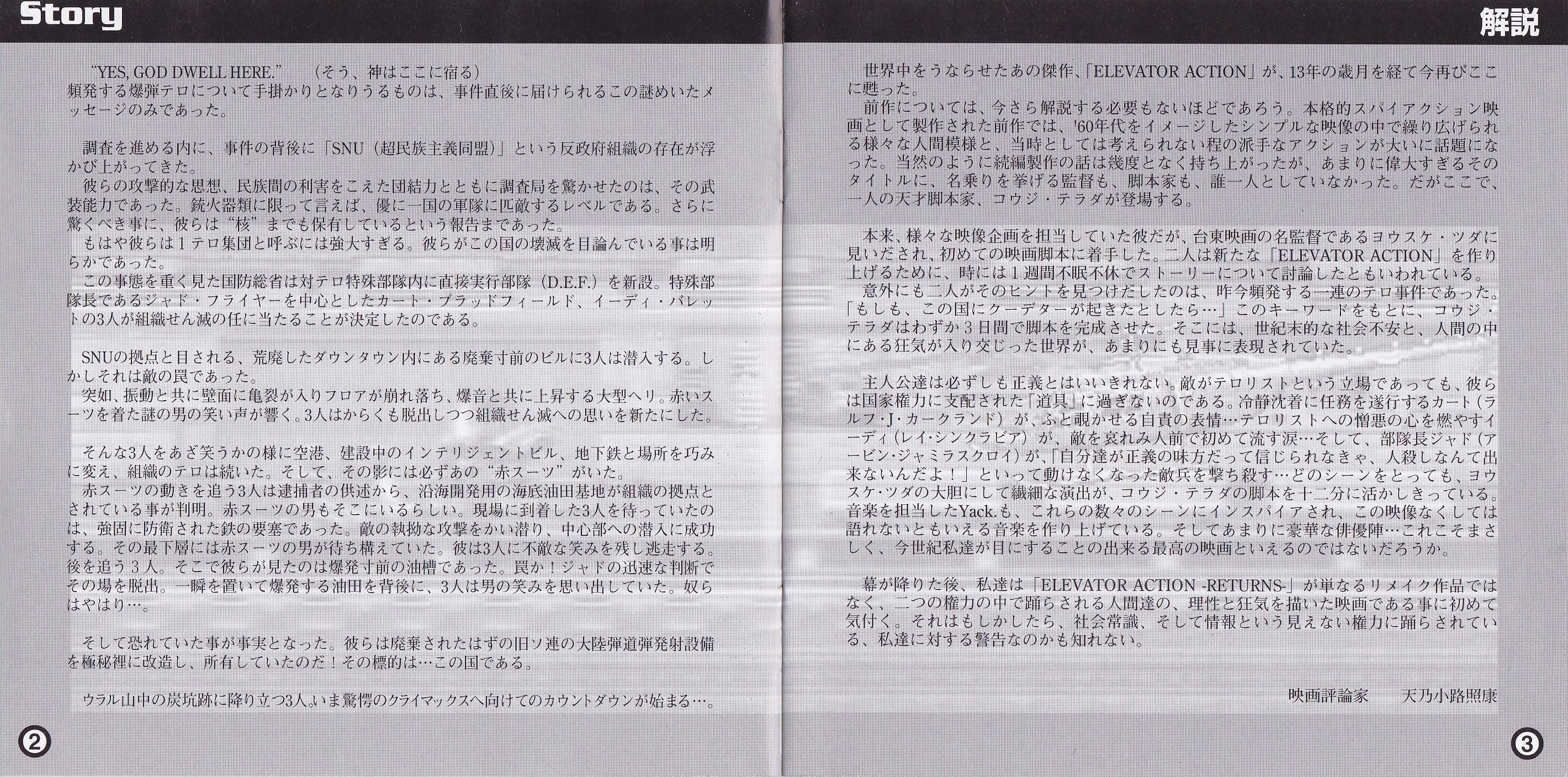
Elevator Action Returns (Taito, 1995)

Post by Randorama »

This squib focuses on Elevator Action Returns, a game that takes the “R2RKMF plus platforms” genre and imbues it with cinematographic panache. There are several ports across different systems (e.g. Saturn, Taito Memories 2 on PS2, the S-Tribute on PS4/Switch), so I invite my readers to check the wiki for this “external”
Facet
of this title. The game is the second of a series that includes the classic 1983 Elevator Action, GBA and PS3 titles loosely based off Elevator Action Returns, and two light guns games (read here). The game’s versions seem only to differ in title: the US one carries the title Elevator Action II. Given the game’s 30th anniversary, I thought of offering my views on the game in a somewhat more organised manner, rather than spouting unorganised rants that I have posted on the forum over the decades. On we go:

Elevator Action Returns (Taito, 1995) is an action/platform hybrid game with some of the game mechanics of tactical shooting games. Players control one of three high-ranking secret agents who must foil the plans of “Red Suit Man” and his army of terrorist henchmen pursuing a “New World Order”. The game is notable for vastly expanding on the first title’s original formula. Elevator Action featured an unnamed spy who must enter marked rooms in a building to steal confidential data, kill black-hatted enemies, and use elevators to reach the building’s bottom floor. E(levator)A(ction)R(eturns) expands on this formula by featuring different types of environments, special weapons, close-range attacks, a noir-tinged atmosphere and plot, plus a glorious OST by Zuntata then-guitarist YACK (Yasuhisa Watanabe). My goal in this squib is to convince my readers that they should really play and 1-CC the game, and that EAR deserves the exceedingly repetitive but endearing praise.

A bit of context, if I may. By early 1995, Taito had released several titles on their F3 board, a new hardware that could handle scaling and rotating sprites, and had high-quality, Dolby surround hardware. Taito released the legendary shmup Ray Force, A(rcade)RPG Light Bringer and puzzle favourite Puzzle Bubble 2 a few months earlier, and released a great selection of sequels to their classic series. Aside EAR, players experienced Darius Gaiden, Bubble Symphony and Bubble Memories, Hat Trick Hero ‘94 and Hat Trick Hero ‘95, Arkanoid Returns, and adorable Akkavader, among others. Taito would have soon moved to more powerful hardware (e.g. the FX-1B system), releasing early “polygonal” gems like Ray Storm. For lovers of 2.5D graphics, however, Taito kept releasing games until 1998, with puzzler Land Maker offering the last hurrah for this board and visual standard.

The game plot echoes preoccupations about the advent of the new millennium and general phobias about terrorism. At the turn of the century and millennium, social unrest and economic turmoil torment an unnamed country on what seems to be Northern Europe. The “New World Order” terrorist group and their seemingly billionaire leader, “Red Suit Man”, start planting bombs in strategic places and pursue a strategy of tension. Special group D.E.F. and members Edie Burret, Kurt Bradfield and Jad the Taff are tasked with defusing their bombs, recover files regarding their operations and killing hundreds of terrorists with zest. The game intentionally exudes an atmosphere reminiscing of 1960/1970s noir-infused spy movies like The Ipcress Files, The Three days of the Condor and early James Bond. The D.E.F. trio’s final mission in the enemy’s bunker offers a veritable “Taito ending”, as proof that the game homages this view of “spy games”.

The game mechanics provide an interesting array of options. Players control one of the three characters of choice with the joystick, shoot gun bullets with the A button, and jump with the B button. Pressing twice in the same direction results in characters running until the player pushes a different direction: characters can jump longer distances when running. Jump animations vary with each character: Jad is a bulky guy barely hopping over obstacles, Edie performs higher and longer jumps, and Kurt delivers impressive somersaults. Characters can shoot an infinite number of normal bullets, with Edie being the fastest sharpshooter and Jad the slowest. Characters can also shoot in a diagonal line (up-right, up-left+A), and hit enemies above them if no obstacles interfere. Hitting enemies with jumps can kill enemies or make them fall down to elevator pits; Characters can also punch enemies to death when in close range.

Players can also configure the C button for the “grenade” attack, or press A and B together. Each character uses their distinctive type of grenade to blow up enemies and structures. Edie places a “fire bomb” at a short distance creating a small fire hazard; Kurt throws a “hand grenade” blowing up along a whole floor; Jad throws a “sensor bomb” exploding when an enemy approaches. Players start with 10 grenades but can collect power-ups awarding five or ten extra grenades. Each character starts with a full energy bar and a spare life; the game does not award extends, a fact not hampering 1-CC in a serious manner. Characters lose energy when hit by bullets or physical hits (e.g. Dobermann dogs’ bites), but die immediately if they fall down an elevator pit, end up crashed by a descending elevator, or try to jump to a lower platform/level.

The game’s platform mechanics play a key role in how they define Stage design/layout and thus difficulty, but some Facets have a key role in the game’s basic mechanics. Characters can enter elevators or hop onto moving platforms, as in the first title. Once they are in an elevator or on a platform, Players can control the elevator/platform’s movement and height by pushing up or down to ascend or descend by one floor/level. Players must thus navigate quite vast Stages by carefully using these moving parts, while also avoiding random horrible deaths by squashing or falling. Be aware that enemies can control elevators/platforms too, and will try to squash reckless characters. Be also aware that getting hit while running may result in players being knocked down and potentially falling off platforms, too. Players must thus carefully ascend or descend levels and floors while using elevators/platforms with wisdom.

We discuss the complex and intriguing role of elevators and levels in the unfolding of the game and its Stages after we have discussed its luscious audio-visual presentation, however. Visually, the Facet that players will most likely note is that sprites tend to be small but with remarkably fluid animations and incredibly intricate designs. When characters shoot, tiny bullet shells exit their guns and fall on the ground, producing a distinct metallic sound when ricocheting. Characters can kill generic punks in shirts; dodgy criminals in trench coats, armed with shotguns; Dobermann dogs; short dudes in Azmat suits; the list goes on. Each of the many types of enemies have their own distinctive swagger and several attack patterns, thus offering the impression that each fight (and kill) has a personal dimension. The game thus features extremely detailed and vivid graphics perhaps comparable to high-quality anime.

The game’s art direction is notable in featuring realistic backgrounds, with some pre-rendered elements. Stages are vast and the camera may zoom on sections and specific rooms during cut-scenes, thus showing the impressive amount of detail underpinning each sprite and Stage. The colour palette is intricate but it focuses on specific colours for each Stage. Stage one features a dilapidated building and lots of grey concrete walls; Stage two is set in airport, with brightly coloured sections inside planes. Stage three has a memorable passage with characters reaching ascending a high-rise building against the backdrop of a crimson sunset. Stage five is on an oil platform, and involves the blue sea and greasy interiors. The game’s visual appearance thus distinguishes itself for its apparent realism but also for the astounding attention to detail. Taito’s F3 board offered powerful graphic resources, and the game exploits them in full.

The aural Facet of the game marries this visual intensity with gusto, thanks to YACK’s endeavours. Let us address sound effects first, as the most immediate proof of this cinematic marriage. The game is notable in implementing a vast array of quite realistic sound effects: guns are loud, bullets ricochet on the floor, punches have weight when they hit bodies, and platform may hum loudly. Some enemies die with loud screams; the engines of the flying vehicles on Stages four and six sound as if they were sampled from small hovercrafts. Mid-sections on Stages four and five only have environmental sounds as their soundtrack; players can hear the steps of walking characters and the sea’s waves, respectively. Characters have memorable lines, like Kurt’s “I am going to get you next time!”. The game thus offers an intense feeling of “immersion” in the action, via its deeply cinematographic aesthetics.

The OST offers aromas of the lounge-jazz style typical of spy movies with panache and many environmental effects. Each Stage’s theme comes in multiple movements, one per Stage Section. Stage one’s Red After Image has a slowly atmospheric lounge theme that moves to a single eerie melody after “Red Suit Man” blows up the building. Stage two’s System Down Starts with muzak-like themes and boarding calls at the airport in which the Stage takes place. The second movement switches to a dramatic action piece, and ends with a third section featuring an sparse acoustic bass notes and a brooding mood. Stage six moves through movements of increasing melancholy, until the menacing Red Suit theme plays during the final battle. Missing Link is a painfully melancholic ending theme, and so is Pre Production, the harrowing “High Score” theme. EAR is an enthralling cinematographically designed game, heart-breaking and beautiful in equal measure.

Let us now focus on difficulty, as the last Facet of the game itself that we explore, before we move to my own personal elucubrations on the game. I believe that the game involves three principal Facets of difficulty: game mechanics, Stage design/layout, and their weak, subtly defined interaction. I believe that they respectively attract 20, 20 and 10 points, even if I also believe that they involve low though flexible final scores. My reasons are as follows. Game mechanics are not too complex, though they are relatively detailed. Players must master how to use the basic gun(s), the machine gun power-up (“M”) and the (Rocket) launcher (“L”). Close range attacks are relatively slow and their activation range is the equivalent of one human sprite, so players may require some practice on their successful use. Jumps are another weapon, but getting while jumping is very risky: careful timing is necessary.

Controlling elevators and using bombs also requires some practice: players may also learn how to use elevators/platforms to avoid incoming bullets. Bombs also require some practice due to their character-specific range and characteristics, even if their effect can be devastating. These five mechanics motivate a 5/20 difficulty points for the first Facet, thus. Stage design/layout presents a slightly more complex picture. Players must visit rooms with a red door to collect the terrorists’ intel and defuse bombs, and can visit rooms with a blue door to get power-ups or bonus items. Only “red rooms” are obligatory to clear a Stage: all “blue rooms” are optional, though often useful. All Stages have an invisible timer: defuse all bombs by within the time limit or witness a “failed mission” screen, and start the Stage again. Visit red rooms quickly, or a very annoying alarm noise will start bleeping.

Stage one is rather straightforward, as the characters start from the roof and must reach the street level. Stage two to six take place in an airport, shopping centre under construction, a city’s sewers, and then the aforementioned oil platform and secret base. Ideally, players can master the Stages’ layouts and find the “path of least belligerence”, i.e. the path by which they visit red rooms and fight as few enemies as possible. Red Suit Man provides an easy final battle but players must race against the clock: 180 (visible) seconds to clear Stage six’s final section. If players master how to waltz through Stages only killing minimal numbers of enemies, Stages two to six provide a difficulty point each, and Red Suit Man offers another point of difficulty. We thus have a 6/20 difficulty points for this second Facet, for a total of 11/50 points.

I propose this score as a minimal difficulty value for a 1-CC: EAR is a low-tier game for intermediate players, if players ignore score-driven opportunities and thus never interact with the third difficulty Facet. The reason why I make this claim is relatively simple to elucidate. Score mechanics hinge on how game mechanics and Stage layout interact, though in a nuanced manner. First, players can shoot lamps, lights and power outlets to trigger temporary blackouts in one or more levels/floors, as in the first title. All kills and bonus items are worth their score multiplied by 2 (e.g. a 100 points-enemy becomes worth 200 points). Close range and jump attacks trigger another multiplier, so killing a 100 points-enemy with a punch, in the dark, is worth 400 points. Light comes back quickly (five seconds or so), so be sure to kill enemies as quickly as possible.

Players can also kill enemies by destroying inflammable oil cans and boxes, thus also triggering multipliers. Burning enemies can set ablaze other enemies and maintain a killing “chain”, in a rather gruesome manner, and bombs always trigger a x2 multiplier when killing enemies. When at risk, players can use rockets or bombs’ explosions to cancel bullets, so their use also has defensive purposes. Blue rooms usually offer power-ups, bonus items or even food (i.e. energy) when characters enter them. However, players must time their choice during their slot machine-like random rotation (i.e. press A or B at the right time). When characters enter either red or blue rooms they cannot be hit, since they are in another room. They also get a second or so of i(invicilbity)-frames, after exiting these rooms. Collecting items in blue rooms can thus increase energy, points or bombs numbers, and allow characters to dodge bullets.

Crucially, the mastering of these mechanics requires players to follow less survival-driven paths through Stages. Furthermore, if players want to pursues a counter-stop (i.e. 999990 points) in the arcade versions, they must learn some tricky forms of milking. Players must reach one key spot in each Stage, where they can spend time kill quickly respawning enemies. The exploitation of these posts is not trivial. Players thus must learn how to handle the hordes of respawning enemies while the seconds tick down on an invisible clock, and without risking a stray killing bullet. The third interactional Facet thus attracts another 10 points for a total 21/50 points: counter-stopping the game is potentially a low-tier effort but also a feasible goal for advanced players. Add two points for using slow-paced Jad (i.e. 13/50 or 23/50 total points); remove two points for quick-witted Edie (i.e. 9/50 or 19/50 total points).

By this point, you may feel ready to grab your copy of the game and have another go at a good score. Xenny definitely thought that “xe” had a chance to play rather than enduring my experiences, too (N.B. “xe” is my own invented pronoun: let us try with this form, for this squib). My bad: experiences first, pleasure later. If you survive the reading of these experiences, of course. It is June 1995, and my uncle is taking me to the big Luna Park in the EUR district of Rome, because he wants to buy a few new boards. Business at his arcade is still steady but arcade gaming currently seems to struggle to attract new players, as only fighting games and new polygonal titles can catch people’s attention. Capcom’s fighters, Namco’s Tekken 2 and Sega’s Virtua Striker guarantee excellent revenues; every other title apparently operates at a loss.

My uncle sets his sights on EAR, Puzzle Bobble 2, Darius Gaiden and Bubble Symphony, plus a few other titles I have forgotten. He is confident that well-designed sequels will make him a buck, and the huge arcade/retailer company operating insight the Luna Park is selling these boards at accessible prices. He is enthralled by EAR, so I am sure that at least one person will play the game in the arcade. My 1995 self does not visit the arcade too often and tends to focus on one or two titles to clear as an upper limit, at any given time. Tabletop RPGs and other hobbies suck most of my hobby time. My 1995 self will join Naval College Morosini in September, so he is not so keen on arcade gaming because it is solitary past-time, often. My 1995 self is not so convinced that this is a good choice.

I only play a few sporadic credits before joining the college, as I find the game slow-paced and distracting due to this pacing choice. The atmosphere and soundtracks are certainly impressive, but my 1995 is mostly focusing on shooters and scrolling fighting games. Any other game feels sluggish, honestly. I do not believe that I ever reach Stage three; I enter Navy life in September, and exit this black hole of anti-democratic stupidity by 2000. In my MAME gap year, I re-discover this game through RAINE, an old emulator that can emulate Taito’s F3 games. My 2000 can understand and appreciate the slow pace and the darker undertones of the game better. Age-based wisdom and actual knowledge of real life “spy games” guide this newfound appreciation of the game. I never find a way to clear Rolling Thunder 2, but I master this EAR with ease, indeed.

It is 2006 and I decide to buy the Saturn port of the game while I am back from my MA studies in Utrecht University. Summer is not so hot and I have no idea on what I will do, now that I have completed my MA. The port is expensive, so I also wonder if it is wise to spend money on a game that I cleared many times, rather than on necessities such as groceries. Oh well, the port seems arcade-perfect, and my grandparents offer me temporary financial support while I spend a gap semester before join a PhD school at Macquarie University, Sydney. I become curious about the scoring system and I admit watching the MAME replays on MARP to learn more about it. I am motivated enough to milk Stages heavily and reach 900k points or so, shortly before I leave for Australia in February 2007.

Over the years, I periodically play the game for a quick, nostalgic 1-CC’s, especially in Summer. Some time in 2015, while working in Sweden, I manage to 1-CC the game with Edie and Jad: not particularly hard endeavours. In 2022 I decide to try a “true spy” run, focusing on killing as few enemies as possible and thus landing the lowest score for a 1-CC. It is the worst summer drought in Wuhan in the last 70 years, and I am painfully alone to face it. One day I can clear the game at roughly 170k and decide that it is a satisfying result, especially since I cannot even sit down and play without sweating profusely. 1995, 2000, 2006, 2015, 2022, 2025: EAR is my reference game during transition phases and brooding moments, when I feel that I can only think in job, wearing pitch black-tinted glasses.

Let us wrap up, before we drown in oppressive thoughts. Elevator Action Returns is an “R2RKMF plus platforms” game that mixes a strongly cinematographic appeal with slow-paced but entertaining action. Players take the role of Edie Burret, Kurt Bradfield and Jad the taff, agents of the D.E.F. agency that must foil the nihilist plants of ‘Red Suit Man”. Players can clear six Stages of platform-based action while disposing of terrorists in discretionary manners, while also recovering intel data and defusing bombs. The game is notable for its flexible game mechanics, its quirky but potentially enjoyable scoring opportunities, highly detailed graphics and a killer OST offering a “kino” experience. Players who are interested in the genre and are looking into an accessible but potentially deeply satisfying 1-CC game can find in EAR a perfect title. Just be sure to be strong enough to also appreciate the harrowing end, of course.

(3246 words, or 8.2 pages in times new roman, size 12, single space; The usual disclaimers apply. Here is a “loose end” topic that I may explore further once I will revise the full set of squibs, then. The Scitron/Pony Canyon VGM album offers different arrangements from the arcade and Saturn versions of the game, and includes a booklet detailing the plot and info from the production team (and the Elevator Action ‘95 remix). It also sheds light on Taito/Zuntata’s “V.C.O.” (Vision, Conception, Origination) design philosophy. It took me decades and the advent of automatic translation software to figure out what V.C.O. stands for. I will discuss this Facet of game design, however, once I will tackle Ray Force in my squibs. “When”, you may wonder, but I must answer by quoting N.2 answering N.6’s questions: “that would be telling”. Be seeing you…until the next squib).
"The only desire the Culture could not satisfy from within itself was one common to both the descendants of its original human stock and the machines [...]: the urge not to feel useless."

I.M. Banks, "Consider Phlebas" (1988: 43).
Randorama
Posts: 4079
Joined: Tue Jan 25, 2005 10:25 pm
Contact:

Slap Fight (Toaplan/Taito, 1986).

Post by Randorama »

The squib for this week is dedicated to Slap Fight, the second of a virtual trilogy or perhaps tetralogy of early Toaplan shmups I wish to write about. This game comes in various versions and bootlegs, with the US(A) version known as Alcon. The M(ega)D(rive)/Genesis version port is considerably different from the arcade original, and a solid version of the game. A recent PC port exists for Steam, which appears arcade-perfect though bare-bones (i.e. it features save states and only a few other options). The game is notable for being the second shmup by Toaplan after Tiger Heli and for having (relatively) complex mechanics and a wealth of scoring secrets. As the game was distributed by Taito, a Space Invaders enemy can appear and award quite a few points. A more in-depth G(ame)D(iscussion) is here, and technical details are here. On we go with the squib, thus:

Slap Fight (Toaplan/Taito, 1986) is a (ro)TATE shump that pits the small ship “Leopard” vs. the vast armies of the power-hungry AI Gaudi, who has set its sights on Earth. The game is notable for having no aerial enemies and thus no “death by collision”, a lot of flickering bullets, and a power-up system similar to Gradius’s. The game is also notable for having a rich set of scoring secrets and techniques that invite players to use different weapons at different sections/areas. Toaplan would release Twin Hawk/Daisenpu in 1989, together with Taito, as second title lacking aerial enemies. Their last title, Batsugun, was perhaps their only other shmup offering several scoring opportunities. My goal is to anticipate the game’s 40th anniversary by offering my readers a squib convincing them to play and appreciate this game in depth, given its foundational status in the genre.

Our future squib on Armoured Scram Object will offer a compact description of 1985 and 1986 as key years for the evolution of the genre. It is worth noting that in 1986 Taito also released Halley’s Comet and Tokyo, and Konami released Salamander as a spin-off/side story to Gradius. 1986 also saw the release of Sega’s Fantasy Zone, the original “Cute’em up”, Capcom’s hybrid action/shmup Legendary Wings plus Side Arms, and Nichibutsu’s mecha-oriented Ufo Robo Dangar. In 1986, a young Tsuneki Ikeda was also deeply impressed by Slap Fight and, in particular, how the later loops of the game provided veritable ”Bullet Hells”. He thus developed the taste for dodging thick swarms of bullets, and many ideas about how shmups’ design could have evolved pursuing this design style with more rigour and depth. 1986 and Slap Fight were, in a sense, the inception date and game of contemporary shmup genres.

With this terse overview of the game historical context and role, we can discuss Slap Fight/Alcon’s rather “standard S(cience)F(iction)” plot. Long time ago, in galaxy far away, the Hulst alien civilization created the AI Gaudi for some unspecified purpose. Gaudi grew so big and powerful that it took control of the whole galaxy and pushed the Hulst to the brink of extinction. However, a few members of this civilization manage to alert Earth citizens of the incoming threat. As Gaudi sets its ambitions on Earth, the Earth government prepares the “Leopard”, a ship able to counterattack Gaudi’s encroaching control over the planet. The game thus chronicles the Leopard’s fight against invading AI Gaudi for the freedom of “Blue Earth”. Any reference to legendary architect Antoni Gaudi, we can assume, is purely coincidental. That Gaudi the AI controls part of Earth, in Ray Crisis style, is my own conjecture, I admit.

Enough of the zany story; the game mechanics work as follows. Players control the Leopard with the joystick and can move it in eight directions. The A button controls attacks, which vary according to the activated armour/weapon system. The B button activates one of the armours/weapons or the other power-ups. Players can collect flashing star-shaped icons that trigger the selection of a power-up following a fixed progression, much like in Gradius. Collecting one star activates one speed increase (out of four); two, the basic “shot” attack; three, a side-shot covering the left and ride sides of the Leopard. The sequence of weapons/armours is then “wing”, “bomb”, “laser”, and “homing (missile)”, then “paddle”. Activating the “wing” attack increases the current weapon/armour power by one level (up to four); activating the paddle triggers a temporary invincibility barrier that decreases in duration over time. Gradius players will find the system intuitive, indeed.

The selection of different weapons however involves the Leopard implementing an armour/extra weapon system. Only one weapon can be used at a time, aside the “side” attack. Once players activate the second power level via the “wing” option, the Leopard’s sprite becomes bigger; at the third and fourth activations, two side pods attach to the Leopard. Hits will destroy these pods and depower the Leopard, but avoid death; the Leopard explodes/dies after one hit, at power levels one and two. If players are using one weapon (e.g. “laser”) and select the “shot” attack, they switch to the basic attack; the same rule holds when selecting another weapon. The paddle starts at roughly 20 seconds of duration and offers complete invulnerability; at the fourth activation, it lasts around 10 seconds. The different weapons offer distinct score opportunities in the game; we however these opportunities once we tackle the topic of difficulty.

Let us first address the aesthetic Facets, however. Slap Fight has a clean if rather generic design; the Leopard traverses four vaguely defined Stages that involve ancient ruins, enemy bases, deserts and other “SF-looking” backgrounds. While design and artistic direction may not look memorable, enemy vehicles are quite well-animated and Stages offer bright, “shiny” palettes and highly detailed art for the time. The Leopard has a generic, “flying tank” look when unequipped, but can turn into a massive, cool-looking space-/air-ship once all “wing” options are activated. The third and fourth bosses, apparently two different forms of AI Gaudi, also appear as zany “giant brain robot” entities, offering a vaguely humorous rendition of this dramatic fight. The game thus may suffer from a relatively generic approach to art direction, typical of the time, but offers well-animated graphics and a relatively variegated use of vibrant colours.

The OST is probably less appealing, even if by legendary Masahiro Yuge. Slap Fight has a minimal OST consisting of four themes (e.g. Expect Success, Stage one; Gain a Victory, and section-specific themes (e.g. Reach the Desire, the “score entry” theme). The MD/Genesis version is notable for being an “upgrade” over the original version, thanks to a young but already immensely talented Yuzo Koshiro. The general “8-bit” feeling underpinning this soundtrack also features prominently in the set of sound effects. Weapons produce exquisitely “retro” explosions, the “paddle” power-up produces a high-pitched, constant and annoying beeping sound when active, and so on. Most enemies do not produce any sound when attacking or exploding, but bosses do so when hit via some odd bleep. Slap Fight may be a prototypical example of Chiptune music, if only because it may be a very early example of it. Overall, Slap Fight/Alcon sounds and looks vintage but “well-crafted 1980s”, in a slogan.

Let us turn to the topic of difficulty. I anticipate matters a bit and suggest that Slap Fight/Alcon offers a top-tier beginners’ challenge at 10/50 points of difficulty. The reason why I propose this score is that the game offers four Facets of difficulty worth each 15, 15, 10 and 10 points: game mechanics, Stage design/layout, Rank, and the interaction of the first two Facets. Game mechanics offer two key challenges: players must learn to use the Gradius-style system and must learn how to handle “wing” power-ups once they reach level three and four. Players can choose not to upgrade also to keep rank at lower levels, however. Stage design/layout is relatively simple, even for a 1986 game: once you know where enemies pop up and destroy them at once, the first loop becomes easy to handle. The third and fourth bosses’ thicker bullet patterns require some practice, though.

Once players however master the four Stages’ enemies’ layouts and the 100 (sub-)areas making up these Stages, they should become able to recover from deaths at any respawning point. Furthermore, Rank revolves around survival time and power levels, but resets once players die. Thus, players who learn to handle maxed out Rank and respawning patterns should have any easy time to 1-CC the first loop. The game has infinite loops, and extends are at 30k and 100k, plus every 100k, so players may also decide to face a steeper challenge by pursuing multiple loop clearances. Notably, enemies shoot and move increasingly faster at each loop, thus rendering successive loops considerably harder and close to modern Bullet Hell shmups in difficulty. Furthermore, the game has several weapon-based scoring techniques and secrets, as explained in this guide. Players who pursue these techniques will experience some interesting if easily manageable challenges.

I thus propose that the game mechanics attract 2/15 difficulty points, Stage design/layout 6/15 points, rank 4/10 points, for the aforementioned total of 10/50 difficulty points. For score-based runs, I also propose another 5/10 difficulty points, but only for runs pushing for higher scores. The “optional” difficulty for the game thus reaches 15/50 points, i.e. a mid-tier challenge for intermediate players. Add two points per loop, for a guesstimate of how hard the game can become on “endurance” runs. Consider, however, that every eighth loop involves bullets and enemies reverting to basic attacking speed and aggressivity. Nevertheless, players who attempt counter-stop scores at 9999990 points and thus try to clear 20 loops or so may face a challenge in the grand master range, at more than 40/50 points of difficulty. As in the case of Flying Shark and many other early shmups, players can pursue exceedingly difficult but optional goals.

Let us move to the experiences’ discussion, then. Xenny? For once, “xe” will shut up because my discussion will touch upon a more delicate and personal topic. It is almost Christmas, 1986, and my natural parents sometimes bring me and my sister to this neighbourhood snack bar/café, before dinner time. My father is seldom at home due to his work, but when he is back, we usually visit this cozy little place before going out for a pizza. My parents drink some alcohol-free aperitif, since they are both teetotallers, and my sister and I eat chips and olives while playing whatever is in the two cabs at the bar. It is night and the sky is clear of clouds, so the full moon shines upon the snow that has completely covered my city and the mountains surrounding it. It is, of course, bitterly cold.

My sister is almost five years older than me and has fully inherited the family looks, so she is really tall and muscular for her age. She is also incredibly good at videogames, so that when we visit the big arcade in the city centre, many people watch her highly skilled performances in awe. We have recently visited this bar as a way to sidestep the law preventing kids younger than 14 years from playing videogames in arcades. It is a snack bar, we never order anything stronger than a Sprite, and there are only two cabs after all. This day, there is a new game that looks really cool and that has ship flying over some kinds of ruins and then a space base or something. I do not remember the other game; my father tells us to play Slap Fight while he tries the other game with mother.

My sister and I spend our credits collecting stars but not using them to power-up the ship. At my own last credit, the owner of the bar notices this problem and kindly explains us how the system works. He plays one credit, reaches the third boss while also showing us how to activate power-ups, and then oversees us while practicing a bit. I do not remember much else from that day; I only remember that sister and I would often go to the bar with mother, play a few games of Slap Fight, and enjoy the cozy, family-oriented atmosphere of the snack bar. I probably never progressed beyond the second Stage or so; my sister probably cleared one loop. I do remember that we would sometimes stop because there were reruns of Captain Harlock, and everybody would watch them attentively and in solemn silence.

It is 2000 and in my MAME gap year I re-discover many of the old Toaplan games. Slap Fight is possibly the first Toaplan game I 1-CC, since the game is not particularly difficult. My 2000 self does not have any distinct memories of my 1986 self playing this game. My late sister and parents are hazy memories by this time, as I am focusing on rebuilding my life after the Navy failure. Over the years, I enjoy playing Slap Fight from time to time, since a single loop requires relatively little time to clear. It is 2017 and it is almost Christmas time, and I am showing this and other games to my father who is visiting me in Gothenburg. He simply observes that yes, he remembered me and my late sister playing the game as children, while he was playing co-op with his best buddy, my father.

Some of you might want to read more; Xenny is pretending to be busy checking the latest NRL results, the damn bogan xenomorph. Thus, we wrap up. Slap Fight/Alcon is a 1986 (ro)TATE shmup by Toaplan and published by Taito that pits intrepid ship the Leopard against Gaudi, an alien invading AI. Players must clear four Stages and their 100 areas to defeat this threat to peace on Earth by using a power-up system similar to the one in Gradius. The game is notable for only having terrestrial enemies and thus lacking collisions, and a smooth difficulty curve. The game also features endless loops that inspired Ikeda-san and other CAVE programmers in their creation of “Bullet Hell” games, and a treasure throve of scoring tricks. Players who want to know the roots of modern shmups should thus “study” and enjoy this game in detail, indeed.

(2214 words or 6 pages, times new roman, size 12, single space format; the usual disclaimers apply. In hindsight, I believe that I would have loved to see Toaplan trying their hand at more sophisticated score systems. As a kid, I remember always trying their “new” games but usually losing interest when hitting unsurmountable difficulty spikes. I certainly liked Rally Bike and its OST, to the point that I even 1-CC’ed it, and I also enjoyed Snow Bros and Pipi and Bibis. Rest of their games, well…it is a long story. This is the second chapter of a trilogy or perhaps tetralogy dedicated to Toaplan; Kyykyoku Tiger should be a future target, and maybe I will cover Tatsujin/Truxton. Well, maybe one day I will solve my decades-long grudge with P&B and write about it in a triumphal squib entirely written in the third person, indeed.)
"The only desire the Culture could not satisfy from within itself was one common to both the descendants of its original human stock and the machines [...]: the urge not to feel useless."

I.M. Banks, "Consider Phlebas" (1988: 43).
1000Eyes
Posts: 89
Joined: Wed Jun 11, 2025 2:58 pm

Re: RRR: Index of squibs

Post by 1000Eyes »

This thread is such a great resource. Many thanks for your continued dedication!

I have a question about Tiger Road. If you don't play with the bonus power ups, will there be a sense of escalation in the difficulty curve? From your previous posts, it sounds like the more bonus stages you complete, the more the game's design gets undermined as it was balanced for a non powered up player, so Im curious to try skipping all the bonuses. It's a really cool combination of GnG and Spartan X with Legend of Kage's jump, a never-was collaboration between Fujiwara and Nishiyama sensibilities, that I want to engage with the design as fully as possible with no cheese. I wont complain when the difficulty wipes the floor with me :D
Randorama
Posts: 4079
Joined: Tue Jan 25, 2005 10:25 pm
Contact:

RRR: Season 2 is coming!

Post by Randorama »

Hello 1000Eyes, and thanks for your feedback. Please spread the love like we have a Ponzi scheme in place, if you like the squibs :wink:

Regarding Tiger Road:

It is perhaps fair to say that completing all the bonus stages makes the game and its levels considerably easier. Stage four is definitely easier with all power-ups in place, and the final boss becomes borderline trivial. Certainly, the game can be finished without ever getting the bonus power-ups, but you can nevertheless try to improve your skills in a progressive manner by starting directly from Stage two, three or four. You will skip previous Stages and thus reduce the amount of bonus power-ups you will collect.

Do also remember that the bonus power-ups are connected to your energy levels, so you may (often) find yourself in situations in which you must know how to handle a section without power ups anyway. The bonus power ups ultimately make the game easier if and when players know how to avoid damage across sections, so they do not (completely) undercut difficulty.

My suggestion is thus: 1-CC Tiger Road without skipping any Stages but also without worrying too much about bonus power ups: learn how to clear each section irrespective of your power-ups and weapons. Then, try by starting on Stage two, three, four. Once you complete all these goals, you can try Tora e no Michi (i.e. the Japanese version) and see if you can clear this 2-loops version. The first loop is easier than Tiger Road's first and only loop, but the second loop is definitely annoying.

Personally, I loved the style dearly as a kid: it exudes Wuxia ideas and tropes in droves (the plot, the Shaolin monk mystic powers, the ridiculously high jumps, the creatures from Chinese mythology, etc.). When it came out it was really innovative, and a great addition to the (then) emergent action/platform/R2RKMF game. The friend I mention in the squib still remembers it fondly after almost four decades, so he was really happy when I showed him the Arcade Stadium port :wink:

Some news, since I fell silent for a few weeks.

I have been writing more material during August, so by this Sunday onwards we are going to proceed at a brisk pace (one squib per week). We should reach 60 (!!!) squibs by October the 6th, which marks the first birthday of the thread. The plan is to go from 60 to 120 squibs by the second birthday, and even have a few "EffortPosts" in the Sports thread and the Single Screeners thread. My goals are a solid post about (association) Football arcade games, a solid post about Maze games (i.e. Pac-Man and clones), and a few more retrospective on retro micro-genres. We now have a thread about Cannon Spike (thanks, 1000Eyes!), so we may start exploring arena shooters in more detail. Importantly, I will also prepare an index for ease of reference for (at least) the squibs, within the next two months or so. Be sure to keep this and the other threads booked, lads :wink:
"The only desire the Culture could not satisfy from within itself was one common to both the descendants of its original human stock and the machines [...]: the urge not to feel useless."

I.M. Banks, "Consider Phlebas" (1988: 43).
Randorama
Posts: 4079
Joined: Tue Jan 25, 2005 10:25 pm
Contact:

Cosmo Police Galivan (Nichibutsu, 1985)

Post by Randorama »

In this squib we are going to discuss Cosmo Police: Galivan, a rather obscure action/platform game in the R2RKMF mould from four decades ago. The game enjoyed a certain popularity back in the day. It received some ports and an RPG-lite “revision” on the NES/Famicom in 1988, please a SNES/Super Famicom sequel in 1993 (see wiki link below). Our reference is the Arcade Archives port, however, which should feature the third revision of the game. The game seems inspired by a Tokusatsu/Sentai tv show from the late Shōwa era, Space Sheriff Gavan. The game however has a different vibe, our hero Galivan fights in a setting that looks S(cience)F(ictional), broadly defined. I never liked Sentai stuff, but this game had a mysterious charm and rather fast-paced action, aside a glorious “main theme”, that attracted me as a kid. Technical details about the original arcade release are here. We begin:

Cosmo Police: Galivan (Nichibutsu, 1985) is an action/ platform (ro)TATE game that features the last survivor of the “Cosmo Police” force against a mysterious and evil alien force. The game is notable for being fast-paced and having enemy formations spawning at random points, no jump button, and a handful of levels that players can loop through indefinitely. The game is notable for being one of the few arcade games that Nichibutsu/Nihon Bussan made outside shmups. The original arcade version was one of those games set at a very loud default volume, and the design style was certainly garish, even by mid-1980s standards. The strong Anime-/Sentai-like vibes also set the game apart from games with more “western-looking” designs from bigger companies (e.g. Taito, Konami). My goal in this squib is to convince readers that 1-CC’ing at least one loop is an intriguing experience, if only because of the game’s flamboyant presentation.

A bit of context, as always, will help us in better understanding the game; our focus will be on Nichibutsu and its historical role as an arcade company. Nichibutsu was minor company that started operating in 1978 and released several shmups, platformers and Mahjong titles. Readers might know the “Cresta” series via Moon Cresta (1983) and Terra Cresta (1985_ (and yes, modern iteration Sol Cresta, 2024). Other shmup classics include licensed Ufo Robot Dangar (1984) and Armed Formation F (1987), i.e. shmups featuring the “multiple combining ships” theme. Kid no Hore (1987), Soldier Girl Amazon (1987) and Mag Max (1985) were respectively an interesting single-screen puzzler, a top-down/(ro)TATE and an HORI(zontal) action/shmup games. In 1984, Nichibutsu was among the first producers of Hentai Mahjong games with Jangou Lady. From 1989 to this day, apparently, they cultivated a “pervy Mahjong” niche; their 1980s games remain highly original, cult-like titles.

Galivan is one such example, in its simplicity. The story and the setting are minimal and straightforward, indeed. On some distant planet, the Cosmo Police is trying to maintain the peace and allow new colonists to develop the planet. A mysterious group of alien pirates, however, decides to ravage the colony and slaughter all the local Cosmo Police Force. Galivan is the last Cop standing, and decide to avenge his comrades and colonists by punching and kicking the aliens. Luckily for him, his Spaceship/base sends him power-ups that allow him to “suit up” with a cybernetic armour and kick the aliens’ asses with various weapons. Anyone who has seen a Sentai tv show knows the basic setting (“man suiting up”, briefly). Add a “distant colony” SF setting, a wealth of robotic enemies and weird aliens, and we have a minimal though intriguing game world.

The game mechanics follow a similar minimal design. Players control Galivan with the joystick by moving the character in eight directions; upward directions (i.e. up, up-left, up-right) control jumps. The A button controls punches and the B button controls kicks when Galivan is weapon-less and without suit. When Galivan collects a “P(ower)” icon, the suit suddenly assembles on Galivan’s body, and our hero can shoot bullets from a pistol. Use the joystick to aim shots in any of the eight directions, and jump before shooting in a downward direction (jump, then shoot down-left, down-right). Collecting a second blue P icon activates the laser sword; collecting a red P icon activates the hand cannon. The laser sword shoots laser beams only in the walking direction but is considerably more powerful; the hand cannon shoots powerful triple cannon shots. The first power-up lasts about 40 seconds; the second, 20 seconds or so.

Galivan starts his fight in police uniform and, when he is not wearing a suit, can take considerable damage from any hit or collision with enemies. His H(it)P(point)s, appearing as an energy bar at the bottom left side of the screen, may go down quickly. When wearing the armour, most hits land half of the standard damage, and some collisions cause minimal damage (i.e. roughly 1 HP out of 128). Larger enemies can however knock down Galivan in either form, with the character rolling back and being unable to attack. Collecting P icons while armed up however increases HPs and extends the duration of the sword or cannon attack, as well as activating a short i(invicilibity)-frame phase. Be sure to constantly collect Ps and avoid direct collisions, and to collect P icons when bullets hit Galivan, to cancel their damage via i-frames activation.

The audio-visual presentation of the game offers a similar minimalist style, even if it is also gloriously flamboyant. Galivan features a palette of intense, fluorescent shades of yellow, red, brown, for terrestrial environments, and blue, steel, and cyan for aquatic and mechanic environments. Galivan must penetrate the aliens’ underground base and reach the deepest levels to defeat their bosses. Thus, the game uses a TATE screen but scrolls downwards, with scrolling controlled by players. Galivan mostly moves through underground caves that however also include underground aquaria, research labs and other artificial environments. The one boss appearing at the end of each Stage is a robot with multiple heads, appearing in a temple-like room. Most enemies are robots and cyborgs, coming in various shapes and formations, with organic aliens only appearing sporadically. All sprites are well-animated for the time, and offer a strong “cybernetic” feeling to the setting.

The OST, in its simplicity, is easily the most intriguing Facet of the game. Kenji Yoshida worked on this and the Cresta games by creating the iconic synthetiser sound that Yuzo Koshiro reconstructed for Sol Cresta. He thus pioneered a Chiptune style that borrowed a frenetic pace from genres such as rock, funk, and early electro-pop. The game has three themes and various intermezzo jingles (e.g. the End-of-Stage jingle). The first theme is Civilian Control II, which plays when Galivan is unarmoured and has a brisk pace underlying the need to suit up. Theme of the Devil, a dramatic if typical “action boss battle”. The main theme is Hard Galivan, a legendary ultra-fast battle theme that echoes Yellow Magic Orchestra funkiest, fastest successes (e.g. Absolute Ego Dance). The dozens ultra-campy, ultra-synthetic sound effects also punctuate action, thus creating the aural sensation that players traverse an ultra-fast, ultra-futuristic, exhilarating Wuxia movie.

The aesthetics of the game thus offer a perhaps classic and pioneering presentation for an ultimately simple but remarkably fluid and fast-paced game. My discussion of Galivan aims to underline this point, indeed. The game’s two sources of difficulty are its game mechanics and its Stage design/layout. First, the controls are rather immediate but require some practice before players can master them. Be sure to master to jumping by using the joystick and properly aim when only armed with the pistol, a task also controlled via the joystick. Furthermore, learn the duration of the laser sword and hand cannon power-ups, since having a constant stream of upgraded weapons also entails recovering HPs at a regular pace. As always, we divide a total of 50 difficulty points into two halves of 25 points per (sub-)Facet. Game mechanics thus attract 4/25 difficulty points.

Second, the game has only four Stages, with Stages three and four being slightly harder variants of Stages one and two. Once players know their layout and thus how to reach the boss room, half of the challenge finds a solution. The other half finds a solution once players know how to handle the dozen or so of different enemy types and their attack patterns, plus the endlessly returning boss. Once players complete four Stages, the game starts looping by offering slightly more difficult versions of each Stage. Stage layout/design thus attracts 8/25 points, with each loop approximately increasing difficulty by two points. At a grand total of 12/50 points for the first loop, Galivan is a low-tier challenge for intermediate players who are satisfied with a quick “1-All” 1-CC. Endurance marathons, e.g. clearing 20 loops or so, may indeed involve far higher levels of difficulty and stamina.

As the game offers a minimal but eclectically brilliant experience, my discussion of my personal experiences with the game will follows a similar minimal style. This is the case because Xenny the bogan xenomorph is dancing at the pace of the Civilian Control II theme while wearing a fluo/retro disco suit, distracting me considerably from my goal (thanks, Noah Hawley!). It is 1986 or so; I vaguely remember that either the neighbourhood café or some other place had a cab with this game and Terra Cresta. My father liked both games, but I was too little to play and I only watched his runs. My mother likes the music style of both games, but she is next to useless on any game requiring reflexes. I have blurry memories of my sister being good at both games, being the precocious genius in the family. I do not recall much else, honestly.

It is 1988 and my uncle has set up one room with games at half price, 100 lire for one credit, in his arcade. My 1990 will have his ass kicked black and blue by Rolling Thunder, in this room, but my 1988 has just discovered this room and its many “old” titles; Galivan is one of them. My 1988 already has no memories of this game, also because every recollection before 1987 is painful to access. I thus approach the game as if it were my first time playing it, and remain mesmerised when first hearing the Hard Galivan theme. I admit that as a kid I do not even like the game that much, but listening to this theme for some minutes is the musical equivalent of riding six ultra-risky rollercoasters in a row. My new father thinks that I might need a litre of chamomile, after one credit.

Even if by this time I am just a kid who can barely clear Thundercade, I have become skilled enough to also clear four Stages of Galivan. This is a game that seems easy once I can get “in the groove”, like that obnoxious Madonna song, and the main theme works perfectly for this. Some people begin to watch my runs because they find it hilarious that a kid sitting on a stool to play a game apparently tries to dance while playing Galivan. Once, I witness these two weird guys, who are also brothers and who apparently can clear any game they touch, clearing 15 times all four Stages. My uncle’s consternated face is priceless, as he comments that spending five hours on the same 100 lires will bankrupt him. The two brothers just laugh with hubris, claiming that they will clear all the games in the arcade.

Memories fade and reappear; in my MAME gap year, 2000, I am sure that I re-learn to play this game simply because I want to listen to the fantastic theme again. At some point around 2003 or so, I discover the M1 emulation player, rip the themes from the game, and record them on tape. Many acquaintances and friend have listened to Hard Galivan and have discovered, in disbelief, that a videogame from 1985 had a delightful dance/funk/rock/something theme to party hard to. From 2003 to 2025, many “victims” have fallen in my trap and have discovered the hypnotic beauty of this theme. Some have even bought the game on Arcade Archives, and “cursed” me for letting them fall in the “retro endless well”. All I can say is that, well, it is never too late to discover cult classics and camp milestones in videogames.

Let us recap, as Xenny keeps dancing fluo-style, unable to stop and take a breather. Galivan is an action/platformer/R2RKMF game in which Cosmic Cop Galivan must exact revenge against evil aliens who killed his fellow cops. Our hero Galivan starts with punches and kicks against an army of robotic aliens, but turns to a badass armoured warrior with a single P(ower) icon and metes justice with guns, laser swords and hand cannons. The game thus combines a Sentai-style design with SF settings and provides a flamboyant, loud audio-visual experience. Players can clear four Stages of intense action and thus loop the game regularly, once they master how to handle the many waves of enemies flooding the screen. Players who thus wish to (re-)discover Nichibutsu highly idiosyncratic but immensely energetic and vibrant style, and enjoy classic “endless loops” action with an excellent flow, can certainly start from Galivan.

(2058 words, or 5 pages, times new roman, size 12, single space; the usual disclaimers apply. I have written this squib in roughly 90 minutes, overwhelmed by the game’s OST and more in general by the unique soundscape that Kenji Oshida created while at Nichibutsu. An urban legend circulating in the high steppes of my hometown’s valley says that once I was rather drunk and I started “DJing” at a party. Specifically, I connected my laptop to the amplifiers and started playing this game’s themes and other game music via M1. Some simply had no idea about what they were listening to, but some asked a mixtape of it. Let us say that there might still be “MAME bootlegs” floating around, as relics of the highly eccentric shenanigans of some liminal being Somebody did recently ask me if I found Koshiro’s work on Sol Cresta innovative: guess what happened?).
"The only desire the Culture could not satisfy from within itself was one common to both the descendants of its original human stock and the machines [...]: the urge not to feel useless."

I.M. Banks, "Consider Phlebas" (1988: 43).
Randorama
Posts: 4079
Joined: Tue Jan 25, 2005 10:25 pm
Contact:

The King of Dragons (Capcom, 1991)

Post by Randorama »

In this squib we discuss The King of Dragons, Capcom’s classic beat’em up/action/2R2KMF game set in a fantasy world. The game had a SFC/SNes port SNES/SFamicom version back in the day, and Capcom released various versions over the decades (e.g. the PS2version, the ”Capcom Belt Scrollers” collection). The game has various revisions and versions, but differences amongst these versions are minimal. With this squib I celebrate 4000+ posts on this forum; probably, another 2000 posts or so faded into oblivion when the old forum disappeared. No matter: a quarter of a century on, and your humble scribe is still enjoying the dubious goal of offering purple prose to this forum’s readers and users. The choice of this game is thus a mix of sheer nostalgia and celebration: we celebrate this trivial milestone by celebrating an almost 35-years old game. On we go, sailors:

King of the Dragons (Capcom, 1991) is a beat’em up/R2RKMF/action game with a High Fantasy setting directly inspired by Dungeons and Dragons. The game pits five heroes against Gildiss the mighty red dragon, who awakens from his slumber and wreaks havoc among the human kingdom of Malus. Players must thus kill thousands of fantasy creatures such as humanoid lizards, undead creatures, renegade humans, and many others, before facing Gildiss. The game is notable for letting players choose between action-oriented characters shooting projectile attacks (i.e. Ravel, Wizard; Leger, Elf) and beat’em up oriented characters using melee weapons (i.e. the Derek, Fighter; Aldo, Cleric; Vargas, Dwarf). The game also offers a levelling up system, magic spells, and items, and a generally basic but intriguing A(rcade)RPG experience. The goal of this squib is to convince my readers to pursue a 1-CC of this great game, and enjoy it as classic title within the ARPG micro-genre.

Let us continue our discussion with an overview of the game’s context of release. The squibs dedicated to Data East’s Dark Seal, Mutant Fighter/Death Brade and Taito’s Rastan and Cadash provide compact discussions on how Western-style Fantasy entered the design world of arcade games. 1991 was also a key year for Capcom: epoch-defining Street Fighter II hit arcades and changes the arcade scene forever. Capcom, however, also released the excellent but much more difficult beat’em ups Knights of the Round and Captain Commando, and little multi-genre gem Three Wonders. The King of Dragons also influenced TSR’s decision to let Capcom create arcade D&D games (i.e. Tower of Doom and Shadow over Mystara). The game thus confirmed that Capcom designers could create stellar games at a stunningly fast pace, and offered more approachable challenges to a vast crowd of international players. The King of Dragons thus became an instant ARPG classic.

The plot and world setting follow this trend by providing a standard D&D-esque adventure. The red dragon Gildiss has awoken from his centennial slumber and has decided to prey on humans and their advancing civilization covering the kingdom of Malus Other demi-human being, undead entities and other creatures join forces with Gildiss, also out of fear of the red dragon’s enormous power. Humans decide to take up arms against these hordes to survive, but the ensuing battles define a precarious stalemate. One task force of powerful heroes thus forms, with the sole goal of killing Gildiss and, well, steal of his treasure. Heroes, yes, but such an epic feat comes with considerable pay slips, after all. The heroes thus embark on their quest across 16 Stages that vaguely resemble D&D’s GreyHawk and Mystara classical settings. Their showdown with Gildiss occurs once they have cleared the land ff the non-human threats.

The game mechanics are rather simple. The joystick controls the characters in eight directions, as characters move in a standard “belt-scrolling” (i.e. horizontal, isometric) plane. The A button controls attacks, which vary with characters. Derek, Aldo and Varfas have melee weapons (respectively sword, mace, axe) and thus land swings in the direction they face. Ravel and Leger have projective weapons (respectively bow and arrows, magic staff-based magic projectiles) and thus send long-range attacks. The B button controls jumps, with vary in height and length according to how players control movement mid-air. Jumps always cover the same trajectory on the characters’ horizontal axis, so players should be careful when jumping to the right/left of their current position. Pushing A and B buttons simultaneously releases a series of (magic) lightnings on enemies and consumes eight H(it)P(point)s that hits up to six enemies on screen.

In perfect D&D and ARPG style, characters can also level up; in perfect arcade game style, characters can also obtain extra lives. Players start with 32 (Leger) to 40 (Derek, Aldo, Ravel) or 48 HPs (Derek). Each character can level up according to a points-based chart: for instance, all characters will reach L(e)v(e)l two once reaching 20k points. Levelling up entails that characters increase their maximum HPs by 8 points every two levels, reaching hundreds of HPs once characters reach higher levels (e.g. Lvl 16, at which HPs max out). Characters can apparently level up indefinitely, as the game offers plenty of scoring sources. Levelling up results in a temporary “winning pose” triggering roughly two seconds of i(nvicibility)-frames; successful enemy hits also activate these i-frames. Extends occur at 200k points and every 450k points, and can also progress indefinitely due to the rich scoring opportunities.

Melee-armed characters have a third option that projectile-armed characters lack: parries. In a manner like Capcom’s other 1991 pseudo-fantasy brawler, Knights of the Round, melee characters can parry hits from enemies with their shields. Players must press and hold the A button and push the opposite direction of the enemy’s attack. If this macro combination is active when the hit lands, players will successfully parry the hit, slide a bit backwards (i.e. in the direction of the hit), and lose the ability to attack for approximately one second. Thus, the parry defence mechanism is more forgiving and helpful than in Knights of the Round, even if characters cannot parry most attacks from bosses. Finally, characters can hit floating magical orbs to release magic spells. These usually appear when players quickly kill six or more enemies in combo-like succession, or open treasure chests with favourable RNG items.

As befits ARPG games, characters can also obtain magic power ups that increase their offensive and defensive prowess. For this specific mechanic, there is a minor difference across versions: the US(A) and J(a)P(an) versions may release defensive magic items before offensive items. Irrespective of which item type occurs first, characters obtain these items after defeating each boss and after opening certain key treasure chests across Stages (e.g. a chest midway during Stage four). Players start with Lvl one items and collect a Lvl two item after defeating “Orc King”, the first boss. They may reach Lvl eight before facing Gildiss, even if they can forsake powering-up to increase scoring chances. This latter Facet affects how difficult the challenge of a 1-CC can become, as enemies on final Stages obviously have tons of HPs. All Stages start with 80-time units, and mostly include four further 20-unit extensions.

As befits ARPGs, characters also come with their own individual skills. For offensive power, Derek the warrior is initially the strongest character, followed by Aldo (cleric), Vargas (dwarf), Ravel (elf) and Leger (Wizard). Once characters max out their offensive magic items, the reverse order applies: Leger has the strongest attacks. For defensive power, Aldo begins and remains as the strongest character, with Derek, Vargas, Ravel, and leger following him. Agility-wise, Derek and Ravel come on top; Vargas and Leger follow, and Aldo is the clumsy guy in armour. Aldo levels up the fastest, and then follow Derek, Vargas, Ravel and Leger. Irrespective of these differences in skill sets, however, characters appear surprisingly balanced. Skilled players could thus aim to 1-CC the game with each character, with the difficulty curves and scoring opportunities offering different but balanced types of challenges at different Stages.

Before we move to the discussion of difficulty and scoring, however, let us explore the dual Facets of visual and aural presentations. Visually, the game offers big, detailed, and well-animated sprites for basic enemies and bosses. Gildiss is a magnificently big dragon; only his head, tail and claws appear on screen and attack the characters. Settings are certainly standard High Fantasy fare in their design but nevertheless involve richly detailed illustrations and vibrant colours. The cyclops’ spiralling tower (Stage six) and the dark Wizard castle in the highlands (Stage 13) offer intriguing settings; Gildiss’s cave and its immense expanse of treasures offer great backdrops for the final battle. A note of colour is that the five characters have standard but well-designed looks, even if the Warrior and the Elf seem to hunch forward a bit. For a CPS-1 game, The King of the Dragons looks bright, colourful, and very atmospheric.

The OST perhaps provides the game’s weakest Facet. Alph Lyra, Capcom’s in-house band, brought in new composers in the 1988–1990 period. Legendary Yoko Shimomura of SF II fame was one of these composers; this game perhaps would not qualify as her most illustrious work. The game has a few themes that occur in multiple Stages and boss battles. These themes could qualify as standard “Fantasy Fanfare”, vaguely similar in tone and style to movies and anime of the time (e.g. Record of Lodoss War). A clear case is Gildiss’ theme, Dragon Fire, which is an epic and dramatic fanfare underlining the intensity of this final boss battle. Sound effects and voice samples for characters are functional even if they sound a bit muffled, and seem to occur in other Capcom games (e.g. Cadillacs and Dinosaurs, for “reptile” creatures). The game’s audio-visual Facets are thus well-crafted and evocative, though not perfect.

Let us discuss difficulty, now that we have a good grasp of the game’s mechanics and presentation. The game offers three rather standard Facets of difficulty: game mechanics, Stage design/layout, and Rank. The partition of the 50 standard difficulty points I propose is 20 (game mechanics) plus 20 (Stage design) plus 10 (Rank). The game mechanics provide an initial if perhaps modest challenge because players must master the use of the weapons of their characters of choice, and the forced linear trajectory of jumps. The parry mechanic (or lack thereof, for the Elf and Wizard) and the proper timing of spells require some practice, as well. Both mechanics involve a (potential) loss of HPs, but can solve tight fight situations in elegant, quick manners. Once players master these Facets, they will overcome the 4/20 difficulty points that the game mechanics Facet expresses.

Stage layout/design involves the mastering of the more challenging boss battles and the handling of some key enemies, for the most part. At 16 stages of length, the game offers recurring bosses that offer their specific challenges. The Minotaur on Stage two and six (as a mid-boss) requires good timing to avoid frontal charging attacks; the Wyverns on Stages three and 14 require more precise timing, as their charges are aerial in nature. The Cyclops and Cyclops twins on Stages six and 15 require good footwork, especially to avoid their stone-throwing attacks. The Dark Knight on Stage nine and the twin Royal Knights on Stage 12 have treacherous attacks, and so does the dragon rider on Stage nine. The great Dragonian and Dark Wizard on Stages 11 and 13 also require tight footwork and dodging manoeuvres, since their attacks tend to have short activation windows.

These bosses require mastering of their more challenging attacking patterns, and thus motivate a difficulty point each. Orc King and the Spiders on Stages one and seven, the Hydra on Stage four and the group of wraiths on Stage 10 provide modest challenges. Gildiss is a typical Capcom final boss: his attacks are fast and lethal, and the fiend has tons of HPs, thus motivating two difficulty points. Bosses battles aside, players must also learn how to handle groups of animated skeletons and humanoid lizards and, in latter Stages, phalanxes of armoured archers. These enemies invariably occur in groups and have specific defensive patterns that can throw players off-guard; they thus require enemy type-specific strategies and mastery. At 11/20 difficulty points, Stage layout/design provides a challenge that mostly centres on how players handle enemies’ formations/waves across Stages. Once players master these sub-Facets, they should be fine.

Rank is the third difficulty Facet, with score-pursuing goals acting as a possible sub-Facet. The game has a simple survival rank system that increases difficulty once players obtain extra lives. If players only have the default one life in stock, the game’s rank remains almost at its basic level. Players can thus simply avoid to worry about losing lives, as rank increase results in faster, more aggressive, and intelligent enemies. Levelling up and obtaining new items affects rank via modest increases. Furthermore, players can avoid collecting offensive magic items, keeping their offensive power at lower levels (e.g. Lvl four for the Wizard). Since the game awards points on successful hits against enemies rather than on kills, this choice has the dual side of increasing score (enemies require more hits to die) and levelling up and getting extra lives more often.

A perhaps extreme case involves players forsaking offensive magic items and remaining with a Lvl one weapon for the whole game. In this case, all enemies require several hits to die, but therefore offer considerable scoring opportunities. Players can level frequently and thus increase rank more frequently, too, but can compensate by dying more often. Time limits become an issue, however: even minor skirmish require considerably more time, and boss battles become races against the clock. I thus propose that rank offers another 2/10 points if players do not focus on scoring opportunities, but can increase to a full 10/10 points if they push for scoring runs, due to rank manipulation. King of the Dragons’s 1-CC challenge thus starts at 17/50 difficulty points and ends at 27/50 points. The game is an upper tier for intermediate players, but becomes an upper tier challenge for expert players who pursue top scores.

We are now approaching the end of our squib, even though there is a final hurdle we must overcome before wrapping up. Xenny the bogan xenomorph is quivering in fear at the thought of discussing the complex matter of my experiences with this game; he would rather enjoy a Dame Edna skit while drinking a schooner of Tooheys Old. Xenny, suit yourself: I am going ahead with my ruminations of decades past. It is the end of 1991 and I am visiting my uncle’s arcade during the Christmas holidays. There seems to be no end in sight to the Street Fighter II craze. This means that anyone who wants to play one of the hundred or so games that my uncle has in the arcade will find the cabs free of queues. However, this day is different: a small crowd has formed around a new game and no, it is not a Street Fighter II bootleg.

I am a kid, so my chances to visually access the action are slim: the crowd mostly consists of adults, including The Grease Brothers. The Unibrow kid is one exception, but the lad is already a towering 1.82 metres, by this age. Volleyball practice and a countryside diet of meat and dairy products certainly help him in growing up quickly. The other people in the crowd are some of my new friends that I made, by attending my hometown’s geek club. I develop a hint about the game’s setting, as these people would not visit the arcade unless there would be some game with heavy Fantasy or SF settings. The Grease Brothers notice me, start howling and cackling in a mildly lunatic manner, and say that the “little bear” (i.e. me) has smelled another game ripe for the victory. Never mind the perennial odd behaviour; lads, bears do not howl.

Puns on my surname aside, the brothers end their credit, grab me and Unibrow Kid, and literally force us to skip the queue and try a credit of the game. Everyone begins to protest but then acknowledges that us “skilled kids” should fare quite well, in this new game. Unibrow Kid insert a credit with a certain degree of anxiety: we generally are not crowd-pleasers, and play poorly when observed. Our first credit however feels like a minor success. With a pairing of Elf and Wizard, we meet our demise at the cyclops, on Stage six. A few congrats are in order, as The Grease Brothers apologise for letting us skipping the queue: arcade etiquette is important. The Unibrow Kid is shaking with excitement: he needs to think a bit, but then he proposes me a great plan: clear the game with that pairing of characters.

For the next two months, we hit the arcade regularly, while I also make a mission to clear Tumble Pop with my other friend. The King of Dragons provides us with an intriguing challenge, certainly, but our uncle provides everyone playing the game with an even more intriguing challenge. He believes that the game is too easy and there are too many people clearing the game, thus spending 50 minutes or more on one credit. So, he increases the default difficulty gradually, until he leaves the game at the hardest settings. No matter: everyone in this non-trivial group of players ends up clearing the game, with some of us clearing it with multiple characters. At some point, my uncle buys a second board and places it in a wide-screen cab. The hand-written sign on the cab says: “Easy version: the cab below is for freaks like my nephew”.

By the end of February, the Unibrow Kid and I do clear the game in co-op, on hardest settings, and with all combinations of characters. The one run we are proud of involves the Dwarf-Cleric combo; characters are generally well-balanced, but these two guys are a bit slower and clunkier. Once The Grease Brothers explain to us how to play for score, we also start pursuing top scores, in co-op and alone. By June 1992, we decide that we have squeezed the game as much as we want, and we move on to other games. Over the years, I have cyclically returned to this game (e.g. in 2000, in my MAME gap year; 2006, in Utrecht; 2012, in Stockholm; 2020, in Guangzhou). A 1-CC is a breeze, when I play at default settings; shame that I enjoy it in loneliness, but bless that I can recall the beautiful arcade experiences.

Let us wrap up, as Xenny is about shedding a tear, even if xenomorphs lack eyes. The king of Dragons is a High Fantasy beat’em up/R2RKMF/action belter/ARPG/etc. game with almost virulent D&D overtones. The game features basic RPG mechanics such as levelling up, use of magic items and a basic spell, and a roster of five characters/heroes to choose from. The game is also notable for its relatively approachable difficulty but tricky bosses, beautifully detailed graphics but a relatively bland OST (sorry, Shimomura-sensei), and a score system that may intrigue players with a lot of patience and spare time on their hands. Although the game saw its release in 1991 along with Street Fighter II, it had considerable success among crowds, and went on to become a classic of the arcade genre(s) to which it belongs. Be sure to 1-CC the game with at least one character, and perhaps go for the whole roster clears; the journey will be worth the time.

(3102 words, or 7.8 pages in Times New Roman, size 12, single space; the usual disclaimers apply. Something I also remember from the game is that in 1992-1993, it was easy to find “cabs in the wild” that had his title installed. I suspect that Capcom designed this title as a more moderate challenge that would attract players who could not handle Captain Commando or Knights of the Round, due to their considerably higher difficulty. I am pretty sure that I never played the game at its default settings, during its arcade life cycle. When I played it for the first time in MAME, I was wondering if the difficulty settings were too low. Fun Fact: this appears to be the first title designed by legendary Kinu Nishimura of Street Fighter III fame. Capcom games invariably exude historical relevance, don’t they?).
"The only desire the Culture could not satisfy from within itself was one common to both the descendants of its original human stock and the machines [...]: the urge not to feel useless."

I.M. Banks, "Consider Phlebas" (1988: 43).
Randorama
Posts: 4079
Joined: Tue Jan 25, 2005 10:25 pm
Contact:

Shinobi (Sega, 1987)

Post by Randorama »

We move on with our journey and touch on the founding title of one of Sega’s flagship series, Shinobi. The game has received dozens of ports on various systems and has appeared on various reprints over the years (the list is here). “Shinobi” as the mysterious Sega ninja has also become the moniker for dozens of characters across a veritable franchise. Most readers will be aware he latest release in the series, but the official wiki[/url provides full entries for the many titles released across the decades. The game has several revisions and a few bootlegs, with minor differences distinguishing them. Personally, I admit that I only ever played this first title, and blissfully ignored all other entries aside Shadow Dancer. We will discuss the second canine-endowed chapter at some later time, but for now we focus on the foundational adventures of Joe Higashi. On we go:

Shinobi (Sega, 1987) is an R2RKMF/tactical action/etc. game that pits a mysterious ninja (or “shinobi”) against a terrorist organization with a nefarious plan of terrorist unrest. Players must control the actually-not-so-mysterious and unmasked ninja and clear five Stages and corresponding sub-stages from terrorists, while also rescuing kidnapped ninja apprentices. The game is notable for its smooth difficulty curve, hidden score-driven mechanics that vastly affect difficulty, and the rather bland audio-visual presentation that however involves atmospheric Stage designs. The game is also notable for being the initial title in the aforementioned Sega franchise, even if latter titles moved away from the tactical action formula to various extents. My goal in this squib is to convince readers that a 1-CC of this game is an excellent entry in any player’s 1-CC portfolio. Players who want considerably harder challenges may also find an appealing argument in discovering how to play the game for score.

A bit of context, as always, can frame our game’s inception. By 1987, the cultural influence of Japan was noticeable. Within the realm of movies and videogames, ninjas had a sudden burst of popularity that mostly revolved around near-mythological and invariably ridiculous renditions. One can blame Frank Miller’s Ronin and Daredevil’s run, or maybe the Teenage Mutant Ninja Turtles comics/cartoons and Z-movie ninja flicks for the idea that ninjas were superhero-like warriors from feudal Japan. Still, Shinobi appeared at a time in which Taito’s Legend of Kage, The Ninja Warriors, Data East’s Bad Dudes vs. Dragonninja and Tecmo’s Shadow Warriors also graced arcades with ninja action. Ninja sensibilities also infused classic titles such as Capcom’s Strider, Konami’s TMNT, and Taito’s The Ninja Kids (…and Taito’s Cadash and Data East’s Dark Seal ARPGs, even). The sheer campiness of these games, comics, and movies was a cultural highlight of the 1980s, I daresay.

Let us discuss the plot, before we focus on the game mechanics. As revealed in the ending credits, Joe Higashi is our mysterious ninja who must save the world from a group of terrorists. These silly-looking terrorists plan to recreate the environment of Japan’s Sengoku era, in which ninjas played a vital role, via their terroristic activities. Joe must put an end to this completely idiotic plan also because the mastermind behind this plan is his teacher (pardon, sensei) Musashi. The legend says that Joe wants to put an end to this non-sense because only sleep-deprived programmers could come up with such a silly plot, and Joe hated his creators. Jokes on Team Shinobi’s extremely campy, quintessential 1980s-style narrative skills aside, Shinobi has a rather simple and bland storyline with a lot ninjas, terrorist-looking enemies and odd mythological beings (e.g. mini-Tengu) on later Stages.

The game mechanics are simple and yet rather elegant. Players control Joe’s movements in eight directions with the joystick, his jumps with the B button and his attacks with the A button. Joe can jump (up, up-left, up-right), walk (right, left) crouch (down) and walk while crouched (down-left, down-right). Joe can then move between planes of action, in Rolling Thunder style, via command moves. Push up+jump to move into background planes or higher platforms; push down+jump to move back to the “main” plane of movement/action. These moves are available only on those Stages (and sections) in which there are two planes, of course (e.g. Stage 1-1). Joe can throw shurikens when players push the A button and enemies are at a distance; Joe will use a close-range attack (i.e. punch, katana slash, kick when crouched) when enemies are at a minimal distance (one arm/leg). Joe can also perform jumping attacks.

The C button and its attack are a central innovation of the game that found a few other applications in the genre, though in different forms (e.g. Surprise Attack’s special attack). Each Stage, Joe can use one magic spell to clear the screen of all enemies. Once used, Joe must clear enemies and exit the Stage by only using non-magic attacks. Joe must save ninja apprentices that the terrorists kidnapped on each Stage. On each Stage, one of the disciples awards Joe a handgun that our hero uses as an armour-piercing weapon delivering two H(it)P(oint)s and thus killing any enemy with one hit. Death on a Stage results starting from the beginning but without saving Jonin again, thus only having shurikens and spells as weapons. Joe has up to three minutes to reach the exit of a Stage; enough time to clear Stages while also pursuing top scores.

The topic of top scores requires a more general discussion of difficulty that we complete once we discuss the game’s aesthetic presentation.Shinobi runs on Sega’s 16B-hardware of Golden Axe, Passing Shot and Alien Syndrome. The game thus has a modest visual presentation with a limited palette of pastel colours, and smooth even if not so impressive animations. Stage one takes place in some non-descript city, and Stage two in a port where the terrorists traffic their weapons. Stage three moves the action to the terrorists’ secret base in the mountains, then their high-altitude Chinese-looking training grounds, and finally Musashi’s secret hideout. Enemies include terrorists but also ninjas, Buddhist monks, midget Tengus and samurais, but overall look decently designed even if not exactly distinctive. Even for a 1987 game, Shinobi looks functional, and certainly a modest effort if compared to Sega’s 2.5D glories Outrun, After Burner and Thunder Blade.

The OST and sound effects also have a very functional aura about them, with “functional” being here near-synonymous with “bland”. The game four recurring themes that repeat themselves in a fixed loop. These themes may sound like non-descript muzak or perhaps generic music from (ninja) action flicks. I believe that BGM 3 offers a more atmospheric tone in its vaguely Japanese-sounding melody, and perhaps the Bonus Stage may sound intriguing to some players give its upbeat tempo. Voice samples, a novelty for the theme, are also relatively clear even if the samples’ quality is not excellent, given the capabilities of the hardware. Explosions and hits sound quite clear, and the noise of shurikens sibilating through Stages and landing on enemies’ armours and shields may be quite realistic. Nevertheless, Yasuhiro Kawakami was beginning his long career at Sega and worked with simple hardware. Thus, Shinobi is audio-visually functional or, less euphemistically, bland.

The game however shines when we look at the difficulty Facet. I propose that the game provides three key Facets of difficulty: game mechanics, Stage layout/design, and the interaction between these two Facets. The “interaction” Facet also includes rank and scoring opportunities, for reasons that I am going to explain in the next few paragraphs. I first clarify that I divide the totality of the standard 50 points in 10, 20 and 20 points per Facet, respectively. For game mechanics, I propose that players require mastery of long-range attacks (shurikens, bullets) and their characteristics. Shurikens cannot penetrate enemies’ shields and swords, unlike bullets, and thus require precision in their use. Players who die on a level need to know how to use them against enemies with parrying abilities. Jumps require mastery of timing and distance covered, and high jumps a good grasp of the timing involve to switch planes.

At a basic level, game mechanics do not provide other challenges, so they only motivate 2/10 difficulty points. Stage layout/design, on the other hand, requires some clarification. Stage one includes two sub-Stages (1-1, 1-2) and a boss Stage (1-3). Stages two to five include four sub-Stages, for a total of 19 Stages. Players can clear any Stage with basic weapons (shurikens and close-range hits), but the use of magic spells and the handgun attack may help players clearing most Stages in a near-effortless manner. Stages 4-2, 4-3, 5-2 and 5-3 however require a more careful approach, due to how some enemies can land hits if players progress too carelessly. Bosses require precise timing for jumping attacks, as they lose damage only when attacks hit their weak spots. Stages thus provide 9/20 difficulty points in total, if players learn when to use magic spells.

The third “interaction” Facet works as follows. Players can clear Stages without using spells (5k points per spell). From Stage 2-1 onwards, all Stages require some extra practice to achieve this result, involving those sections at which players may use bombs. Open the difficulty score at 7/20, for this third Facet. Players can then pursue the true challenge: the “no shuriken” approach. If players only use close-range attacks, they will collect another 20k points per Stage, but each Stage becomes remarkably difficult and the generous time limits (three minutes) may become very strict instead. Add another 7/20 points, as this approach becomes daunting also from Stage 2-1 onwards. Players can obtain extra lives at 100k points and then every 50k points. After Stages one to four, players can obtain an extra life during the “Bonus Stage”, a first-person shooting mini-game in which Joe shoots ninja before they reach his position.

The third interactional Facet motivates a full 20/20 difficulty points if players pursue a no-magic spells, no shurikens, all perfect scores on bonus game Stages. Rank may facilitate matters: if players lose (or drop) lives, bosses lose HPs and some of the enemies (e.g. ninjas, warriors with shields) become less aggressive. After two deaths in a row, this effect dissipates. Thus, Shinobi reaches an 11/50 points of difficulty if players aim for the 1-LC, but lower scores (down to 9/50, really) if they achieve a 1-CC: it is a game for upper tier beginner to lower tier intermediate players. Avoiding the use of spells increases difficulty up to 16/50 points, i.e. a mid-upper tier for intermediate players. Pursuing top scores increases difficulty up to a dazzling 36/50 points: a mid-upper tier challenge for master players. Shinobi thus offers a considerably deep challenge, to those players who pursue increasingly difficult challenges.

And now, experience time, with Xenny being ecstatic about the idea of reading about my childhood experiences with this game. Well, he is completely drunk thanks to a bottle of Bundaberg rum, even though I wonder if xenomorphs can get drunk to begin with (I mean, acid for blood, etc.). I admit that I do not remember when I first played this game, but certainly it was not in my uncle’s arcade. My uncle never really bought any generic JAMMA games from Sega except for some puzzlers: Flash Point, Twin Squash, and Puyo Puyo. For him, Sega meant sprite-scaling dedicated cabs, including the legendary Galaxy Force. I am however sure that I played this game a few times at a small arcade that was the back room of some ice-cream parlour facing the main square of my home town. The game was set at the hardest difficulty, too.

I do remember visiting this “backroom arcade” from time to time to play Shinobi and some other SNK titles from the pre-Neo Geo era (probably, Psycho Soldier and Prisoners of War). I never really achieved any relevant results, also because all games were set at their hardest difficulty. It is 1989 or 1990, and I temporarily forget about Shinobi after visiting this arcade (only) a few times. In 1992 or so, however, I start visiting the junkies’ arcade located in the dodgy back alley small square that I mentioned in my Sly Spy squib. By this time, I am the Three Wonders games (i.e. Midnight Wanderers, Chariot) and Varth, from Capcom. The game is at default difficulty settings, in a decent cab, and with working controls. I progress smoothly until I start reaching 5-2, and decide to quit the game; the “flying ninjas of doom” Stage exasperates me too easily.

In 2000, my MAME gap year, I re-discover the game and finally manage to learn Stage 5-2, and then the rest of the final Stage. I remember that I almost deleted the ROM, once I saw the ending. Still, the first clear is quite satisfying. I learn to clear the game without using spells over the next 18 months or so, but I decide not to pursue a no-shuriken clear: too hard, too frustrating. Nevertheless, by this point in time I can clear the game easily, especially when I use spells and avoid harder scoring challenges. Over the years and the cities, once more, I turn this game into a proverbial Linus blanket 1-CC: when in doubt about life matters or under a clout of doubt, I open the game, quickly save the world from ninja terrorists, and feel better about life.

Let us recap, while Xenny throws up (ultra-acid) Bundaberg shots due to its excessive drinking (“xe” must have seen the latest Alien: Earth episode). Shinobi is a R2RKMF/tactical action/etc. game that pits Joe the ninja against his mentor Musashi, the leader of a terrorist ring. The game is notable for being part of the tactical action shooting micro-genre, not so impressive presentation, but a remarkably complex game system. Players can play Shinobi for a quick 1-CC and enjoy the smooth design; they can also pursue more score-oriented goals, and navigate a complex maze of wickedly well-designed Stages. Whatever manner players may wish to pursue this game, they will probably enjoy Sega’s brilliance in design exuding from this timeless classic. A 1-CC would also look good in any gamer’s CV portfolio, and more advanced achievements would look like veritable badges of honour.

(2213 words, or 6 pages in times new roman, size 12, single space; the usual disclaimers apply. I never liked this game too much until I re-discovered it via emulation, and finally 1-CC’ed it. My futile attempts at playing it for score never achieved relevant results, but I still believe that Team Shinobi’s first arcade creation is a brilliant classic. Just be sure to have a lot of patience, as it seems a necessary skill with this micro-genre. Random memory: I remember that the “backroom arcade” had a decent number of grizzled players who could 1-CC Shinobi and other titles with ease, at their hardest difficulty. It developed the weird moniker of "Tigers’ den”, as the bullying of less skilled players was very common practice. My own personal experiences about this matter, however, can remain back in the dark meanders of my quite more unpleasant memories).
"The only desire the Culture could not satisfy from within itself was one common to both the descendants of its original human stock and the machines [...]: the urge not to feel useless."

I.M. Banks, "Consider Phlebas" (1988: 43).
Randorama
Posts: 4079
Joined: Tue Jan 25, 2005 10:25 pm
Contact:

Midnight Wanderers/Roosters (Capcom, 1991)

Post by Randorama »

In this squib we discuss Midnight Wanderers/Roosters: Quest for the Chariot, the first game/option in the compilation game Three Wonders/Wonder 3, the latter being the J(a)P(an) name of the games. This tryptic of games represents a curious case in Capcom’s vast library of arcade classics, as it combines an action game with an HORI(zontal) shmup (i.e. Chariot) and a single-screen puzzle game (i.e. Don’t Pull). The first port of this game is on Saturn, and the Capcom PS2 collections also include this delightful trio. Of course, players can get a copy from the Capcom Arcade Stadium compilations. The great arena shooter Cannon Spike includes a modern re-interpretation of Siva, the 2P(layer) character, along many other Capcom glories (e.g. Mega Man/Rock Man). We will discuss this title and Chariot in the squibs, and Don’t Pull in the Single-Screen games thread via a mini-squib. So, on we go with our squibs:

Midnight Wanderers (Capcom, 1991) is an R2RKMF/action/platform game that features two adventurers (the “midnight wanderers” or “Roosters”, in the JP version) on a quest for the mythical “Chariot”. In the eternal fight between “God” and “Gaia”, the Chariot stands as a holy item of light that can heal beings from the curses of Gaia’s spells. The two wanderers must traverse five Stages full of perils, bizarre creatures, and majestic views to enter Gaia’s castle and defeat this divine being. Only then, will the wanderers obtain the Chariot and save the world. The game is notable for its highly imaginative fairy tale-looking world, its pedagogically gentle difficulty, and its beautiful aesthetic presentation. My goal in this squib is to convince my readers that they should enter this world and help the wanderers to defeat Gaia. In this way, they can enjoy an entertaining and not so stressful 1-CC, hopefully.

The King of Dragons squib provided a compact overview of 1991 as a glorious historical context of release for this and other legendary Capcom titles. In this and the other squib for this triplet of games, I would like to deepen historical connections with other Capcom titles and introduce a wild conjecture of mine. By 1991, Capcom had released several R2RKMF titles with a definite “Western” approach to conceptual design (e.g. Ghosts’n Goblins, Strider). In 1989-1990, Capcom also entered the tie-in arena with a Willow and a Nemo action/platform games, respectively based on a cheesy Fantasy flick and an ill-fated anime. During this period, too, SNK entered the market with the Neo Geo, and Capcom had several promising new hires such as Yoko Shimomura. Senior staff at Capcom may have possibly thought that working together on “simpler” games, and releasing them as a “bundle”, Neo Geo-style, was not necessarily madness.

Regardless of the company choices that brought Three Wonders to life, the game had a good success. In part, the mixed Gaslight, High Fantasy and vaguely 1920s surrealist design and how it meshes with the first two games’ plot may have played a role. In Midnight Wanderers, players control Lou and Siva (1P, 2P), two halflings who live in the kingdom of Ashtar, for which God and Gaia wrestle in a perennial battle. Gaia cannot apparently suffer intelligent beings, and want to turn them into trees. God thinks that these beings deserve a chance to atone, and thus decides to help Lou and Siva, the midnight wanderers, to defeat Gaia’s forces. Thus, the Midnight Wanderers begin their quest to defeat Gaia and rescue the Chariot (of light) relic and break Gaia’s curse, across Stages featuring homages to many classic but perhaps now obscure Fantasy sources.

The plot and world settings are thus simple in their conception and yet luscious in their aesthetic realisation. First, however, we discuss the game’s mechanics. Players control Lou and Siva via the joystick, which can move in eight directions. The B button controls jumps, which can be mid and high in elevation. The command moves B+(down-left or down-right) allow the duo to slide in one direction; high jumps (i.e. up, up-left, up-right)+B) allow the two to grab upper platforms. Push up to fully move on a platform, or move left or right while holding to a platform’s border. Pushing down+B can result into the characters moving to a lower platform. Lou and Siva shoot arrows from their crossbow when players push the A button; jumping shots can occur at different heights. Both halflings start with their dresses on but get naked, Ghosts’n Goblins-style, when hit. A second hit kills them.

Players start with one life in stock and can collect poker-style cards to extend further lives. A total of 100 hearts corresponds to an extra life, so be sure to collect cards offering from one to five hearts. Lou and Siva can recover their dresses when they collect a lamp-like item (or 10k if they are covering their bodies), and can also collect coins for points. The duo’s arsenal also includes “bound” arrows (hit an enemy, release a laser bouncing off the enemy) and “boomerang” arrows (shoot an arrow and a boomerang-like weapon). The two can also shoot “tail” knives, i.e. shuriken-like knives flying to either side of the screen. Players can then have three floating helping creatures as “options”: the one-eyed newt (homing bullets), the ghost (land-bound energy streams, and the humanoid flame (raising stream of fire). Collecting twice the same option summons a more powerful helper.

One complex Facets in which the game shines is its aesthetical presentation. The game’s designers and illustrators probably took inspiration from at least Alice in Wonderland, Rodney Matthews, Winsor McKay’s creations and Disney classics, among many possible sources. The world of Midnight Wanderers includes halflings, goblins, anthropomorphic frogs, and various other creatures pilfered from the widest range of Fantasy sources. Stages have a beautifully fairy tale look about them, with the CPS-1 hardware chugging a wide range of pastel colours and backgrounds rich with detail. Characters have fluid animations and colourful sprites, with some enemies re-appearing in Chariot (e.g. the “moon-face” enemies on Stage four, and the Stage’s boss “Moeban” re-appearing as “Alcazar”). Stage-specific enemies are highly distinctive, such as the flying hands manipulating Pinocchio-like toys on Stage three. Gaia, the final boss, appears as a giant globe with clouds and storms floating on continents looking like humanoid features.

Stage settings are perhaps the most visually appealing part of the game, however. Stage one is set at dawn, in the wooden outskirts of one of Ashtar’s cities. The endless lights of houses punctuate the background, while Lou and Siva begin their quest. Stage two moves the action near a swamp, and then into a lake from which an fish-shaped “flying ship” emerges, and on which Lou and Siva battle the bosses. Stage three presents a ruined Ashtar capital filled with dangerous toys, with backgrounds featuring immense-looking crumbling towers bathed in rivers of dusk light. Stages four and five are in Gaia’s (i.e. the “demon’s”) castle, but appear to be in outer space. Constellations in the shape of stars and lines scroll in the background, while Lou and Siva must reach Gaia’s throne. The game indeed looks like a modernist, gorgeous fairy tale.

The fairy tale-themed, highly imaginative presentation combines with an epic orchestral OST by then-Alph Lyla newbie Masaki Izutani/T’Yomage. Stage one offers Forest Country and Bargoss, two cinematic scores setting the epic tone of the OST. Stage two’s Water Country offers a more cheerful and more action-oriented interpretation of the OST’s style. Stage Toy Country offers the most original theme, given its use of “circus music” genre to underline the melancholic atmosphere of a world full of citizens turned into trees. Stages four and five themes return to the epic orchestral style but with a darker, brooding tone. Gaia, the final showdown’s theme, manages to evoke the perfect atmosphere with a fast-paced theme centred around a (synth) organ. Voice and sound effects are well-done if basic, but the game suffers little from vaguely odd-sounding explosions and Lou and Siva having few voice samples. Nevertheless, Midnight Wanderers also sounds like a fairy tale.

Let us turn to the topic of difficulty. The game follows a standard Capcom R2RKMF pattern. Its difficulty mostly centres on game mechanics and Stage layout/design as its core Facets (see e.g. Black Tiger, Dynasty Wars, Tiger Road squibs for discussion). We can thus divide the standard 50 points into two partitions of 25 points each, and explain how we can assign difficulty values to each Facet. Regarding game mechanics, players must master Lou and Siva’s attacks, and find which weapon they prefer to use, possibly switching weapons when they deem necessary. Although some sections become easier when players use specific weapons (e.g. the section before the third mid-boss, with “tails” knives), players can easily clear any Stage with any weapon. Players can also use any one of the three option helpers to overcome Stages: each floating friend has offensive advantages and weak defensive points, when properly mastered.

Players must then learn to handle to sometimes sluggish fire rate of each weapon: our duo can shoot up to three arrows per time, wait 30 frames or so, and then shoot another three arrows. Jumps may sometimes be quirky: Lou and Siva may not land on a platform but rather grab the platform, and hang from the target platform instead. Game mechanics thus motivate 4/25 difficulty points, as their mastering should become relatively immediate for well-prepared players. Stages provide interesting challenges, too, even if these challenges find easy solutions. Stage one in the city outskirts and forest does not provide relevant challenges and has “Balgoss”, a Yautja-lookalike being, as an easy boss. Stage two requires players to master the timing to kill some of the enemies and a few jumps, but its bosses “Shellshock” and “Raru duo” have easily dodged attacking patterns.

Stage three’s first part requires that players progress slowly when killing the Pinocchio-like marionettes, and careful jumping in the part before the Humpty Dumpty-like mid-bosses. In the second part, players must learn how to reach the boss as quickly as possible, though “Dougar”, the boss, is easy to master. Stage four lacks mid-bosses, but has several spots in which players must learn tricky jumping times; the boss, “Douban”, uses fast but easily avoidable attacks. Stage five offers two passages (shortly before the first mid-boss, the section before Gaia) that require precise jumping timing and quick progression, to avoid timing out. Gaia, for a Capcom final boss, is a surprisingly moderate challenge, but only if players learn how to exploit the sliding move evasively. Stage design/layout thus offers 8/25 difficulty points, for a total of 12/50 difficulty points. Midnight Wanderers is indeed a lower tier challenge for intermediate players.

Let us now move to a discussion of my experiences with the game. Xenny is listening to Yes 1970s albums since this afternoon, while wearing wannabe hippies’ dresses and drinking warm beer to look, dunno, “hip”. “Xis” attempts at being retro-chic make me larf a bit, but it is still some progress from when “xe” would only listen to AC/DC and Men at Work, missing home. It is late summer 1992 and I am frequenting the junkies’ arcade in the dodgy little square hidden within the dark alleys of my hometown centre. My uncle, during the 1992–1993 period, seems obsessed with Capcom and SNK brawlers, and with Taito F3 games. Yes, I like all these games, and by this point in life I belong to “team SNK” and “team Taito”. I worship Samurai Spirits and Fatal Fury Special; Taito-wise, I will develop a visceral love towards Rayforce, in 1994.

In late August 1992, however, I must frequent other arcades if I want to play other Capcom, Konami, or Irem titles, or the odd “retro” title (e.g. Shinobi). Besides, Denise is lamenting the same lack of variety in her gaming diet, so she acts as my impromptu guardian when we attend this arcade. Let us just say that nobody dares to come close to me as soon as they see her with a threatening face, worth of Misuzu from Kunio-kun/Renegade. I discover Three Wonders an early September afternoon, and try out Chariot first, because the shooter mechanics look interesting. After a couple of unsuccessful credits, I try out Don’t Pull and fail to clear the second stage, even. Denise chuckles quite a bit when overseeing me trying the games but also suggest that I have a go at the “action” game. I try Midnight Wanderers as the last game.

I find the atmosphere enthralled, even if I also note that it plays like a way more approachable version of Ghosts’n Goblins or other action games. The fantasy-esque fanfares and the fairy tale-ish settings are gorgeous, at least for a game that looks produced in economy: I mean, three games in one board/title? Anyway, I immediately find this game more approachable than the other two titles and previous Capcom action games. I can reach the stunningly gorgeous Stage three after a few credits and fall in love with its deeply melancholic circus song. Within a week or so, I can consistently reach the fourth boss or even Stage five, even if I have the occasional credit on which I lose quickly. The game’s firing rate throws me off in its sluggishness, and I have moments in which I think that the characters are sloths, not elves.

Still, I can clear the game after a roughly three weeks of attempts. I admit that I had to watch someone else playing the game and handling Gaia with slides, to nail down the final battle. A few people find the result amazing, because I am after all a kid, and because kids should not really attend such shady places like arcades. Let us just say that these questions remain unanswered, because Denise makes the point a few times that I am her protégé. I spend more time playing the game until I can clear it on a single life. I like all three titles but, as the other two squibs explain in (some) detail, I do not achieve completely satisfying results with them in 1992. I will need to wait future occasions and places to clear these games “properly”, especially in the case of Chariot.

By spring 1993, my focus on these three titles wane, and I revert to attending my uncle’s arcade regularly. But years pass and passions may endure strongly. Thus, in my MAME gap year I clear the game again via emulation, also clearing Chariot in its “proper” form. In 2003 I decide to buy the Saturn port and spend quite a few lovely afternoons enjoying this title. This time, I have the occasion of introducing the tryptic to my then girlfriend, and we enjoy playing Midnight Wanderers in co-op. In 2012, during a brief period in which I am back in my hometown with my newly married wife, we also enjoy the collection on my increasingly aging Saturn. Let us just conclude by saying that I have played the three titles repeatedly, over the subsequent years and places: good games never age, as far as I am concerned.

Xenny is signalling me to end; “xe” seems eager to hit the pub and play foosball with the Yautjia neighbours. Midnight Wanderers/Roosters is an R2RKMF/action/platform game from Capcom in which Lou and Siva, the titular halflings adventurers, must save the world from Gaia’s clutches. The game features a gentle difficulty slope, simple mechanics with interesting concepts (e.g. the option helpers), and a greatly creative presentation reverberating a variety of classic Fantasy/fairy tales sources and authors. Players can enjoy the first part of the adventures of halfings Lou and Siva, as their quest to attain the Chariot relic and defeat Chtonian divinity Gaia. Players who want to obtain a manageable 1-CC in their gamers’ resumé and have a “comfort game” to clear at their leisure can certainly master this game. Players who also want to enjoy some lesser-known entries in Capcom’s vast and excellent arcade library should also try out the title.

(2510 words, or 6.3 pages in times new roman, size 12, single space; the usual disclaimers apply. As a teen I really adored this tryptic of games, but it took me a while to 1-CC Chariot and Don’t Pull, as you are going to discover in the next few instalments. A fun fact is that my description of the people praising my skills in this squib is probably the result of me wearing rose-tinted googles. Arcades were often full of rather dim-witted flora, from what I can remember. The “God” vs. “Gaia” theme has an Asian/gnostic flavour, as it pits “Heaven” vs. “Earth”, more than “Evil” vs. “Good”. Clamp’s X/1999 is a good manga example of the theme. The Capcom GSM 5 A(rranged)ST has an orchestral medley of this game’s themes. Please listen to it and enjoy the medley and its equally campy and epic tone.)
Last edited by Randorama on Sun Feb 22, 2026 6:34 pm, edited 1 time in total.
"The only desire the Culture could not satisfy from within itself was one common to both the descendants of its original human stock and the machines [...]: the urge not to feel useless."

I.M. Banks, "Consider Phlebas" (1988: 43).
1000Eyes
Posts: 89
Joined: Wed Jun 11, 2025 2:58 pm

Re: RRR: Index of squibs

Post by 1000Eyes »

Hi Rando, wanted to comment on Jaleco's City Connection. I've been playing it because I hear people classify it as a dot-eat game (the JP wiki even has an article dedicated to this). It just so happens that I was researching action maze games, trying to figure out what makes the genre different from others. IMO, I came up with a 3-point criteria:

1) The Maze is the primary tool. Your attacks must be contextual, or if you do have an innate ability, it must be unreliable and not be the main point. You must rely on the structure of the maze itself to manipulate and outmaneuver your enemies. Spacing away the ghosts in pac man, using tunnels and apples in Mr Do, escaping flanks in Rally X qualify as this.

2) Locomotion is the goal. The game must have a mandate for you to travel the majority if not all of its structure. It could be through dot-eating, or if it has a kill everything condition, it still must make you move around the maze to do so. Enemies must be actively pursuing you at all times. This imo disqualifies Berzerk, because that game is more like a multidirectional arena shooter (like Robotron or Asteroids) that just happens to be built like a maze. This also distinguishes it from stealth game, which is about managing detection.

3) (Near-)Omniscience is guaranteed. You must be given enough information to plan several steps ahead from your pursuers. No Roguelike-style fog of war.

Would appreciate any critique of these rules.

The reason I bring this up is because I feel like it reveals something unique about City Connection: it borrows aspects from maze games, primarily the locomotion goal, but it plays more like a precision platformer with a Bank-Panic-esque reaction element. I've only played up to stage 6 on 1 credit, but I find that the core challenge of the game is the management of air time. In this game, jumps and turns are highly committed, and there's little air control. The game loves to punish this by placing a cat or a car right when you land if you overcommit your jump or did not react to their placement in time. The game forces air time a lot too by spawning walls and cats the longer you stay on one row, so height changes, which lead to air time, are forced. Your attacks are pretty powerful so long as your spacing and reactions are on point, as oil cans can be spammed run-n-gun style and screen scrolling eliminates threats instantly. The danger is not doing them in time. In this view, the opponents in this game act more like randomly generated obstacles rather than pursuers a la Pacman's ghosts, and the real skill is to jump carefully enough and react fast enough to do those jumps. There's no manipulating chasers, and the maze is more terrain than tool.

Really cool game though, which is why I thought to classify it in the first place.
Randorama
Posts: 4079
Joined: Tue Jan 25, 2005 10:25 pm
Contact:

RRR: Index of squibs: I am still alive

Post by Randorama »

Hello everyone,

I have not updated this thread in months for a couple of reasons.

First, the forum is now a pain in the ass for me to access. CloudFlare works 75% of the time when I am in Italy (for holidays), and 5% when I am in China (work). Thanks to the admins of this forum for adding an extra layer of security that has made my fruition of the forum more or less an ordeal.

Second, I have been extraordinarily busy with my new contract, because I am at a career bottleneck. I admit that whenever I have free time, I try to play some games rather than writing about them.

There is actually a third reason, to be fair. In the first year of life for the thread, I prepared enough material to fill up to average novels: 200k words worth of squibs, against 100k words as the average length for a 300-pages novel. This was roughly twice the "workload" I planned for this hobby in a year (well, maybe even 2.5 times). I felt that I was overdoing it, to sum it up in a very simplistic manner.

The fourth reason ("hey Rando, didn't you say that there were two reasons?") is that my plans also included migration of the squibs, in a more polished form, to my WordPress account/blog (here). I cleaned up the blog a bit last October, but work demands have intensified considerably, and I ended up having enough time to post this entry only now.

For those who were missing my squibs: please bookmark the WordPress blog ("Untold Tales of the Arcade") and please feel free to harass me, once you have read the few posts I have written so far. I will probably use it to release new material and revise old material, for the next six months or so. I am going to release a few new squibs in the next few days, as I prepared them shortly before CloudFlare fucked up everything.

But first...
Last edited by Randorama on Tue Feb 24, 2026 9:11 am, edited 1 time in total.
"The only desire the Culture could not satisfy from within itself was one common to both the descendants of its original human stock and the machines [...]: the urge not to feel useless."

I.M. Banks, "Consider Phlebas" (1988: 43).
Randorama
Posts: 4079
Joined: Tue Jan 25, 2005 10:25 pm
Contact:

Re: RRR: Index of squibs

Post by Randorama »

Hello 1000Eyes and sorry for the late reply. My comments on your thorough insights about CityConnection are as follows.

I think that your point [1] is perfect. I cannot think of exceptions to this general rule, as "manipulation of the enemies via the maze's layout" is perhaps the most prototypical aspect.

For [2], I think that Berzerk is a hybrid/combined game, i.e. an arena shooter with single-screen stages designed like (simple) mazes. Many single-screen games involve maze-like stages, in the sense that stages form closed game fields, whence the "maze-like" classification.

For [3], I agree on this rule, and I think that this works as a constraint in a subtle manner. Players will survive for short amounts of time if they cannot plan ahead, even though at the same time there is always a degree of improvisation/randomisation in most games. Your description of City Connection highlights this point by underlining how jumps work (roughly: "be careful and be sure what will happen when you commit to a jump"). Players need to understand how to initiate and complete jumps with respect to random enemies appearing on screen, but there is no need to make very long plans to complete stages - as long as players "paint" all platforms and handle enemies and blocks carefully, they can clear stages without too many problems (...or use the warps).

I am reading through the maze thread, which is great. Hopefully it will not be a nightmare to access the forum in the future.

The other squibs are coming soon.
Last edited by Randorama on Tue Feb 24, 2026 8:53 am, edited 1 time in total.
"The only desire the Culture could not satisfy from within itself was one common to both the descendants of its original human stock and the machines [...]: the urge not to feel useless."

I.M. Banks, "Consider Phlebas" (1988: 43).
Randorama
Posts: 4079
Joined: Tue Jan 25, 2005 10:25 pm
Contact:

Armoured Scrum Object/Alpha Mission (SNK, 1985)

Post by Randorama »

In this squib we discuss Armoured Scrum Object/Alpha Mission, and interesting and rather ancient shmup from SNK. The game had several ports across consoles (e.g. FC/Nes, SMS) back in the 1980s and some newer ports across the decades (cf. the wiki). However, our reference edition is the trustworthy Hamster Arcade Archives version. The game received a sequel on Neo Geo, Alpha Mission II: The Last Guardian, in 1991. We will cover the second title as time will pass and our squib journey will unfold; for this week, however, we focus on this little and venerable pre-Neo Geo gem. The game comes in various versions, with A(rmoured)S(crum)O(bject) being the J(a)P(anese) name and A(lpha)M(ission) being the US/EU/other name. This squib represents my occasion to celebrate the game’s 40th anniversary, and to provide some exposure on a pioneering title that might have fallen into oblivion, due to the tides of time. We begin:

Armoured Scram Object/Alpha Mission (SNK, 1985) is a (ro)TATE shmup that combines the “dual plane” mechanics inaugurated in the Xevious series with an interesting approach to power-ups. Players take control of “the Syd”, a spaceship that must fight against the forces of the Seven Star alliance to save Earth. The game is notable for introducing a complex and partially unique power-up system involving “armours”, a second more difficult loop and one of shmups’ first “real endings”. The game is also notable for being rather difficult though overall manageable, and for the mildly hilarious names of its bosses (e.g. “Bonbonera”, “Mecatarian”, “Jojo Zeze”). My goal in this squib is to convince readers that the game is an old classic but also a very solid shmup experience, given its many innovative game mechanics. My goal is also to convince readers that a 1-CC of this game is a great addition to any “shmup CV”.

Let us provide some context, to start pursuing this twin goal. In 1985, shmups were still an embryonal genre that however was evolving in some specific directions. Capcom was experimenting with genre-hybrid mechanics and settings via 1942, Exed Exes, Section Z and Gunsmoke, among other titles. Konami released the genre-defining Gradius, but also fans’ beloved Twin Bee. Toaplan made its first appearance in the genre via Tiger Heli; Nichibutsu’s Terra Cresta offered a glorious OST. Namco’s Xevious and Super Xevious, respectively from 1983 and 1984 were also notable success stories and, most importantly, provided the basic game mechanics for ASO/AM. This game thus represented one further entry in the “dual plane’” sub-genre, with ships shooting distinct aerial and land-bound attacks. Taito’s Tokyo, Master of Weapon and Ray Force (1986, 1989, 1994), along with Alpha Mission II and Konami’s Detana! Twin Bee, provided a further legacy for this intriguing shmup sub-genre.

ASO/AM provides innovative mechanics for the time, but its plot offers perhaps a standard SF/shmup story. It is the year 2300 and the Seven Star Alliance, from the Tetranova galaxy, must find a new home planet after having wasted their own planets and their resources. They thus set their sights on the Milky Way galaxy and discover that Earth is precisely the kind of planet that can sustain the lifeforms behind this alliance. The Earth government decides that the invaders must succumb at all costs, and develop “the Syd”, a formidable spaceship and fighter that can increase in power via extra armours increasing its firepower. The first game covers a key battle between Earth and this alliance occurring in 2515, with the Syd invading and destroying the Seven Star Alliance’s headquarters. The second game, which we do not discuss here, covers the last battle between the two forces.

If the plot appears not excessively original, the mechanics may have a whiff of novelty and innovative conception, after all these decades, and due to their uniqueness. Players control the Syd in eight directions via the joystick. The A button controls aerial attacks taking the form of Laser beams; the B button controls terrestrial attacks taking the form of Missile attacks. Players can collect three yellow “L(aser)” icons to upgrade to a two-streams laser beam, and then to a three-streams beam. Players can also collect three red “M(issile)” icons to upgrade to a 2-missiles and three-missiles terrestrial attack. The yellow and red “K(eep)” icons guarantee that the Syd keeps the power levels from the previous life, after dying and respawning. The reversed L and M icons appearing after reaching level three attacking power, with black fonts on brown background, decrease attacks’ power levels instead.

Players can also collect blue “S(peed)” icons to immediately move faster, with blue “K” icons having the same “keep” functions (and, brown/black “S” icons, the same depowering functions). “B(onus)” icons give extra points (from 500 to 8000 points), “W(arp)” yellow icons allow players to warp forward through stages (or backwards in their depowering “R(everse)” version), and the red “P(layer)” icons gives an extra life. Extends are at 100k and 200k points, so extra P icons are quite useful if rarely appearing, during credits. The C button controls to the “armour” system, which is the key innovative game mechanics Facet in ASO/AM. Players can shoot terrestrial enemies and structures to reveal the various icons and “components” of one of the eight possible armours. When players collect three pieces of an armour type (front, left and front sides), the complete armour type appears in the “armour stock” (lower side).

Players can collect up to five armours in the stock, and can activate one of the five armours by pushing C, choosing an armour type moving left or right and then pressing A, and the using the armour. The Syd starts with 16 E(nergy)P(oint)s when using armours, and can increase the limit to 24 via the red “V(oltage)” icon. Blue, yellow and red “E(nergy)” icons respectively restore one, four and eight EPs each; the black/brown (reversed) “E” icons remove four points, and the “C(ancel)” icon removes all energy and partially formed armours. The eight armour types all have their key features; however, they also all share a minimal defensive function. If the Syd receives hits when donning these armours, it will lose EPs rather than exploding/dying. Players can thus equip the Syd with an armour and enjoy replenishable protection during Stages, if players manage armours properly.

Before we dwell further into game mechanics, use of armour types and a discussion of difficulty in the game, we discuss the game’s aesthetic presentation. For a 1985 game, ASO/AM offers well-animated graphics, a relatively original design for bosses, and a peculiar choice for colour palettes. Stages seem to take place over Seven Star Alliance bases and in open space, and thus feature vaguely futuristic and alien-looking complexes and enemies. Each Stage has two sections, with a mid-boss fight involving spaceships vaguely resembling giant fishes. Bosses also provide interesting takes on organic designs (e.g. Stage three’s scorpion-like Shariputra), thus anticipating the design themes of Darius, among other shmups, by more than one year. Stages mostly feature only a few shades of thematic colours (e.g. a “dark blue” for Stage one), thus sometimes creating temporary problems of low visibility. Bullets and enemies feature fluid animations, thus remedying mono-chromatic issues.

The OST is simple but relatively intriguing. Stages feature one theme for the first half, and a second theme for the second part, starting from the mid-bosses. The Syd’s Theme for first halves is a generic fast-paced march; Syd’s Over drive switches to a slightly more serious tone, perhaps to underline that the Syd is getting closer to the boss. Bosses’ themes offer a bit more variety. For instance, the Hekaterian theme adds a threatening vibe that matches Stage one’s rather challenging battle; the theme re-occurs for Stage three’s battle against the scorpion-like Shariputra. The Jojo Zeze, then theme for the final boss is a stern military fanfare underlining that the Syd’s mission is at its most critical phase. More in general, the game has a functional OST with good audio quality, with generic sound effects to mark explosions. Overall, ASO/AM appears aesthetically solid and pleasing, if unexceptional.

Let us move to the topic of difficulty. ASO/AM offers three key Facets of difficulty: game mechanics, Stage layout/design, and rank. I propose to partition the standard 50 points into 20, 20 and 10 points, with respect to these three Facets. Game mechanics require players to master the use of a dual weapon system and keeping track of power levels. Players must also develop a good grasp on how to use the various armours (and when), and how to collect armour pieces and power-ups. Once players have mastered these Facets, they should have a good control of the Syd and its attacking potential. Stage layout/design offers a simple but steep challenge: bosses are demanding, and Stages involve bottlenecks of dense enemies’ formations. If players master key spots and bosses’ patterns, however, they will likely clear Stages consistently. Using armours as defence options throughout Stages also definitely increases survival opportunities.

Rank, the third Facet, plays a minor but important role. If players can collect and complete armours consistently and power-up quickly, enemies will start shooting more bullets, then faster bullets, and then slow homing red bullets. Bosses also have more H(it)P(point)s and more aggressive attacks, with bosses in the second loop mostly featuring homing bullet patterns. Players can intentionally depower and thus lower rank with brown/black icons, but rank will lower at a slow pace; players should best avoid this technique. I thus propose a 7/20 difficulty score for the first Facet (game mechanics), 13/20 difficulty score for the second Facet (Stage design), and 7/10 difficulty score for the third Facet (rank). At 27/50 difficulty points, ASO/AM is a medium/top tier challenge for expert players, but perhaps a rather accessible 1-CC for those who want to clear a looping game. Be sure to use the right armour for Jojo Zeze, though.

Let us move to the discussion of my experiences with the game. Xenny has gone to an AFL match, though “xe” did not tell me which one: the bogan xenomorph is surprisingly coy, when it comes to personal matters. I have no idea on how “xe” can like the sport, but maybe it is a cultural heritage Facet/aspect/thingie or something. Anyway, I will be relatively brief, for once, since my experiences with the game are temporally quite delimited. It is 1990 and I am training with gusto: my 1990 self is a relatively good swimmer and will try out water polo in September, with the new training year. The swimming pool snack bar now has two cabs usually sporting older titles, a foosball table, and a pinball. I recall the other cab featuring Tecmo’s World Cup 90, an (association) football videogame; ASO/AM occupies the first cab in the bar.

My 1990 self is playing other games at my uncle’s arcade during this period, but also spending some time after training to hang around with swimming mates and other people. My 1990 self does not really like the Tecmo’s football game, but playing in versus mode with other people is indeed fun, for this Facet of myself. Still, my 1990’s interest finds its target in this other shooting game that is now definitely “old” (1985, five years ago!) but still looking interesting. With the eyes of my 2025, this game looks rather topsy turvy in balance and difficulty: the upgrade mechanics appear simple, but reaching the first boss without armours and upgrades means a certain “Game Over” screen. My 1990 self, however, simply spends a month or so in futile attempts, before finally learning the armour system. The 1990 self is quite stubborn when it comes to shooting games, indeed.

Thus, from early February to early March 1990, I spend quite a bit of time and credits simply learning how the game works. Once I figure out all the mechanics by myself, however, progress suddenly comes rapidly and effortlessly. The Stages are not so difficult and tend to be relatively repetitive. Every 20 seconds or so there is some enemy formation trying a sniping attack, and homing bullets can be a pain to dodge and lure outside the screen. Again, though, my 1990 self is very patient and enjoys the slow but steady progression in the game. One Stage per month means that by the end of August and of the typical short summer of my hometown, I can reach the Stage six boss and its dramatic music. One day, basically by accident, I use the “flamethrower” armour and discover that the boss becomes trivially beatable, indeed.

Once I clear this boss, I realise that the game starts again from the beginning. For a while, I harbour a temptation to leave the game aside: my 1990 self is not fond of games with multiple loops. The snack bar owner tells me, however, that the game ends at the thirteenth Stage: he managed to clear all Stages already. From September 1990 to February 1991, around the time of Carnival, I play the game with methodological stubbornness and learn the very basics of water polo. By Carnival time, I manage to reach the second iteration of the sixth boss and exploit the flamethrower armour once more. I end smirking once I discover that the thirteenth Stage is simply the end screen, telling me that I win: ah, well done, 1990 self. But I am just in time to start playing Alpha Mission II, at this moment in life.

We do not continue this story now; cliffhangers with a vaguely defined resolution time are one of my passions. Thus, we recap. Armoured Scrum Object/Alpha Mission is a (ro)TATE shmup by SNK that saw its release in 1985. Players control the Syd, a spaceship that must defeat the alien invaders from the “Seven Star Alliance” forces, to defend the blue Earth. The game is notable for its good graphics and sound, given its year of release, and for a complex and then-innovative power-up system involving “armours” and dual aerial/terrestrial attacks. The game is also notable for having a second loop, offering the possibility to players to 1-CC the game if they can manage to beat the rather challenging bosses. Players who wish to enjoy a veritable time capsule of the genre and pursue a relatively easy 2-All 1-CC may enjoy this title deeply, perhaps.

(2221 words, or 6 pages in times new roman, size 12, single line; the usual disclaimers apply. I think that as a kid I was a bit oblivious to the fact that SNK games were rather difficult. I suspect that one day I might write up a squib in which I discuss my greatest failures in attempting 1-CC’s. The squib will include a long list of their games for the most part, especially early Neo Geo duds, and perhaps quite a few Irem titles as well. At this stage I can promise that I will write a squib about Alpha Mission II, but I suspect that I will procrastinate until 2026 or so. I still love the company dearly, if only because of their completely crazy history and Eikichi Kawasaki’s leadership over the decades. Raise your hands if you want a “Failures” squib, hey!).
"The only desire the Culture could not satisfy from within itself was one common to both the descendants of its original human stock and the machines [...]: the urge not to feel useless."

I.M. Banks, "Consider Phlebas" (1988: 43).
Randorama
Posts: 4079
Joined: Tue Jan 25, 2005 10:25 pm
Contact:

Phelios (Namco, 1989)

Post by Randorama »

In this squib we discuss Phelios, one of the few Namco shmups (and games) that I have ever 1-CC’ed. The game has received quite a few ports after its arcade release (cf. the wiki below), but our reference port is the arcade archives version on PS4/switch. Readers who are acquainted with the Saint Seiya franchise and this game may have noted the clear similarities and zany disregard of the original myths, indeed. Though I belong to “that” generation of manga/anime fans, I never saw the anime and I liked Phelios for its impressive 2.5D graphics and great OST. The shmup difficulty wiki suggests that it is an easy game, irrespective of the difficulty level and versions (J(a)P(an), “World”). Before I start a venomous tirade against Saint Seiya and 1980s’ battle manga in general, we proceed at a brisk pace with the squib:

Phelios (Namco 1988/1989) is a (ro)TATE shmup which pits “Apollon” against the mysterious “Typhon”, who has kidnapped Apollon’s beloved “Artemis”. Apollon rides the flying horse “Pegasus” and kills various types of enemies across mythical environments while shooting bullets from a magic sword and/or “options”, supporting energy weapons like Gradius’ options. Phelios is notable in offering a curious mish-mash of Greek and Scandinavian myths in its design, probably because it tried to exploit the popularity of manga Saint Seiya. The game is also notable for being one of Namco’s early games on their powerful M2 hardware, which offered complex graphical effects and high-quality audio. Makoto Takeuchi, Sailor Moon’s creator, paid homage to the game in one of the stories featuring the famous magical girl. My goal in this squib is to convince readers that Phelios is a manageable 1-CC that can also offer a laughter about its curious mash-up attitude.

Let us offer some context regarding the game and its role in Namco’s evolution as an arcade company. Namco released the M2 board in early 1988, and with a long line of impressive JAMMA-style games. Games usually featuring complex 2.5D (i.e. scaling, rotating) graphics and sound capacities usually appeared via their dedicated cabs (e.g. Sega’s Space Harrier, 1985; Out Run, 1987; Taito’s Night Striker, 1989). Namco released Phelios, Metal Hawk, Valkirie no densetsu, Rolling Thunder 2, Rompers, Assault and Dragon Saber and many other great games on this board. It thus pioneered “pseudo 3D graphics and Dolby-quality music” as a perhaps more economical option for arcade operators and players alike. Operators could buy the games and insert them in generic cabs, rather than resorting to buying game-specific cabs. Players could enjoy superior visuals and music without spending higher prices to operate the game-specific cabs.

Phelios and other Namco titles were thus technologically innovative for their times; Phelios also presented some narrative innovations via its shameless pilfering of artistic concepts from Saint Seiya. The game pits Apollon, a quintessential knight in shining golden armour, against God of the underworld Typhon. The netherworld divinity seems to be in love with Artemis, Apollon’s fiancé, so he kidnapped and planned naughty stuff of some sort or another. Apollon decides to save her fiancé and embarks on a very standard quests through many perils and Stages (called “Chapters”, in-game). After defeating each boss, Apollon receives a message from Artemis and/or Typhon through a magic mirror, and then continues his quest. Of course, the quest ends once Apollon defeats Typhon (…in space) and saves poor damsel in distress Artemis. Add a Disney-like castle in the background and voila! We have an astonishingly standard ending for the game.

The world setting and concepts underpinning the game, however, are quirkier and more innovative than it seems. Apollon and Artemis seem to bear the names of Greek deities who are siblings and children of Zeus. Personally, I am not aware of Greek deities called “Typhon”, though I know that Greek gods practiced not so standard erotic/sentimental relations. Some bosses originate in Greek myth, e.g. Stage one’s Medusa. However, most enemies have a vague Scandinavian look about them (e.g. the trolls and skeletons appearing across Stages), and Apollon looks like a Renaissance knight. Phelios’s plot and world settings anticipate typical themes of mash-up fictions rather shamelessly. They also seem to anticipate modern shmups featuring human protagonists (e.g. Cave’s Esp series, Alpha System’s Shikigami no Shiro series), together with Capcom’s Legendary Wings Forgotten Worlds (1985, 1988, respectively). Overall, Phelios mixes a standard plot with original if cringe-worth world settings.

The game mechanics are notable in their simplicity and tinge of ”Euroshmup” approach. Players control Apollon and his Pegasus (i.e. winged horse)’s movement in eight directions via the joystick. The A button controls shots: Apollon points his magic sword and shoots magic bullets (probably) against enemies. Apollon can collect “S(peed)” power-ups to move faster, up to four levels of speed. He can also collect “O(ption)” power-ups and obtain floating balls of energy following Apollon’s movements closely, each Option/energy ball shooting in synchrony with Apollon. Hold A to prepare charge shots, with the sword on the bottom side of the screen showing power levels. Apollon starts with two lives and extends at 50k and 100k points. He also starts with two hearts/H(it)P(oint)s, can refill HPs via the “L(ife)” power-up, and can get an extra HP via the “E(xtra)” power-up. We discuss other Stage-specific mechanics once we tackle the topic of difficulty.

Let us move to the audio-visual presentation. Phelios distinguishes itself in providing scaling and rotating effects, aside having its own peculiar mash-up visual identity. Stage one opens with Apollon flying over a temple on a hill and moving to an open space, then diving into a canyon in which multiple rivers flow and giant dragons dwell. The descent shows Apollon in first person, camera positioned behind the character, and smoothly animated scaling sequence. In the second phase of Stage one, Apollon moves in sweeping arc movements across the canyon: the background scrolls and rotates to either side, to create this effect. Stages two and three also include descents displaying highly detailed scaled backgrounds scrolling in the depth dimension; the game uses this axis in a simple but elegant manner. Several enemies and objects also feature rotating sprites, adding another layer of dynamicity to the visual presentation.

The design style also offers other sources of inspiration and moments of awe in players. Stage three is apparently set on a floating city, with buildings and houses in classical Greek style connected through bridges as they hover in the clouds. Apollon must descent from a higher altitude into one canyon passing through this dream-like environment, and ride at high speed while other enemy “flying knights” pursue him. Stage four seems set in Hades, with intricately animated fire creatures shooting intricately animated fireballs. Subsequent Stages present dungeons full of traps and dangerous enemies that veer into High Fantasy territory, with the final Stage apparently set in Space. Intermezzo sequences switch to 1980s anime-like shorts involving blonde, blue-eyed Artemis and her begging Apollon to rescue her. The mix of heterogeneous styles might appear cacophonic, but may also be endearing to estimators of campy mangas like Saint Seiya.

Let us discuss the OST, then. The game provides an interesting case of a collaboration amongst various artists then working at Namco (read here for the credits). The OST, however, follows a style that mixes operatic, movie-style score with wises uses of piano sequences and sophisti-pop themes. Stages/Chapters one to three open with an epic fanfare, Delos Hill, which then leads to Stage-specific themes (e.g. the fast-paced chase theme Skies of Parboleos for Stage/Chapter three). The game veers into dramatic territory with Stage/Chapter four’s Monster of Flame, Stage five’s Wandering Soul and Stage six Watchdog in Hell. Stage/chapter intermezzos feature the melancholic piano theme Artemis’ tears, in perfect cinematographic style. Sound effects are loud and evocative, and voice samples from Artemis and Typhon (and Apollon’s death cries) surprisingly efficient. Overall, Phelios sounds and looks like an 1980s fantasy movie or perhaps anime, with a certain epic and dramatic flair.

Now that we have a good grasp of the game’s aesthetic achievements, we can discuss the game’s difficulty. I propose that the 50 standard points of difficulty can receive a partition along three Facets: game mechanics, Stage design/layout, and Rank. I propose a distribution of 20, 25 and 5 points each, also. For game mechanics, players need to master the charge shot and the use of the main shot. Charge shots can kill all enemies swiftly, but interspersing them with normal shots allows players to avoid gaps in their attack stream. Players can then use special attacks: “L(aser)” on Stage/Chapter one, “A(rrow)” on Stage/Chapter two, and “H(oming)” on Stage/Chapter four. The use of these attacks is optional, though helpful to kill enemies quicker. The “Phelios” charge shot on Stage seven is powerful but requires some practice, before players can kill Typhon quickly. Game mechanics thus warrant 3/20 difficulty points.

Stage design/layout works as follows. Players can choose between the “easy” or “hard” course (“novice” and “advanced”, in the World version) and play either five or seven Stages/chapters; “novice” course skips Stages five-six. Stages one and two are trivial; Stages three to seven do not present intense challenges except for sections that require specific techniques. For instance, in Stage three a group of knights chases Apollon by appearing from the bottom of the screen while he navigates a canyon at high speed. Once players know when the knights appear and how to bait them into smashing themselves against the canyon’s walls, the Stage is almost trivial. Similarly, bosses require specific killing techniques that may however become easy to perform with practice. Typhon has two forms in the “hard”/ “advanced” course, so it requires some mastery. Stage design/layout thus motivates 6/25 and 11/25 difficulty points for the two respective courses.

The third Facet, Rank, plays a minor and perhaps curious role. The game has rank based on survival time, but Rank apparently maxes out already by the second Section of Stage/Chapter two. As Rank goes up, bullets go faster, enemies attack more aggressively, and bosses have more HPs. Since Rank maxes out early, players may master it with relatively little mastery. Furthermore, deaths reset rank and, once Apollon respawns, power-ups appear almost immediately. Recovery from death can be rather lenient, in most occasions. Overall, Rank clocks at 2/5 difficulty points, and the total difficulty reaches 11/50 points for the easier course, and 16/50 points for the harder course. Phelios is a bottom-tier to mid-tier challenge for intermediate players, in my opinion. If players memorise the relevant traps and do not mind the occasional death, it should be an accessible 1-CC.

And now, the experiences of your humble scribe with the game. Xenny is discussing work matters with some Yautjia colleagues, as their franchises are going well and they want higher royalties from the studios. So, we can discuss experiences in quiet and peace, also because doors are set to explode, if my readers dare to leave their rooms instead of finish reading the squib. It is April 1990 and my uncle has bought a few new Namco games, including Phelios and Assault. I do not remember details well, but I do remember that by this point in time most arcade customers tend to steer away from the games of certain companies. SNK, Irem and Namco tend not to get much love. The fact that my uncle likes to increase games’ difficulty once someone gets good at them does not exactly help, also. Damn operators’ manuals and their “2 minutes” rule.

I decide to try Assault and Phelios in this order, and realise after three credits of the first game that I probably should desist from pursuing a career as a tank operator. Absolutely stunning music, but playing with two joysticks makes my young brain hurt. Phelios, on the other hand, seems like a much more straightforward shooting game. I start a credit and one of the Grease Brothers pops behind my shoulder to quickly explain how this game works. By 1990, I have a conflicted relationship with these guys. They can master games in short amounts of time, but somehow believe that my kid self can play games and closely follow instructions at once. Still, Phelios leaves me speechless due to its amazing presentation and seems a much more straightforward shooting game. The setting looks astonishingly stupid (Apollon? Typhon? Bad English?) and yet, somehow, I like Artem…the game.

For the next three months or so, progress is slow but steady, and I certainly do not attempt to play the “advanced” course. I see “older Grease Brother” completing this course once, realise that the course is way too difficult for me, and focus on the “novice” course. If he is around, “Old Bro” is happy to act as my mentor and co-pilot; the fact that I can handle 10% of his synchronous guidance does not concern him much, though. By the end of July, though, I can consistently reach the final battle with Typhon, even if I choke out of sheer tension. One day, my impromptu mentor finds the right solution: he goes behind me during the final boss battle and simply dictates the winning moves. After a final left dodge and a charge shot hitting Typhon’s mug, I finally clear the game and save Artemis.

Old Bro shakes my hand and tells me that the next goal is the “advanced” course. I politely decline and forget about what happens with this game and my experiences of it for years, afterwards. During my MAME gap year, my 2000 rediscovers the game and decides to also clear the advanced course. The feat is not hard, so I get the result with relative ease. I inform Older Grease Brother, who by now is one of my email friends and carefully suggests me what to play in MAME (eh!). He compliments me for achieving this result rather than giving up, and suggests me to try a few other Namco titles. Let us just say that I politely decline his suggestions, and that last Christmas, 2024, he mentioned again that I should really get back to Assault, Rompers and Pac Mania. Old Bro does not give up easily, I guess.

I wanted to mention the fact that Old Bro also still collects Saint Seiya rubbi…merchandising in his 60s but let us wrap up instead. Phelios is a 1988/1989 (ro)TATE shmup by Namco in which Apollon must save betrothed Artemis from the clutches of Typhon. The game is notable for providing impressive 2.5D graphics, a great OST and a simple and yet intriguing game experience. The game is also notable for featuring one of the first human characters as the protagonist in a shmup, instead of the usual airplanes and spaceships. Since Phelios does not provide an exceedingly difficult challenge, it may offer an easy but satisfying 1-CC for players who want a “Namco achievement” in their gaming portfolio. Players who also find moderately camp mash-up games intriguing may also enjoy the adventures of Apollon and Artemis, especially if they love happy Disney endings.

(2366 words in total, or 6.4 pages in times new roman, size 12, single space format; the usual disclaimers apply. As a kid I really like mythologies and of course I developed a good knowledge of Greek mythology by the second grade or so. I admitted that I was not so surprised that the story featured “Apollon” and “Artemis” being an item, mostly because Greek mythology has a lot of “family love”. I mean, Zeus and Hera are brother and sister and husband and wife, and Zeus does all kind of “against nature” acts to spread around his expansive love. Personally, I believe that the Pollon manga/anime offers an appropriate rendition of Greek gods as a bunch of astounding morons, exquisitely humans in their shortcomings. Sometimes I wonder if Apollon and Artemis do the nasty once the game is over, but probably because I am a perv, eh!).
"The only desire the Culture could not satisfy from within itself was one common to both the descendants of its original human stock and the machines [...]: the urge not to feel useless."

I.M. Banks, "Consider Phlebas" (1988: 43).
Randorama
Posts: 4079
Joined: Tue Jan 25, 2005 10:25 pm
Contact:

Chariot (Capcom, 1991)

Post by Randorama »

In this squib we continue our discussion of the Three Wonders/Wonder 3 tryptic by focusing on Chariot: Adventures in the sky, the HORI(zontal) shmup sequel/second part to Midnight Wanderers. As we mentioned in the previous squib, these three games have received on several formats (Saturn, Capcom PS2 collections, and Capcom Arcade Stadium). As we also have mentioned in the previous squib and we will mention in a final mini-squib, Don’t Pull is unrelated to these two games. The three titles nevertheless form a formidable trio of great arcade action, indeed. OK, I admit that this squib will compress of some of the information that is relevant to both Chariot and Midnight Wanderers. Nevertheless, my readers should be able to read this squib without too many problems. Xenny might come over and dismember those readers who might have skipped previous entries, though: the lad cares about completism. Let us move forward:

Chariot (Capcom, 1991) is a HORI shmup that acts as a direct sequel or second part of Lou and Siva’s adventures, the two “Roosters” from action title Midnight Wanderers. In this title, the dynamic duo must fly to an ethereal space full of hand-drawn constellations and bosses looking like embodied zodiac signs, and defeat cosmic demon overlord Lar/Ra. The game is notable for combining ideas from various previous HORI titles and having a whiff of ”Euro-shmup” mechanics, a relatively high difficulty, and an even more surrealist design than the first title. The game also recycles several enemy sprites from the first part, though these sprites appear under different names. My goal in this squib is to convince readers that 1-CC’ing this title is not a trivial quest, but it is one worth pursuing. After all, HORI shmups with such glorious design and interesting mechanics have been rare, in arcades.

Thanks to the King of Dragons and Midnight Wanderers squibs, we now have a relatively detailed and compact overview of 1991 and its immense relevance for Capcom. For this game, it is worth discussing the genre context in which this game appeared, focusing our attention on HORI titles. By 1991, Irem had released R-Type (1987), R-Type II (1989), Dragon Breed (1989), Gallop and X-Multiply (1991). Irem’s brand of superbly pixel-illustrated HORIs co-existed with Taito’s SF sagas (e.g. Darius, 1986/7; Darius II, 1989; Metal Black), 1991). Konami’s series (e.g. the Gradius series, 1985-1990; Thunder Cross I-II, 1988-1991; Parodius, 1990-1996; Xexex, 1991) and other gems from minor publishers (e.g. V-system’s Rabio Lepus, 1987; P-47 from Jaleco/NMK, 1988) shone brightly. Capcom had a strong pedigree in the sub-genre, with Side Arms, 1986; Forgotten/Lost Worlds, 1988; Carrier Airwing/U.S. Navy. Add SNK’s Prehistoric Isle, Toaplan’s Zero Wing and NMK/Jaleco’s Saint Dragon, 1989; the sub-genre was in rude health.

In this historical context, Capcom’s Chariot might have passed almost unobserved, even if its design style could easily compete with Saint Dragon as a surreal, almost avant-garde title. The game’s plot and world setting partly motivate this bold approach to design. Lou and Siva have saved Earth and its creatures from Gaia’s attempts of domination. However, the cosmic demon Lar, a patron divinity of Gaia, has kidnapped princess Shara from Ashtar and challenged our heroes to save her, as a revenge for Gaia’s defeat. Our heroes use the Chariot as a tool to ride in the ethereal skies and thus wage battle against the six Zodiac guardians and enemies recycled from Midnight Wanderers, now working under Lar’s talon. They fly across the cosmos of their solar system, a veritable mix of Dungeons & Dragons: Spelljammer and Call of Chtulhu fantasy/horror themes, while riding (breathable) cosmic ether currents.

We discuss this unique setting in more detail when discussing the audio-visual presentation. First, however, we go through the mechanics of the game. Lou and Siva ride “Chariot” relics, which look like space-bound, magic-powered hang-gliding tools. Players control their movements in eight directions with the joystick; the A button controls the main attack, and the B button the special attacks. The duo starts with a one-way shot that can reach a five-way wide range once players collect four orange shot power-ups. Players can switch to the green shoot, a faster and full-frontal attack involving green-coloured energy waves. For both attacks, players can tap semi-automatically: press and hold the button roughly every 90 frames to create a low-frequency auto-fire stream. Lou and Siva can also collect a land bomb that can reach a second level of damage, and an armour encasing the Chariot relics and protecting them from one hit.

The B button controls special attacks, which work as follows. Players can collect “pods” that extend the Chariot’s energy “tail”: a special attack consumes three pods, which refill at the rate of one pod every 20 frames or so. Lou and Siva start from three pods and max out at seven. Pods can directly damage enemies upon contact (one pod per hit), and can absorb bullets also upon contact (one pod per bullet). The wide shot corresponds to a full-frontal energy special attack; the green fast shot, to a broader wave special attack. Lou and Siva can also collect hearts to obtain extra lives: the first is at 50 hearts, then 70 hearts and every 90 hearts. Finally, Lou and Siva can collect coins, which progress in value if players collect one coin per value at a time (e.g. 100, 200, 400, 800, 1600, 3200 and 4800 points).

For a HORI shmup, Chariot has an immediate, fast-paced approach to action, which also dictates its moderate difficulty level. First, however, we discuss its aesthetic presentation. Chariot exemplifies a variant of the Space Fantasy micro-genre with panache. The game holds on the implicit assumption that space is not empty, but filled with (breathable) Ether that Lou, Siva and their enemies can easily navigate. Stars in the sky appear connected via the lines defining constellations, and goblins can fly wooden spaceships. As the map appearing through Stages implies, too, Lou and Siva must reach the space castle of “Lar”, who appears to be none other than (Egyptian) Sun god Ra, though in its most destructive aspects. The two midnight wanderers must first cross the aetheric skies of Earth, the Moon, the Gemini, Cancer, and Sagittarius constellations, before facing Lar in its own surprisingly tenebrous (and vast) kingdom.

As in the case of Midnight Wanderers, the Stage settings shape the visual aesthetics of the game’s world in a powerful manner. Stage one is set on Earth’s atmosphere, which seems populated with floating platforms and demonic creatures. “Aeolus”, the first boss, is a giant cloud shaped like a humanoid face. Stage two is set on an underground base on the moon, with a final section involving the “moon-face” creatures from the first game. “Hypnos”, the second boss, looks like a Moon-shaped robot straight out of a Fritz Lang movie. Stages three and five involve transitions between Stages/planets in deep space, with skies full of fantastical constellations, comets, and other bizarre objects. Stages four, six and seven show that Lar’s forces inhabit castles as wide as planets, with dark and intense palettes underlining their demonic nature. “Space”, in this game, seems a dangerous, even Cthulhian place.

The OST then-Alph Lyla newbie Masaki Izutani/T’Yomage marks the switch to a more cosmic but also darker setting via an equally darker OST. Stage one’s The Atmosphere maintains an epic, bright atmosphere; however, Stage two and three themes, The Moon World and Outer Space switch to more “action-style”, fast-paced themes underlying the thematic change(s). Stage four Asteroid’s theme would perhaps be appropriate in an horror movie, along with the Stage’s almost monochromic crimson glow in the background. Stage five and six’s Asteroid Belt and Castle of Demon Ra introduce a dramatic tone in the OST that continues in Stage seven’s The World of Darkness, a simple fanfare matching the “boss gauntlet” Stage. Demon Ra is another fanfare and Lar/Ra’s theme, and underlies with its austere timbres the gravity of this battle. Gorgeous, dark, atmospheric, and fantastic in equal measures, Chariot is also a brilliantly designed game.

Let us move to the topic of difficulty. Chariot follows the “standard Capcom model of difficulty” much like Midnight Wanderers, with a minor variation: Rank. Thus, the three Facets that I propose as defining the game’s difficulty are game mechanics, Stage design/layout, and Rank. Rank plays a minor though clear-cut role, game mechanics are a bit more relevant, and Stage design/layout offers the central source of difficulty. We thus go with respectively 5, 15 and 30 points (out of 50), for these Facets. Game mechanics motivate 5/15 difficulty points. Players must master the semi-automatic tapping method, choose which type shot they prefer, learn how to use charge shots, and learn to use the “pod tail” defensively and offensively. Rank is based on survival time: players will experience faster bullets and enemies with more HPs, if they can avoid death for long spells. 2/5 difficulty points suffice, for this Facet.

Stage design/layout motivates the highest partial difficulty value, in my opinion. Stage one does not provide considerable challenges, but players need to develop strategies for killing the dragon-looking mid-boss and Aeolus as quickly as possible. Note here that all Stage bosses have a point-based timer. The bonus for killing the boss starts at a 100k points per Stage number, e.g. 100k*3=300k points for “Gemini”, Stage three’s boss named after the eponymous constellation. Bosses use complex patterns and fast bullets, so players must kill them quickly. By Stage one players must also develop good strategies to collect or avoid the bonus items that bosses drop at apparently random angles, as extending lives in this game is a trickier task. Stage two already increases the difficulty by including enemies attacking from behind (first part) and moon-faces having tons of HPs (second part). Hypnos, Stage two’s boss, has tricky attacks as well.

Stages three to six provide typical HORI R-Type-style of challenges in the form of tight corridors, enemies spawning at weird angles, and some sections scrolling vertically. The meteor shower on Stage five echoes Darius later “Cosmic” Stages (e.g. Zone T) and requires the same approach. The bosses on Stages three to six (Gemini, “Cancer”, “Sagittarius” and “Alcazar”) also have tricky though manageable patterns. Their harder parts on Stage seven, which features a Gradius-style boss rush, become manageable only once players have learnt how to speed-kill the bosses. Lar is a standard Capcom final boss, with tons of HPs and ultra-aggressive attack patterns. I thus propose that Stage design/layout motivates a 16/30 difficulty value, the total being 23/50 points (i.e. 2 points higher than the difficulty wiki). Chariot is thus a lower-mid tier challenge for expert shmups players, even if it pilfers abundantly in challenges from other previous shmups.

By this point of the squib, is looking at me with puzzled face. “Xe” seems almost to be eager to read about my rose-tinged memories of times past, when I was enjoying such gems in the springtime of my youth, and…no, OK no. I tied the bogan xenomorph to the chair, and stunned “xim” into stupor with copious amounts of Carlton beer. There is no way that he is going to be able to escape, the useless Sydney Swans fan. Thus: it is again 1992, and we know that I am frequenting the junkies’ arcade with Denise. Aside Three Wonders, I am really into Capcom’s Varth, Captain Commando and Warriors of Fate, Sega’s “retro game” Shinobi. I am sure that I am playing some other titles at this arcade (probably, Konami’s Vendetta), but I do not remember all the details well. Damn these rose-tinted googles, for they blur my sight.

I decided to play Chariot with more zest and focus the moment I can clear Midnight Wanderers with one life. It is now early November, and the snow falls abundantly and the sky appears perennially overcast, an impenetrable steel grey walls over our heads. This winter promises to be even colder and darker than the usual, indeed. I begin my uncertain attempts at getting better at this game by learning the basics: how to use the “tail” and the pods, when to use the charge shots, and to avoid the green shot because I cannot use it decently. As a kid, I am a “wide shots or death” type of shooting game player. My progress is sluggish but study, and as winter becomes darker and more Lovecraftian, I slowly trawl through Stages and, well, Lovecraft’s mythos, an author who I discover via the RPGs/games/geekdom club I frequent.

I start reaching Stages four and five consistently by the end of November, when I have already read most of H.P.L.’s core mythos stories. Given the game’s much darker tone when compared to Midnight Wanderers, I develop this lingering feeling that the designers inserted some mythos themes in the game. Naively enough, I imagine that Stage four’s themes would be perfect accompaniments for my Call of Chtulhu tabletop RPG sessions. By Christmas time, I start reaching the final boss Lar and…I feel perplexed. All that happens on screen is the appearance of a golden mask that should be Lar’s sprite, and the timer ticking down. Lar does not move or attack, even though the the brooding theme plays in the background. Once the timer reaches 100k points, Lar releases a roar of death and I clear the game, somehow. Denise thinks that the game is buggy, though.

Denise’s comments torment me for months and then years; spring comes, I go back to my uncle’s arcade, and I forget about this tryptic of games. In my MAME gap year, though, I re-discover this title and discover that Denise was right: “our” copy of the game was faulty, as Lar is quite the badass final boss. Thus, I decide to clear the game “properly”, this time, and achieve the result satisfyingly. I do play the game again during my Saturn period, 2002-2005, and from time to time I enjoy a run via emulation. I must admit that I cannot 1-CC the title on command, since its difficulty would require me more constant practice. Well, when I am in particularly Lovecraftian moods, I simply launch the game, fiddle around with settings and/or cheats, and play the game. Xenny always frowns when “xe” sees me doing this, the bloody moralist.

Enough with pleasant retro ruminations. Chariot is a HORI shmup from Capcom, 1991, that appeared along with Midnight Wanderers and Don’t Pull in the Three Wonders combo game. The game combines several mechanics and ideas from other HORI series into an original combination and offers a wildly imaginative rendition of Lou and Siva’s space (pardon, sky) adventures. The game offers a considerably harder challenge than the first part of this story, if only because the switch in genres involves a faster pace and more aggressive enemies. The game is also notable for its evocative OST and for its simple but interesting scoring system. Players who wish to challenge themselves with a fast-paced, considerably challenging HORI shmup may find Chariot a satisfying 1-CC to obtain. As a further incentive, players may also find it satisfying to save princess Lara from Lar’s clutches, in perfect fairy tale’s style.

Xenny is urging me to cut it out with this squib nonsense thingy, as “xe” needs to go to church and is rather late (Xenny, I am not coming with you. Besides, why are you a believer?). We thus wrap up. Chariot: Adventures in the Midnight Sky is a HORI shmup by capcom that presents the further adventures of Lou and Siva. After the defeat of Gaia in Midnight Wanderers, the two halflings hop on their Chariot relics and save princess Larissa from the clutches of Lar, the “dark sun” demon behind Gaia’s attack. The game is notable for offering a considerable challenge, interesting if quirky scoring opportunities, and for its Gaslight/Space Fantasy themes. Players who want to play highly eccentric, queer games can certainly enjoy this game, and possibly also enjoy 1-CC’ing it; the kingdom of Ashtar and its inhabitants will appreciate the gesture.

(2532 words, or 6.6 pages, times new roman, size 12, single space; the usual disclaimers apply. I have no idea about Xenny’s denomination, so please do not ask me. I wonder how “xe” handles the fact that xenomorphs are this immensely aggressive and predatory species with the tenets of faith. Oh well, a brief look at any textbook of history will tell us that xenomorphs could have been perfect inquisitors, I guess. “Renounce to heliocentrism or I will call the Face-huggers, rarrr!” sounds far less intimidating than many medieval tortures by the Church, though. Note Denise thought that I lost my chance to 1-CC the game due to the faulty board, in 1992, but I mentioned her that I solved the grudge when I attended her marriage in 2005 or 2006. BTW: Chariot’s orchestral medley From Capcom G.S.M. 5, Hold the clouds, is also good).
"The only desire the Culture could not satisfy from within itself was one common to both the descendants of its original human stock and the machines [...]: the urge not to feel useless."

I.M. Banks, "Consider Phlebas" (1988: 43).
Randorama
Posts: 4079
Joined: Tue Jan 25, 2005 10:25 pm
Contact:

Robocop 2 (Data East, 1991)

Post by Randorama »

In this squib we return to Delta City and its protector, Robocop. As we mentioned in the first squib, the first title was part of a tie-in project by Data East that involved various ports across various formats, and also had a Pinball machine dedicated to it. The second movie increases the number of cyberpunk themes but also involves a poorly written plot. Briefly: OCP tries to create a “robo-cop” slave out of a drug lord but they are quite unsuccessful, and Alex Murphy has to clean up their mess. Sin City creator Frank Miller wrote a completely different story, as chronicled in a related comics series, but the movie executives mangled it beyond recognition. As in the case of many DECO game, the game lacks home ports but there are quite a few Robocop 2 console titles, as (vaguely defined) movie tie-ins. We focus on the squib about the arcade game, however:

Robocop 2 (Data East, 1991) is belt-scroller action/R2RKMF game that pits Alex Murphy/Robocop 2 against the increasingly numerous and violent mob hordes in Delta City/Detroit. The game offers a loose adaptation of the second movie, and offers a peculiar control set reminiscent of Technōs’ Kunio-kun/Renegade and Double Dragon II “directional” attacks. The game is notable for its not so crisp but still good graphics, its late 1980s/early 1990s funk/techno/pre-“synth-wave” OST, and the typical dark humour permeating Data East games. The game is also notable for its low difficulty and its first-person shooting sections, including two bonus Stages. My goal in this squib is to explain why 1-CC’ing this “montage game”, i.e. a game connecting (loosely) related game ideas in a surprisingly coherent game, is a good idea. Data East games certainly represent a peculiar part of arcade videogaming history, and Robocop 2 is an obscure but intriguing footnote.

Let us frame the game in a compact historical and company-focused context. In 1991, Capcom was dominating the market with Street Fighter 2, as we discussed in e.g. the Midnight Wanderers and The King of Dragons squibs. SNK was also taking momentum and attention with their early Neo Geo titles (e.g. Cyber-Lip, Magician Lord, Sengoku, Baseball Stars Professional, Fatal Fury and soon Art of Fighting). Big and small companies were still performing relatively well: the arcade market was in good health, still. Data East was churning new games on more powerful hardware at considerable paces, as we discussed in the Mutant Fighter/Death Brade, Wolf Fang/Rohga and Tumble Pop squibs. In 1991 they also released Caveman Ninja/Joe and Mac, Captain America and the Avengers (a very early, beautifully drawn Marvel tie-in) and Thunder Zone/Desert Assault. Even from a first, highly skewed look, 1991 turned to be a legendary year for arcade games.

Let us however focus on Robocop 2 and Alex Murphy/Robocop’s in-game tale. The game’s plot loosely adapts the movie’s plot. Alex/Robocop is doing his duty as a Detroit/Delta city cop. At some point, he discovers that OCP has taken the ring leader of a powerful drug cartel, Cain, and inserted his brain in a powerful cyborg body. After an initial confrontation, he realises that the only way to end the reign of Cain (and OCP) in Delta city’s underworld is to root the ring and Kain himself. In five Stages of tense belt-scroller action, Alex/Robocop beats the living daylights of Cain, his gang, his OCP backers allowing him to take refuge in their tower, and more. The plot may not appear too appealing, but please trust me: it makes more sense that the movie’s plot, and anyway it flows more coherently than in the movie.

Let us move to the game mechanics. The joystick controls Alex/Robocop’s movements in eight directions. Alex/Robocop can also jump with the C button, at a fixed length and height. Alex/Robocop can then shoot to the left with the A button and to the right with the B button. If Alex/Robocop is also moving in the shooting direction, it will shoot and look “forward” (e.g. shoot and walk to the right). If Alex/Robocop is shooting in the opposite direction of the movement direction, he will rotate his body almost entirely but keep shooting (e.g. shoot to the right, walk leftwards). Alex can shoot while jumping, and retains the close-range punch attacks from the first game. He can also grab and throw enemies to the opposite side, which becomes a rather convenient attack against some enemies (e.g. hammer/axe-wielding thugs on Stage two, robots on Stage four).

Alex/Robocop has 40 H(it)P(oint)s and two extra lives: hits can deal anything from one to approximately) 16 HPs. There is an extra “energy pill” on each Stage refilling 32 HPs, and Alex/Robocop gets HPs back after clearing each Stage. Stages have a timer: players have 300 seconds to clear them, and each two seconds should convert to 1 HP. Thus, players who can clear Stages quickly can also recover more HPs. Alex/Robocop can also use various weapons with limited ammos (e.g. Vulcan cannon, machinegun) to dispense justice. Properly placed punches remain perhaps the most lethal weapon, also because Alex/Robocop’s fire rate, even with auto-fire, is low. Players can obtain an extra life if they clear all enemies on the two first-person bonus Stages, after Stage two and Stage four. Stages one and three also have first-person sections, but the rest of the game progresses in a belt-scroller (i.e. linear) manner.

Given this compact overview of the mechanics, we can move to the game’s audio-visual department. The game is notable for running on one of Data East’s custom boards (i.e. a ”Caveman custom” board) from their 1990s’ period, which sported vastly improved graphics and sound. Robocop 2 is one of the earliest titles in this new Data East series. Thus, it sports sometimes fluid and detailed animations (e.g. the ED-209 on Stage four), but often relatively poorly animated sprites (e.g. most human enemies). The game has a very broad colour palette in which however neon/fluorescent shades dominate, given its late 1980s/1990s aesthetics. Stages have good if sparsely detailed backgrounds, though Stage two’s arcade section has these zany Sly Spy (destroyable) cabs. Alex/Robocop has fluid animations, but he moves as rigidly as his movie counterpart. Fun fact: in two-player co-op mode, the second unnamed “Robocop” has a dark pink, almost neon-like armour body.

The OST provides a similarly functional though not brilliant presentation by Gamadelic members Tatsuya Kiyuchi and Tom Sato. Stage one and two’s theme, Sector 1/2, is a funk/early hip-hop/Prince-like exercise in sound montage that immediately evokes 1980s and cut-and-paste culture. Stage three and four’s theme, Sector 3 and Sector 4 are more cinematic fanfare with a vaguely dour sound; these Stages are set in an industrial complex and in OCP’s underground junkyard, respectively. Stage five’s theme, Sector 5 is an epic score for a Stage-long battle against Cain in OCP’s skyscraper, with a final dramatic theme. The ending credits offer another intriguing funk/cut-and-paste extravaganza, as proof of the 1980s’ spirit still exuding from game and movie. Sound effects and samples are hilarious: players will certainly adore the “go back to the junk-yaaaaard” taunt, I guess. Overall, though, Robocop 2 displays a richer audio-visual presentation that its predecessor, though it has several rough Facets about its overall presentation.

Let us turn to the discussion of Difficulty. I anticipate matters by saying that the game is worth a 9/50 difficulty points, in my opinion, and is a upper-tier game for beginner players. I motivate this score as follows. Difficulty stems from three Facets: game mechanics, Stage layout/design, and Rank (10, 30, 10 points respectively). Game mechanics do not provide a steep challenge, in my view: once players master the use of directional shooting, jumps and close-range attacks/punches, they have mastered the game mechanics. Stages provide general challenges. For Stage one and two, players simply need to progress slowly and learn the two bosses’ patterns. Stage three takes place in a waster factory with mutated thugs, a leftover concept from the first Robocop movie. Once players learn to handle mutated thugs and the boss by shooting from a distance, the Stage becomes easy.

Stage four, in the underground junkyard of the OCP skyscraper, requires players to use mostly close-range attacks with robots; the boss is rather easy, instead. Stage five has a fight with an ED-209 model, and then four “rounds” with an increasingly aggressive and well-equipped Cain. However, only the last two phases can provide an actual challenge. Rank, furthermore, increases enemies’ HPs and aggressivity only if players have more than two lives in stock; otherwise, it will mostly remain stable over time. I thus propose 2/10 difficulty points for game mechanics (first Facet), 5/30 difficulty points for Stage design/layout (second Facet), and 2/10 difficulty points for Rank. At 9/50 difficulty points, Robocop 2 is an easier game than Robocop, with its 13/50 points. It is also an approachable game that any player with a bit of patience and commitment can 1-CC, perhaps even easily so.

And now, Xenny, experiences; I know that you are going to love them, as always (*dodges a particularly fiendish spray of xenomorph acid*). It is late 1992, and by this time in my life I have mutated in a full-blown nerd/geek/otaku who plays too many videogames, tabletop RPGs, and board games. In my defence, I read comics and SF/Fantasy books in English and French, and I regularly qualify for regional swimming competitions. In a mostly mountainous region, to be fair. Anyway, my uncle’s cousin arcade is going well, but my cousin is mulling over the idea of broadening his offer to slot machines, billiard tables, and other amenities. An idea he entertains for a while and then leaves aside is to also offer Cyberpunk 2020 and other RPG sessions for modest sums, with him as the referee. He firmly believes in business diversification, I guess.

Around Christmas time, my cousin invites me to visit his arcade and play some of the new games. I only remember Robocop 2 from this period, to be period, and perhaps Capcom’s Magic Sword and Taito’s Grid Seeker. I find both games rather hard and I decide to leave them aside, since my visits tend to be short. By this point in life, I am frequenting three arcades at once while also playing too many RPGs. Still, Robocop 2 looks like a cool game that my uncle seems to have overlooked, somehow. After a few credits, I realise why: the game is quite easy, at least on default credits, and reaching Stage three is a trivial matter. I see that other players struggle more with the game, but mostly because they cannot figure out when and how to shoot left or right. Casual players need ultra-straightforward controls, I guess.

I believe that I spend roughly a month, from a few days before Christmas to roughly mid-January, playing the game and reaching the clear with only one life. I achieve the clear within one week or so of practice, with my cousin’s fiancée commenting that I am simply too skilled for a middle schooler. My uncle’s cousin acknowledges that he should follow my uncle’s advice and rank up the difficulty to maximum, when games are too easy. I observe casually that I am still the only one who can clear the game, so probably the difficulty is fine. For the remainder of the time I spend visiting the arcade, I do enjoy playing the game also because the game’s atmosphere and OST are perplexingly charming to my taste buds. There is something about Data East, 1980s montage feelings and cold, dreary winter days that feels with me with fuzziness.

Xenny is however about to collapse due to the excessive sugary memories; thus, we wrap up. Robocop 2 is a belt-scroller type of R2RKMF/action/run’n gun/etc. game that loosely adapts the eponymous movie. Players must help Alex Murphy/Robocop kicking Cain’s ass, and thus save Detroit/Delta City from this failed OCP attempt at creating a second “Robocop”. The game features five Stages of interesting though easy challenges involving street thugs, robots, mutant-like criminals, and finally Cain. The game is notable for the colourful though a bit rough graphics, the cool first-person bonus Stages, the quirky Gamadelic OST and the overall intense “1980s” vibe stemming from the game. Fans of Data East and players who want a quick, non-stressful 1-CC should enjoy the game; everyone should also enjoy the game, because Data East was great. Be sure to enjoy the game nostalgically, indeed.

(1905 words, or 4.8 pages, times new roman, size 12, single space; the usual disclaimers apply. This squib is a bit longer than the Robocop, but both are a bit shorter than other squibs. Well, I guess that I did not have much to say about these two games. Well, I know that some of my readers like when I rave about games and mechanics and difficulty settings. With “simpler” titles, though, ranting & raving is a bit hard. Also, with some games I can be merciful on Xenny because my experiences ultimately amount to a few weeks in which I played and enjoy the title under discussion. I should also admit that I am just writing random rubbish to reach my target word or roughly 150 words per paragraph. Ok, another few words and I will stop annoying readers and in particular Xenny, fair enough).
"The only desire the Culture could not satisfy from within itself was one common to both the descendants of its original human stock and the machines [...]: the urge not to feel useless."

I.M. Banks, "Consider Phlebas" (1988: 43).
Randorama
Posts: 4079
Joined: Tue Jan 25, 2005 10:25 pm
Contact:

In The Hunt (Irem, 1993)

Post by Randorama »

Time for some 1990s’ action: we discuss In The Hunt, one of Irem’s last arcade games and a spiritual prequel to Nazca/SNK’s legendary Metal Slug series. The game received ports on PS1, Saturn, and Arcade Archives, among others. The game’s versions present some interesting differences involving the EU(rope) and US(A) versions against the J(a)P(an) version known as Kaitei Daisentsu, or ‘underwater war’. We discuss these differences once we address the details of the game, as they play a key role in defining difficulty. Trivia: the submarine appearing in the first level of Metal Slug is a model of the one appearing in this title, and the first part of Stage 3 in Metal Slug 3 clearly pays homage to this game, given its “submarine action” approach. More trivia: Sega’s N-Sub (1980), and Tecri’s Sauro (1987) feature submarines, and Taito’s Depth Charge (1977) a destroyer chasing submarines. Thus:

In the Hunt/Kaitsei Daisentsu (Irem, 1993) is a free-scrolling HORI(zontal) shmup that pits two submarines from the “United Ocean Garrison” against baddies DAS (Dark Anarchy Society/Destroy And Satsujin, in Japanese/Engrish). The game is notable for its mixed naval/aerial action, free-scrolling approach, gorgeous pixel art, and considerable difficulty (it is an Irem game, indeed). The game is also notable for its being set in the ”D.A.S. Universe”, Irem’s attempt at a multi-game world setting with post-apocalyptic undertones, and a certain dose of dark humour. Players who know Irem for legendary games such as R-Type and Ninja Spirit, and legendary creators such as ”Akio” may likely know this title as well. My goal in this squib is to convince all players, however, to go for the 1-CC in this game, and stamp on their CV a veritable feat of shmupping skills and arcade patience.

Before I offer a full case in the remainder of this squib, I compactly offer a context for this Irem game by focussing on this legendary company’s output. In 1992, Irem had an unsuccessful financial year. Tie-in beat’em up Hook was well-designed but unsuccessful, Bomberman arcade did not achieve the expected popularity, and R2RKMF title GunForce performed a bit better. [Undercover Cops was more successful, perhaps due to the erstwhile popularity of beat’em ups as a genre. These last two games introduce the “D.A.S. universe”, a post-apocalyptic setting in which a mysterious organisation melted the Polar ice caps and installed a dictatorship in a ravaged Earth. Irem certainly were not the first company introduced common world settings: Capcom’s Mercs and Bionic Commando, Final Fight and Captain Commando were two other examples. Irem however apparently launched this idea in the sadly unsuccessful attempt to save their arcade and financial fortunes, sadly losing their bet.

The plot and world setting are wacky and brooding in equal measures. D.A.S. melt the polar caps via nukes and gain control of the mostly drowned world with a military coup, given that they prepared for their self-designed apocalypse. The United Ocean Garrison forces represent the surviving countries, and decode to attack D.A.S. via the “Hydro Fober Grampus”, or “Granvia”, when they discover that D.A.S. is preparing another doomsday weapon. Here I omit one particular regarding the submarines’ pilot, as readers might find it hilarious to independently discover who these pilots might be. Trivialities aside, the Granvia(s) and their personnel must battle D.A.S. conventional (e.g. planes, submarines) and unconventional (e.g. sea monsters, old gods) forces to free Earth from their iron grip. As players discover once they clear/1-CC the game, the cost will however be exorbitant, even if Earth will ultimately be free. Post-apocalypse, with a side of ultimate doom.

Let us move to the mechanics, lest we drown in depression. Players control the Granvias’ movement in eight directions with the joystick. Once submarines reach the surface level and emerge, they can only move left, right or submerge again: they are submarines, indeed. The A button controls the frontal torpedoes, which occur in three types. These are the red (icon) type (medium power, narrow coverage, fastest fire-rate); the blue/cyan sonar type (weak power, wide coverage, medium fire-rate); the green shrapnel type (strong power, medium coverage, slow fire rate). Red torpedoes simply hit enemies in front of them; sonar torpedoes create subaqueous whirlpools destroying enemies above and below their trajectory; shrapnel torpedoes travel two thirds of the screen and explode with violence. Each weapon can power up three times when collecting the same type, and before reaching the maximum power level; both Granvias start with the red torpedo type.

The B button controls the anti-air attacks and the deep charges. Granvias shoot up to four charges below them upon pressing the button. Once they disappear from the screen by destroying/damaging enemies or hitting obstacles new charges can appear. Granvias simultaneously shoot surface weapons, “M(issiles)” and “A(nti-Air)”, with this button. Both can power up three times: M increases from one to four missiles, A from one to four surface mines. Both missiles and surface mines travel upwards, but surface mines stay on the surface for two seconds or explode upon hitting enemies. Missiles can work as homing missiles against air targets if the Granvias reach the surface; otherwise, they also travel upwards but explode when surfacing. A attacks turn into machinegun fire, when Granvias surface. Players start with two lives, extend when they collect 100 “star” points via crimson spheres worth one or five points (small or big spheres).

The mechanics’ relative complexity signals that the game’s difficulty may not appear trivial. Before we discuss this matter, though, we analyse the aesthetic presentation. In The Hunt anticipates the Metal Slug’s series marvellous pixel art by three years, though it shows that this group of programmers were already veterans of the field. Stage one, “South Pole”, opens with a magnificent scene involving the Granvias’s dispatch in polar waters, with two fluidly animated, ultra-detailed whales swimming in the background. From the first Stage, players can observe that each vehicle has incredibly fluid animations, with all missiles, torpedoes and depth charges creating complex water flow/bubble effects. Bosses have incredibly detailed sprites and are gigantic: Stage “Deep Dark Sea” three-headed dragon/kaiju and Stage “Seabed Ruins” “lost god” occupy the whole screen, and move with anime-level animations.

The way graphic designers present the submarine, post-apocalyptic D.A.S. universe is also immensely creative. Stage “South Pole” involves a battle below the icebergs of this pole; Stage “Sunken town” has the Granvias battling D.A.S. forces in the remnants of a submerged metropolis. Stage “The Channel” anticipates Metal Slug 3 “factory” Stage in its final part; Stages “Deep Dark Sea” and “Seabed Ruins” veer into (Sea) Fantasy territory, with their volcanic settings, lost ruins, and monsters. Stage six, “The Enemy Base”, depicts D.A.S. base and their technologies with incredible amounts of detail. Add that, being this a submarine game, waves, underwater explosions, and other maritime aspects appear in excruciating detail. The colour palette mostly focuses on intense, dark shades of orange, copper, red, blue, and grey; it is a world of dark maritime depths and volcanoes, and steel-forged naval technology. The D.A.S. universe in this and other titles looks gorgeously dark.

The OST of the game offers a solid and functional counterpart to the visuals, even if it does not reach Metal Slug heights. Susumu's soundtrack may qualify as “standard” chiptune music, and does not distinguish itself for its brilliance. Personally, I find the Deep Dark Sea 2 theme accompanying the second half’s Stage atmospheric. Similarly, The Enemy Base’s theme is dark and brooding enough to properly match the tense challenge of the final Stage. In general, though, the OST functionally matches the action without being excessively memorable. Sound effects are certainly intriguing, with loud explosions of various types often drowning the OST due to their loud volume (pun intended!). Players may also find the roars of the kaiju/dragon and lost god bosses mildly entertaining, I guess. Overall, the game looks stunning and sounds good: it thus represents a late peak of superb aesthetic design by IREM.

Let us turn to difficulty. The game offers three Facets of difficulty: game mechanics, Stage design/layout, and Rank. I propose to distribute the 50 total points we usually assign for difficulty as follows: 4 for game mechanics, 24 for Stage design/layout, and 4 for Rank. Game mechanics require some practice before players can master them, due to the highly specific type of game structure that In The Hunt has. Players need to carefully learn when and how they can surface to shoot aerial enemies, and when to stop progressing when submarines and other subaqueous enemies are too close. Since players control scrolling, they need to learn to only advance when they have destroyed all enemies, and to stay still otherwise. Players must then learn how the different weapons work, possibly deciding on which weapon to use for each section; mastering depth charges also is crucial, for survival.

Stage design/layout offers the bulk of the challenge, in this game, since it stems from two subtly distinct Facets. First, players must learn enemy-specific strategies. For instance, helicopters constantly respawn in certain sections, jets with anti-submarine missiles follow specific attacks and have specific spawning points across Stages (e.g. midway through Stage one, beginning of Stage three). On Stages one, three and six, the Granvias must also destroy huge anti-submarine corvettes, and across these Stages (and Stage two) they must also deal with rocket launchers. Stages then provide specific sections as challenges that require puzzle-style solutions, for players to navigate them successfully. Note that Stages have a different order in the JP version. The US/EU sequence is “South Pole”, “Sunken Town”, “The Channel”, “Deep Dark Sea”, “Seabed Ruins”, “The Enemy Base”; in the JP version, we have “Sunken Town” and “Deep Dark Sea” to be the fourth and fifth Stages, respectively.

Stage layout difficulties work as follows, irrespective of their order of appearance. On Stage “South Pole”, players must learn how handle ice blocks and exploding depth mines. On Stage “Sunken Town”, they must learn how to slow down or accelerate anti-ballistic missiles emerging from the sea floor, and how to navigate through sunken high-rise buildings. On Stage “The Channel”, they must learn how to navigate three distinct sections of shallow waters and a section with train wagons falling off bridges. Stage “Deep Dark Sea” involves a first section with floating gas bubbles, a second with underwater volcanoes, a third with Darius-like enemies, and a fourth with constantly respawning underwater mechas. Stage “Seabed ruins” forces Granvias to move upwards, and to literally smash through three different sections of underwater ruins and deep-sea mines. The awakened lost god will otherwise smash the Granvias and D.A.S. forces mercilessly.

Stage “The Enemy Base” has two mid-bosses shooting thick streams of mines, two anti-ballistic missiles sections, a giant corvette and, in general, is full of enemies attacking in tight spaces. Each section in the game acts as a puzzle-like environment from which players must survive unscathed. Add that each boss requires highly specific tactics and use of weapons, and that the final Boss involves five sections requiring such precise tactics. For instance, the “Factory” boss requires players to destroy the boss’ lasers in its first form, to avoid water-piercing hits from their beams. In the second form, players must tuck themselves in one corner and create a thick layer of anti-air attacks to counter the boss’ aerial bombardment. Overall, the game’s Stages act as veritable gauntlets of difficulty that require careful planning and tight execution in equal measure. The game is from (roughly) the same makers of R-Type, after all

To complicate matters further, Rank plays a minor but crucial role, as the third Facet. Rank is based on survival time: the longer players can avoid death, the higher the amount of H(it)P(oint)s enemies will have and the fast their attacks will be. Losing one life early in the game lowers Rank considerably, but it is useful if players can clear the other Stages effortlessly. If players reach the final Stage on their first life, all enemies will be absurdly aggressive and will brim with HPs. Overall, I propose that the first facet, game mechanics, motivates a 4/10 difficulty points; the second Facet, Stage layout/design, 24/30 points; the third Facet, Rank, 4/10 difficulty points. At 32/50 difficulty points, In The Hunt is a low-tier game for master players, and possibly one of the most difficult games without a second loop. Design-wise, it is a quintessential Irem game indeed.

And now: experiences. Xenny? Xenny lies catatonic on the floor, because I tend to write sections of squibs in parallel. This is the third batch of experiences I am writing tonight, so the poor lad is just trying to survive the storm of saccharine-poisoned prose that I am imposing on “xim”. Hang in tight, Xenny: this one is short. It is 1995 and I back from the first year of Naval College. It has been a horribly traumatizing experience, and even mentioning in this squib makes my inner soul crawl with nausea. I am atheist and I do not believe in a soul, but I do believe that this description should be accurate enough of my feelings, in 1995 as in 2025. I have 10 weeks to spend at home with friends, and I spend them enjoying RPGs, videogames, walks in the mountains, sleepless nights catching up with comics, etcetera.

These days I often attend my uncle’s arcade with friends, including the guy with which I cleared Data East’s TumblePop, and Joe and Mac and, perhaps, Capcom’s The King of Dragons. Was it maybe the unibrow kid? In 2025, I have imprecise memories of my co-op adventures: please forgive me. I am frequenting both guys during these holidays, and we are frequenting my uncle’s arcade, which has started to become increasingly full with old cabs and non-working pinballs. We are teen, but we are beginning to feel that arcades might be fading away by the time we will be adult. Anyway, I remember that my friend and I see this game on a late June afternoon and we are deeply impressed by the game’s pixel art. We hurry to insert coins but hesitate once we see the attract screen; “Irem”, in our heads, means excruciatingly hard, punishing, sadistic games.

I admit that by 1995, I have cleared Legendary Hero Tonma and Hammerin’ Harry from Irem. Any of their other games has kicked me in the teeth, figuratively speaking. My friend has cleared the Bomberman arcade games, and cried endlessly over Ninja Spirit. Our first credit confirms that our fears about this title were right. We find the game absurdly hard, to the point that we spend a couple of hours (and too many credits) just to understand the controls. We manage to master the controls within the next week or so, but it takes us another two weeks just to clear the first Stage. Yes, the game is fun, but it is also dauntingly difficult. By the time I must leave for the college, we progress no further than the Stage four tri-headed sea creature; we have no idea on how to beat it.

It is 2000 and I have left my navy life behind, including those three obscenely oppressive days of submarine training. My MAME gap year is a mix of debauchery and monk lifestyle, as mentioned in so many squibs. I can confess that during a cold, dark winter, at the height of my shut-in/Hikikomori phase, I am playing this game with religious fervour. I spend a couple of hours per day just dissecting and analysing this title, to exorcise the horrible recent past of mine. It takes me two weeks just to figure out Stage four’s boss, finally; another two months for Stages five and six. In June, after seventh months of daily, devout, exhausting practice, I can clear the game once, twice, thrice. I play it again sporadically; it is a great, brooding, brilliantly designed title. Every time I play, however, chilly navy memories crawl up my skin; sorry, Irem.

Xenny has recovered; the idea of me suffering from traumatic flashbacks must have resurrected “xim”. Time to wrap up for us, too. In The Hunt is a HORI shmup set in Irem’s “D.A.S. Universe” and chronicling the fight of the Granvias against D.A.S.’s naval power. The game features unique submarine shooting action, incredibly well-designed but challenging Stages, multiple weapons, and tons of beautiful explosions, with a supplement of Kaijus and lost gods. The game also features the stunning visuals that its creators fully developed with the Metal Slug series, and a functional if somewhat bland OST. Players who enjoy post-apocalyptic settings, sadistically super Irem design and difficulty, and want to achieve master-level 1-CC’s without dealing with loops can certainly tackle this game. Perhaps, they will be able to engrave the game’s logo on their own “1-CC trophy chart”, like the Granvias’ crew does after clearing each Stage.

(2656, or 7 pages in times new roman, size 12, single space format; the usual disclaimers apply. Jokes aside, I honestly believe that Irem games are not all exasperatingly difficult, but the difficult ones are mind-numbing. I do not even want to mention titles in the R-Type series as I would start having seizures, but the other few titles I cleared from their catalogues always felt like massive gaming achievements. On the other hand, once players know what to do and when, their games may open considerably, as they seldom required ultra-precise dodging or lightning reflexes. Just to use a rather trite catchphrase, Irem’s games were “thinking’s man arcade games”, if only because they always had this puzzle-like component in their design. I always admired these guys and their games; loved them? No, I am not a masochist, thank you).
"The only desire the Culture could not satisfy from within itself was one common to both the descendants of its original human stock and the machines [...]: the urge not to feel useless."

I.M. Banks, "Consider Phlebas" (1988: 43).
Post Reply