Nvidia G-Sync Pulsar LCD Motion Clarity Technology...

The place for all discussion on gaming hardware
Post Reply
User avatar
Josh128
Posts: 2351
Joined: Thu Jan 16, 2014 9:01 am

Nvidia G-Sync Pulsar LCD Motion Clarity Technology...

Post by Josh128 »

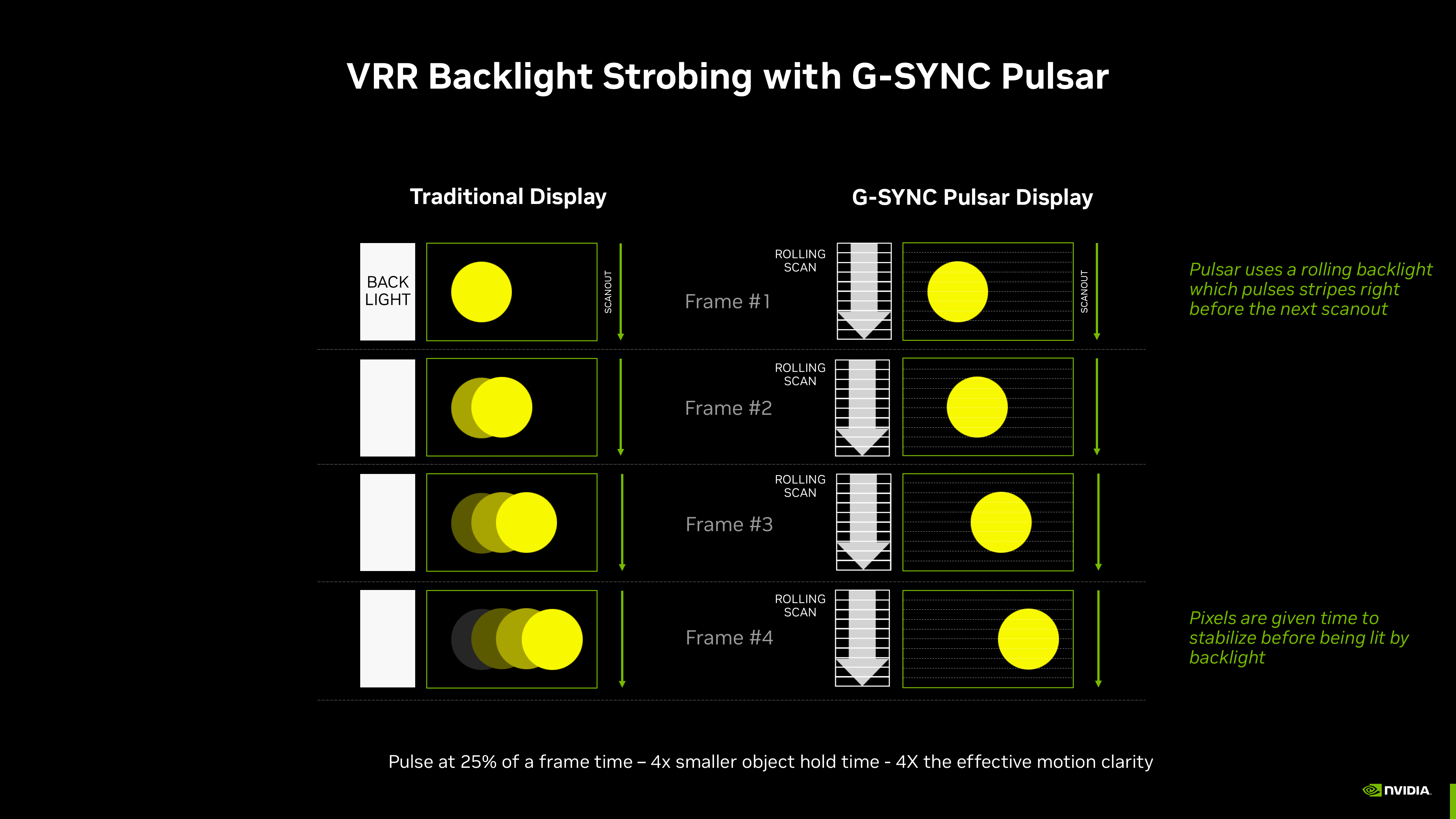
This new tech from Nvidia appears to be a game changer for one of the most annoying quirks of LCD tech, motion blur. It effectively combines VRR + ULMB2 with a rolling pulsed backlight to achieve unheard of motion clarity. Digital Foundry says it is amazing and matches or exceeds existing OLED motion clarity, which is quite the claim. They say that activating also actually INCREASES brightness. Initial rollout of the tech limited the Pulsar functionality to a mimimum of 75 Hz, which DF says Nvidia did out of caution to avoid perceived flicker at lower refreshes, but after Blur Busters and DF both contacted Nvidia and pleaded for lower floor, Nvidia has apparently determined that a floor of 48Hz is possible and agreed to drop the minimum to that refresh in a future FW update. This is amazing news as it will be able to cover all MAME games and emulators for any system ever made.

Currently you have have a Pulsar capable monitor and an Nvidia late model GPU card to get it to work, and it is unclear as to whether this will ever be open sourced and allow for an AMD option. This for me personally, would be one of the best reasons to seriously Nvidia GPUs over AMDs going forward, and I say this as someone who has been perfectly satisfied for the last 10 years or so with AMD GPUs in my personal PCs. This tech, to me, is as revolutionary as the original G-Sync tech pioneered by Nvidia, and removes a major issue inherent to LCD and probably my biggest pet peeve with it.

Image


https://www.nvidia.com/en-us/geforce/ne ... ry-7-2026/

https://www.youtube.com/watch?v=fRxzGyxJIbA
Emerl
Posts: 49
Joined: Tue Jul 16, 2019 3:26 am

Re: Nvidia G-Sync Pulsar LCD Motion Clarity Technology...

Post by Emerl »

I would be strongly considering this if ULMB2 worked with other HDMI devices (like PS5 and RT4k). I understand that Pulsar might require special drivers, but regular strobing being locked to NVidia GPUs is totally unnecessary.
User avatar
Josh128
Posts: 2351
Joined: Thu Jan 16, 2014 9:01 am

Re: Nvidia G-Sync Pulsar LCD Motion Clarity Technology...

Post by Josh128 »

I agree. Im no fan of Nvidias closed source business practices, but at the same time I cant fault them for trying to profit from their inventions. I'd love to see this in action for myself to see if all the hype about it is warranted. From a technical standpoint, it seems like it could be.
User avatar
Kez
Posts: 840
Joined: Thu Jul 20, 2017 7:09 am

Re: Nvidia G-Sync Pulsar LCD Motion Clarity Technology...

Post by Kez »

I am intrigued by this in principle but ultimately contrast is more important to me, so I'll be sticking with OLED for now at least. Hopefully it will evolve and be implemented alongside proper local dimming or in some emissive display tech like OLED.
User avatar
orange808
Posts: 3872
Joined: Sat Aug 20, 2016 5:43 am

Re: Nvidia G-Sync Pulsar LCD Motion Clarity Technology...

Post by orange808 »

LCD can be the right choice for a lot of people. Right now, the tech is both more durable (assuming the rest of the panel's components are well made) and brighter than OLED. I assume the brightness of the LCD panel is what makes this viable. In a bright room, raw nits are more important than pure contrast, so it depends on the use case.

These new displays are a unique new hardware design? It looks like a lot of horizontal bands (zones) of backlight to me. If that's the case, the panel should exhibit better blacks than current local dimming using the rolling backlight?

VRR and BFI together sounds interesting. I'm fascinated by the VRR (or variable blanking period tolerance) and rolling/strobing backlight being used together, because that would normally introduce odd flicker and should create changes in the perceived "brightness" of the image when the refresh rate changes? Adjusting for that sounds like a rabbit hole to me. Maybe I'm missing something, but that's what I would expect to see. I recall one monitor attempted BFI and VRR years ago and it got poor marks in reviews.

Given that LCD is durable and computer monitors get a lot of hours with static images and GUI elements on the screen, this could be really good for both monitors and laptops.
Last edited by orange808 on Wed Jan 14, 2026 3:31 pm, edited 2 times in total.
We apologise for the inconvenience
User avatar
Josh128
Posts: 2351
Joined: Thu Jan 16, 2014 9:01 am

Re: Nvidia G-Sync Pulsar LCD Motion Clarity Technology...

Post by Josh128 »

Kez wrote: Wed Jan 14, 2026 2:36 pm I am intrigued by this in principle but ultimately contrast is more important to me, so I'll be sticking with OLED for now at least. Hopefully it will evolve and be implemented alongside proper local dimming or in some emissive display tech like OLED.
Yeah it seems like the ultimate evolution of this would be a rolling scan of individual mini backlights instead of a full band of them. What I am visualizing is that the LEDs behind black or dark pixels would not be illuminated (or very dimly illuminated depending on the color of the LCD pixel) during each band of rolling scan, thus combining the blur elimination of Pulsar + the contrast improvement of mini LED.

I love my per pixel contrast too, but I still think this is a huge step forward for LCD and cant wait to check it out.
User avatar
Josh128
Posts: 2351
Joined: Thu Jan 16, 2014 9:01 am

Re: Nvidia G-Sync Pulsar LCD Motion Clarity Technology...

Post by Josh128 »

orange808 wrote: Wed Jan 14, 2026 3:27 pm LCD can be the right choice for a lot of people. Right now, the tech is both more durable (assuming the rest of the panel's components are well made) and brighter than OLED. I assume the brightness of the LCD panel is what makes this viable. In a bright room, raw nits are more important than pure contrast, so it depends on the use case.

These new displays are a unique new hardware design? It looks like a lot of horizontal bands (zones) of backlight to me. If that's the case, the panel should exhibit better blacks than current local dimming using the rolling backlight?

VRR and BFI together sounds interesting. I'm fascinated by the VRR (or variable blanking period tolerance) and rolling/strobing backlight being used together, because that would normally introduce odd flicker and should create changes in the perceived "brightness" of the image when the refresh rate changes? Adjusting for that sounds like a rabbit hole to me. Maybe I'm missing something, but that's what I would expect to see. I recall one monitor attempted BFI and VRR years ago and it got poor marks in reviews.

Given that LCD is durable and computer monitors get a lot of hours with static images and GUI elements on the screen, this could be really good for both monitors and laptops.
I havent heard that the actual backlight arrangement of the Pulsar compatible displays is any different from other modern LCDs (not sure if this display is FALD/mini-LED), but rather that there is some dedicated control circuitry on the driver PCB. I could be wrong about that though.
Last edited by Josh128 on Wed Jan 14, 2026 3:34 pm, edited 1 time in total.
User avatar
orange808
Posts: 3872
Joined: Sat Aug 20, 2016 5:43 am

Re: Nvidia G-Sync Pulsar LCD Motion Clarity Technology...

Post by orange808 »

Josh128 wrote: Wed Jan 14, 2026 3:31 pm
Kez wrote: Wed Jan 14, 2026 2:36 pm I am intrigued by this in principle but ultimately contrast is more important to me, so I'll be sticking with OLED for now at least. Hopefully it will evolve and be implemented alongside proper local dimming or in some emissive display tech like OLED.
Yeah it seems like the ultimate evolution of this would be a rolling scan of individual mini backlights instead of a full band of them. What I am visualizing is that the LEDs behind black or dark pixels would not be illuminated (or very dimly illuminated depending on the color of the LCD pixel) during each band of rolling scan, thus combining the blur elimination of Pulsar + the contrast improvement of mini LED.

I love my per pixel contrast too, but I still think this is a huge step forward for LCD and cant wait to check it out.
If the panel is bright enough and the bands small enough, per pixel contrast is probably overkill, no?
We apologise for the inconvenience
User avatar
Josh128
Posts: 2351
Joined: Thu Jan 16, 2014 9:01 am

Re: Nvidia G-Sync Pulsar LCD Motion Clarity Technology...

Post by Josh128 »

orange808 wrote: Wed Jan 14, 2026 3:34 pm
Josh128 wrote: Wed Jan 14, 2026 3:31 pm
Kez wrote: Wed Jan 14, 2026 2:36 pm I am intrigued by this in principle but ultimately contrast is more important to me, so I'll be sticking with OLED for now at least. Hopefully it will evolve and be implemented alongside proper local dimming or in some emissive display tech like OLED.
Yeah it seems like the ultimate evolution of this would be a rolling scan of individual mini backlights instead of a full band of them. What I am visualizing is that the LEDs behind black or dark pixels would not be illuminated (or very dimly illuminated depending on the color of the LCD pixel) during each band of rolling scan, thus combining the blur elimination of Pulsar + the contrast improvement of mini LED.

I love my per pixel contrast too, but I still think this is a huge step forward for LCD and cant wait to check it out.
If the panel is bright enough and the bands small enough, per pixel contrast is probably overkill, no?
I dont think per pixel contrast is necessary on these, I was just referencing emissive panel tech. But I do think that to improve contrast you would have to have "gaps" in the lit horizontal band of backlights where dark pixels are. If you just light everything in the stripe, you still have the same contrast issues as a non FALD LCD display. You wouldnt need LED per pixel, but say if you had 100 leds per stripe, dont illuminate, or modulate the illumination of those behind dark or black areas of the image in that stripe, just like FALD is currently done.
User avatar
Kez
Posts: 840
Joined: Thu Jul 20, 2017 7:09 am

Re: Nvidia G-Sync Pulsar LCD Motion Clarity Technology...

Post by Kez »

orange808 wrote: Wed Jan 14, 2026 3:27 pm LCD can be the right choice for a lot of people.
Yeah totally, I still use LCDs for a lot of stuff but I really appreciate true blacks when gaming and I am not super sensitive to motion blur except on very fast scrolling stuff where I do find BFI quite nice.
orange808 wrote: Wed Jan 14, 2026 3:27 pm These new displays are a unique new hardware design? It looks like a lot of horizontal bands (zones) of backlight to me. If that's the case, the panel should exhibit better blacks than current local dimming using the rolling backlight?
My understanding (happy to be corrected) is that the rolling backlight is essentially a fixed brightness, and the zones are exclusively used for this strobing feature. So functionally it is just a global backlight with no local dimming. It doesn't seem unreasonable that this could eventually work in tandem with local dimming though.
orange808 wrote: Wed Jan 14, 2026 3:27 pm I'm fascinated by the VRR (or variable blanking period tolerance) and rolling/strobing backlight being used together, because that would normally introduce odd flicker and should create changes in the perceived "brightness" of the image when the refresh rate changes? Adjusting for that sounds like a rabbit hole to me. Maybe I'm missing something, but that's what I would expect to see. I recall one monitor attempted BFI and VRR years ago and it got poor marks in reviews.
It is intriguing, ostensibly these are the very problems that Pulsar solves and by all accounts it does work. I wonder if flickering still creeps in with particularly unstable framerates, like when CPU bound or something. Hardly a dealbreaker though as VRR kinda sucks in that scenario anyway.
User avatar
Guspaz
Posts: 3242
Joined: Tue Oct 06, 2015 7:37 pm
Location: Montréal, Canada

Re: Nvidia G-Sync Pulsar LCD Motion Clarity Technology...

Post by Guspaz »

orange808 wrote: Wed Jan 14, 2026 3:27 pmLCD can be the right choice for a lot of people. Right now, the tech is both more durable (assuming the rest of the panel's components are well made) and brighter than OLED.
For monitors, yes. For TVs, no. Very very no. RTINGS longevity testing has demonstrated that modern LCD TVs fail at pretty absurdly high rates, enough that they may fail before an OLED would have burned in. And it's not just edge-lit TVs either.
orange808 wrote: Wed Jan 14, 2026 3:27 pmThese new displays are a unique new hardware design? It looks like a lot of horizontal bands (zones) of backlight to me. If that's the case, the panel should exhibit better blacks than current local dimming using the rolling backlight?
Pulsar is not compatible with local dimming, so the perceived black levels will be the same as if Pulsar wasn't used. Because each band of the backlight is being lit much brighter than it otherwise would be so that you don't perceive a drop in brightness versus pulsar being off. So to the eye, it's equivalent to the entire backlight being on at the same time. You'd still need local dimming inside the band to get the improved contrast.
orange808 wrote: Wed Jan 14, 2026 3:27 pmVRR and BFI together sounds interesting. I'm fascinated by the VRR (or variable blanking period tolerance) and rolling/strobing backlight being used together, because that would normally introduce odd flicker and should create changes in the perceived "brightness" of the image when the refresh rate changes? Adjusting for that sounds like a rabbit hole to me. Maybe I'm missing something, but that's what I would expect to see. I recall one monitor attempted BFI and VRR years ago and it got poor marks in reviews.
I don't know exactly what Pulsar is doing, but since they're already clearly driving the backlight waaaaay harder for this to work, they can correct for any perceived changes in brightness by varying the backlight intensity with the scanout speed. I know that the complexity of managing this for OLED panels on a per-subpixel and per-frame basis is why no mobile (phone, tablet, laptop) OLED display supports VRR. They all fake it in various ways. In the case of phones, by just switching between a small number of pre-defined refresh rates that they've pre-calculated all the PWM tables for, and in the case of laptops by pretending that a high refresh rate panel is a VRR display (a laptop might have a 960 Hz display that pretends to be a 240 Hz display so that the differences in frame times and pacing aren't noticeable). So maybe that's why they're requiring GPU-side support for this, to do the calculations. That said, I'd expect the calculations for this to be dramatically simpler than for an OLED, because instead of per-subpixel, you only need to do it per backlight band, and the image brightness wouldn't matter...
User avatar
Josh128
Posts: 2351
Joined: Thu Jan 16, 2014 9:01 am

Re: Nvidia G-Sync Pulsar LCD Motion Clarity Technology...

Post by Josh128 »

Guspaz wrote: Thu Jan 15, 2026 3:23 am

I don't know exactly what Pulsar is doing, but since they're already clearly driving the backlight waaaaay harder for this to work, they can correct for any perceived changes in brightness by varying the backlight intensity with the scanout speed. I know that the complexity of managing this for OLED panels on a per-subpixel and per-frame basis is why no mobile (phone, tablet, laptop) OLED display supports VRR. They all fake it in various ways. In the case of phones, by just switching between a small number of pre-defined refresh rates that they've pre-calculated all the PWM tables for, and in the case of laptops by pretending that a high refresh rate panel is a VRR display (a laptop might have a 960 Hz display that pretends to be a 240 Hz display so that the differences in frame times and pacing aren't noticeable). So maybe that's why they're requiring GPU-side support for this, to do the calculations. That said, I'd expect the calculations for this to be dramatically simpler than for an OLED, because instead of per-subpixel, you only need to do it per backlight band, and the image brightness wouldn't matter...
Care to elaborate on this? OLED does not need to modulate brightness with VRR as it is a sample and hold technology. As the framerate increases or decreases, the image is just held longer without updating, there is no blank period between refreshes which would require any brightness adjustment.

BFI is not currently compatible with VRR, but thats solely due to perceivable flicker below a the 120Hz threshold. Technically theres no reason it cant be used in a VRR range above 120Hz. The reason its not is that it would need to turn on and off if you dip above and below that range. Turning it off WOULD DEFINITELY require lowering the brightness of the lit pixels.
Emerl
Posts: 49
Joined: Tue Jul 16, 2019 3:26 am

Re: Nvidia G-Sync Pulsar LCD Motion Clarity Technology...

Post by Emerl »

OLED gamma changes depending on frametime, hence the problem of near-black flicker on OLEDs using VRR.
User avatar
BazookaBen
Posts: 2159
Joined: Thu Apr 17, 2008 8:09 pm
Location: North Carolina

Re: Nvidia G-Sync Pulsar LCD Motion Clarity Technology...

Post by BazookaBen »

Monitors Unboxed and Digital Foundry had videos that explained this a little bit, but the LCD prevents perceptible flicker in a few ways:

It controls the pulse duration, but it also reserves the ability to do a smaller second strobe in the event there is a large drop in frame rate. And then it will quickly taper off that secondary strobe and increase the duration of the first strobe. At least that's how I understood it.

The issue of brightness is probably woven into that calculation as well.

It seems they really nailed it though, based on the impressions I've seen.

I don't feel like we'll see this on OLED for a few years though. They probably want to do locally dimmed LCD before that.
User avatar
Guspaz
Posts: 3242
Joined: Tue Oct 06, 2015 7:37 pm
Location: Montréal, Canada

Re: Nvidia G-Sync Pulsar LCD Motion Clarity Technology...

Post by Guspaz »

Josh128 wrote: Fri Jan 16, 2026 3:01 pmCare to elaborate on this? OLED does not need to modulate brightness with VRR as it is a sample and hold technology. As the framerate increases or decreases, the image is just held longer without updating, there is no blank period between refreshes which would require any brightness adjustment.

BFI is not currently compatible with VRR, but thats solely due to perceivable flicker below a the 120Hz threshold. Technically theres no reason it cant be used in a VRR range above 120Hz. The reason its not is that it would need to turn on and off if you dip above and below that range. Turning it off WOULD DEFINITELY require lowering the brightness of the lit pixels.
My understanding is that OLED panels use PWM for control, and the PWM parameters (frequency and duty cycle) need to change based on the refresh interval and pixel value on a per-subpixel basis, with a bunch of other constrains (like avoiding OLED VRR flicker). This is computationally intensive (it's a lot of subpixels per second), and you can't pre-calculate it, because the VRR range of a display is continuous. That is, a monitor that supports 40 Hz to 120 Hz does not have only 80 possible refresh rates, there are essentially an infinite number of possible frame times in that range. Mobile devices can't afford to burn battery life doing these calculations, but mains-powered devices can.

So, mobile VRR devices just cheat. Smartphones focus on bypassing the "infinite number of possible frame times" part of the problem by just pre-calculating the parameters for a fixed limited number of possible refresh rates, and switch between them. That's fine for them because they want to use VRR to save power when the display doesn't need to be update as often, but it's not true VRR.

Laptops want something that seems more like true VRR, so they fake it by just using a faster fixed refresh rate display. So you have a laptop with a VRR 240 Hz OLED panel... it's actually (at least in the case of the Asus G16) secretly a fixed-refresh 960 Hz OLED panel that just repeats the frame as many times as required to approximate what the VRR input signal is asking for. This way, they actually only need to worry about one possible refresh rate. The side effect is that your VRR frametimes will always be multiples of ~1.04 milliseconds (for their 240 Hz model, since their 120 Hz model is secretly a 480 Hz fixed-rate display), but the idea is that the variation in frametime is so small that you wouldn't notice.
User avatar
Bahn Yuki
Posts: 237
Joined: Thu Oct 15, 2015 11:33 pm
Location: Salem OR
Contact:

Re: Nvidia G-Sync Pulsar LCD Motion Clarity Technology...

Post by Bahn Yuki »

I purchased the Asus one from Newegg as soon as they dropped, unfortunately I returned it the same day. While Gsync Pulsar is interesting tech, the first panels they released are subpar. Awful IPS contrast, a matte screen and 27" 1440p/360hz in a very "cheap" feeling cabinet for $650 isn't a good start. In my testing Pulsar indeed works and shows noticable improvement in motion clarity. I tried a myriad of scenarios and Pulsar is promising and hopefully becomes the standard for LCD gaming monitors for the future.

If the Asus monitor was $350 instead of $650 I would contemplated on keeping it, however at this price you're now entering OLED monitor territory. It might not get as clear, but the other factors such as contrast, viewing angles and color saturation cannot be beaten. What sealed the deal for me was putting the Pulsar monitor up against my SONY HD CRT. It wasn't even close, granted NVIDIA has stated that they are looking into a firmware update which will lower the Pulsar floor down to 48hz. But just looking at 60hz content on the HDCRT vs 360hz Pulsar, the CRT still looked better.

At least we're getting closer. CRTs are not going to be around forever and this technology finally brings us into the ballpark, just not worth it at the steep price they're currently asking for.
LG 83C1(OLED),LG 42C2(OLED),TCL 75R635(MiniLED),Apple Studio Monitor 21(PCCRT),SONY 34XBR960(HDCRT)
SONY 32XBR250,Samsung UBJ590(LED),Panasonic P50VT20(Plasma),JVC NZ8
User avatar
Guspaz
Posts: 3242
Joined: Tue Oct 06, 2015 7:37 pm
Location: Montréal, Canada

Re: Nvidia G-Sync Pulsar LCD Motion Clarity Technology...

Post by Guspaz »

It is ultimately still an IPS LCD panel, and will suffer from all of the normal problems they have, except for (with Pulsar) pixel response times. You still get terrible contrast ratios, IPS glow, backlight bleed, backlight uniformity issues, etc.

Ultimately, until and unless something better becomes practical to replace OLEDs (microled or QDEL are the two main candidates), I believe that the future of improving motion clarity will be through improved BFI on OLED displays and for more modern gaming content, frame generation technologies. As far as I know, there is nothing stopping something like Pulsar from being done with OLED at the display controller/driver level. Brightness is a factor, of course, but limitations for BFI in that regard seem to be more a factor of existing OLED BFI implementations being more like simple hacks than proper solutions. For example, if SDR is 150 nits, and an OLED panel can do 2,000 nits in a 10% window (which the LG G5 can do), then doesn't that give us the chance to do something like a 13:1 or greater BFI ratio with a rolling BFI solution with no loss in perceived SDR brightness?
Post Reply