I noticed this a while ago, but it seems that Viletim didn't advertise as he did with the NESRGB, thanks RGB32E for pointing this out. So lets start a separate thread to discuss this new device.
Here are a couple of observations that I see right from the start:
*Build using a CPLD (not FPGA) brings costs down by a lot - but not software upgradable by end user (right?)
*Works with any N64 system - THIS IS HUGE
*RGB amp on-board - no more messing around with different capacitors/resistors to try and figure out what is best for the N64
*CS# / RAW Sync output!!! Send this to pin 4 of the multi-AV output and your more sensitive RGB monitors will be happy
What I'd like to find out is what is the recommended SCART cable for NTSC/USA users. My current SCART cable has only 220ohm caps on the R, G and V lines and uses V (composite video) for sync into my PVM.
I assume the 75ohm resistors are on that N64RGB PCB but what about the caps? I typically remove the 220 ohm caps from the NESRGB as the above cable is the "standard" way most 3rd party vendors make their NTSC SCART cables for US customers.
BuckoA51 wrote:Would be if there wasn't already a 100% compatible mod available for some time from Otaku Store Clean sync output is a good addition though.
At what cost? This item is only 40$AU or about 35$US. That's only 10$ or so more than a lot of the RGB amps sold around the net. For only 10$ you get A LOT more.
UPDATE: Otaku store wants 47.90 Euro for their mod. This is equivalent to almost 69$AU! WOW! 72% more for Otaku!?
As for the programming pins, you're right! Take a look at the pads on the upper right corner which have no labels. Hmmm.. Yet another bonus!
Voultar wrote:I'd like to see how this contends against a VDC-NUS N64, using the standard run-of-the-mill RGB amp.
We'll probably see comparison video's pop-up now that it's out.
I wonder this as well. I created a circuit a while back with his old XC9536XL CPLD solution, while picture was great (Even better now from the sounds of it), i ended up with jailbars when installed and i don't think it was installation fault or circuit design, though i did try to keep things neat, short and spaced out. Maybe it was his old code that caused it?. In the link below, a user also said it was a cap issue and recapping the PSU did the trick. So if any case if this issue happens with the new board, try recapping the PSU.
leonk wrote:I noticed this a while ago, but it seems that Viletim didn't advertise as he did with the NESRGB
I thought I'd just put it in the shop and see if anybody notices.
leonk wrote:What I'd like to find out is what is the recommended SCART cable for NTSC/USA users. My current SCART cable has only 220ohm caps on the R, G and V lines and uses V (composite video) for sync into my PVM.
I assume the 75ohm resistors are on that N64RGB PCB but what about the caps? I typically remove the 220 ohm caps from the NESRGB as the above cable is the "standard" way most 3rd party vendors make their NTSC SCART cables for US customers.
It will work fine with a straight through cable (no extra components). A cable with a series capacitor on each video line (Gamecube) will work just as well. The video driver doesn't require the caps but adding them does no harm. If you want to use the PAL SNES cable with the extra termination resistors then you can short the three jumpers on the board and it will be compatible.
Voultar wrote:I'd like to see how this contends against a VDC-NUS N64, using the standard run-of-the-mill RGB amp.
To me it looks pretty much the same as the early model N64 + video amp.
As Viletim says it looks almost identical to the standard 'early N64 + THS7314 amp' mod. The benefit is that the output is not overly bright like the standard amp mod which is a huge plus. The standard method seems to result in clipping of the signal that makes the greens look garish in particular (I have 3 and they are all the same).
leonk wrote:I noticed this a while ago, but it seems that Viletim didn't advertise as he did with the NESRGB, thanks RGB32E for pointing this out. So lets start a separate thread to discuss this new device.
Here are a couple of observations that I see right from the start:
*Build using a CPLD (not FPGA) brings costs down by a lot - but not software upgradable by end user (right?)
*Works with any N64 system - THIS IS HUGE
*RGB amp on-board - no more messing around with different capacitors/resistors to try and figure out what is best for the N64
*CS# / RAW Sync output!!! Send this to pin 4 of the multi-AV output and your more sensitive RGB monitors will be happy
This is wonderful news, this should get rid of all those bread board mods that don't look professional.
I do have a question thou about the RAW sync, which pin is the RAW sync? Is it the CS# which in the installation guide it says not to hook it up to since its TTL or is it the CS75#?
leonk wrote:I noticed this a while ago, but it seems that Viletim didn't advertise as he did with the NESRGB, thanks RGB32E for pointing this out. So lets start a separate thread to discuss this new device.
Here are a couple of observations that I see right from the start:
*Build using a CPLD (not FPGA) brings costs down by a lot - but not software upgradable by end user (right?)
*Works with any N64 system - THIS IS HUGE
*RGB amp on-board - no more messing around with different capacitors/resistors to try and figure out what is best for the N64
*CS# / RAW Sync output!!! Send this to pin 4 of the multi-AV output and your more sensitive RGB monitors will be happy
Natch, this happens right after I get mine modded. I'm happy with the job and that mine was compatible with the 'normal' mod but would have liked CSYNC and clean-lookin' thing like this. Glad for everybody else with later-model N64s that have this option now though!
zakruowrath wrote:I do have a question thou about the RAW sync, which pin is the RAW sync? Is it the CS# which in the installation guide it says not to hook it up to since its TTL or is it the CS75#?
Both. The CS75# is 75 ohm impedance - good for your SCART TV hook-up. TTL is useful for RGB monitors that are a bit more sensitive and need higher impedance.
leonk wrote:What I'd like to find out is what is the recommended SCART cable for NTSC/USA users. My current SCART cable has only 220ohm caps on the R, G and V lines and uses V (composite video) for sync into my PVM.
I assume the 75ohm resistors are on that N64RGB PCB but what about the caps? I typically remove the 220 ohm caps from the NESRGB as the above cable is the "standard" way most 3rd party vendors make their NTSC SCART cables for US customers.
An Official PAL GameCube RGB SCART cable. Installed the same RGB amp as I installed into my Duo R as my N64, using luma for sync (no c-sync circuit) the image is what I would expect of stock.
This solution is great in that you don't have to be concerned about the motherboard revision of the N64 though.
zakruowrath wrote:I do have a question thou about the RAW sync, which pin is the RAW sync? Is it the CS# which in the installation guide it says not to hook it up to since its TTL or is it the CS75#?
Both. The CS75# is 75 ohm impedance - good for your SCART TV hook-up. TTL is useful for RGB monitors that are a bit more sensitive and need higher impedance.
Ah ok that makes a lot of sense
I have another question now. Would the 75ohm impedance or the TTL be better for the XRGB Mini being the TTL as you said is for RGB monitors.
spaceape wrote:Will NTSC RGB cables work with the N64RGB?
there's no such thing as "NTSC RGB cables" .. do you mean SNES SCART PAL cables?
Sure there is, Nintendo released official SCART (Jap21) cables over the pond.
PAL consoles lack the 75ohm termination on the RGB outputs.
NTSC-J/U consoles (for the most part) are already properly terminated, but lack the caps. I believe this is what SpaceApe is referring to.
Yes for my NTSC Console. retrogamingcables.co.uk for example has SNES cables for both pal and ntsc for sale. http://www.retrogamingcables.co.uk/stor ... tendo.html. Im guessing that both will work since the shop writes "compatible with all SNES and Gamecube RGB cables." but since Tim is from a pal region himself maybe he only tried cables for this particular region.
The info page he links to also confuses me a bit: http://etim.net.au/n64rgb . It writes "The board supports both (PAL) Super Nintendo RGB SCART and Gamecube RGB SCART cables.".
Also in the installation guide he writes "This is the configuration for a Gamecube SCART cable. If you are intending to use a (PAL) Super Nintendo SCART cable you must add a blob of solder across jumpers J1, J2, J3 on the N64RGB board."
No mention of the NTSC cables so i was just wondering.
Last edited by spaceape on Wed Oct 29, 2014 10:13 pm, edited 2 times in total.
spaceape wrote:Will NTSC RGB cables work with the N64RGB?
there's no such thing as "NTSC RGB cables" .. do you mean SNES SCART PAL cables?
Japan is NTSC. They made RGB cables for the Super Famicom.
Please reread the original msg. He asked about "NTSC rgb cables". I was the one who suggested SNES and SCART. I just wanted to know more info on the cable he currently has.
spaceape wrote:
The info page he links to also confuses me a bit: http://etim.net.au/n64rgb . It writes "The board supports both (PAL) Super Nintendo RGB SCART and Gamecube RGB SCART cables.". No mention of the NTSC cables so i was just wondering.
That's because (outside the extreme niche community we're in) there's no such thing as NTSC USA SCART. We simply don't have SCART TVs. A majority of enthusiasts follow the Euro pin out but use cables modified for NTSC.
If you look at the board pic you'll see that the PCB has resistors but no caps. So for USA NTSC users, a SCART cable only with caps in it, syncing on composite video will work.
This is what the popular SNes retro console accessories cables are.
Personally, I find it cool that a single SCART rgb cable now works on my NESRGB, snes mini and n64!
spaceape wrote:
The info page he links to also confuses me a bit: http://etim.net.au/n64rgb . It writes "The board supports both (PAL) Super Nintendo RGB SCART and Gamecube RGB SCART cables.". No mention of the NTSC cables so i was just wondering.
That's because (outside the extreme niche community we're in) there's no such thing as NTSC USA SCART. We simply don't have SCART TVs. A majority of enthusiasts follow the Euro pin out but use cables modified for NTSC.
If you look at the board pic you'll see that the PCB has resistors but no caps. So for USA NTSC users, a SCART cable only with caps in it, syncing on composite video will work.
This is what the popular SNes retro console accessories cables are.
Personally, I find it cool that a single SCART rgb cable now works on my NESRGB, snes mini and n64!
Alright so the "modified for ntsc scart" cables work it sounds like. Happy to hear that. On the NESRGB you had to solder some jumpers for pal or ntsc but no mention of this with this board.
All my SNES cables from retrogamingcables are with raw sync but pretty sure Tim has this covered as well. Im just Nitpicking here i know.
Unless these cables are carrying an NTSC signal (like composite or s-video) then it's just RGB. RGB isn't NTSC or PAL, though it can carry the same number of fields per second / lines per field.
zakruowrath wrote:I have another question now. Would the 75ohm impedance or the TTL be better for the XRGB Mini being the TTL as you said is for RGB monitors.
I want to say you would be fine with either, but perhaps the 75 ohm would be the best choice.
spaceape wrote:
The info page he links to also confuses me a bit: http://etim.net.au/n64rgb . It writes "The board supports both (PAL) Super Nintendo RGB SCART and Gamecube RGB SCART cables.". No mention of the NTSC cables so i was just wondering.
That's because (outside the extreme niche community we're in) there's no such thing as NTSC USA SCART. We simply don't have SCART TVs. A majority of enthusiasts follow the Euro pin out but use cables modified for NTSC.
If you look at the board pic you'll see that the PCB has resistors but no caps. So for USA NTSC users, a SCART cable only with caps in it, syncing on composite video will work.
This is what the popular SNes retro console accessories cables are.
Personally, I find it cool that a single SCART rgb cable now works on my NESRGB, snes mini and n64!
Alright so the "modified for ntsc scart" cables work it sounds like. Happy to hear that. On the NESRGB you had to solder some jumpers for pal or ntsc but no mention of this with this board.
All my SNES cables from retrogamingcables are with raw sync but pretty sure Tim has this covered as well. Im just Nitpicking here i know.
Wow. Are you sure about that? how is raw sync fed? Does it get it from pin 3 of the multiav or does it have an LM1881 in the SCART connector and require 5V on pin 10? If I'm not mistaken, pin 3 and 10 are not connected in N64 USA consoles (or snes)
Check for continuity on pin 20 of the SCART to other pins on the multiAV. Mine have going to pin 9 = composite out = composite sync.
leonk wrote:If I'm not mistaken, pin 3 and 10 are not connected in N64 USA consoles (or snes)
They most definitely are on the SNES and NUS-CPU-03 revision of the N64. Hell, pin 10 is connected on all N64s because the external RF modulator requires it.
leonk wrote:Wow. Are you sure about that? how is raw sync fed? Does it get it from pin 3 of the multiav or does it have an LM1881 in the SCART connector and require 5V on pin 10? If I'm not mistaken, pin 3 and 10 are not connected in N64 USA consoles (or snes)
Check for continuity on pin 20 of the SCART to other pins on the multiAV. Mine have going to pin 9 = composite out = composite sync.
No im not sure. Just guessing, need Tim to clarify if both pal and ntsc cables work. I just concluded it based on the minute differences you said the different types of cables had and Tim mentioning that all cables would work on his page.
My own raw sync should come from the dedicated sync circuit on the N64 itself (i have a US CPU-3). I use no sync stripper cable. I use a XRGB-3 so don't think i need the 5v. Sorry im not aware how it all is connected as i didn't make the mod myself but i do know it has an THS7314 RGB amp.
Well my question were for the N64RGB only but always good to get educated. Thanks.
Tim already said above that cables with caps in them (aka pal gamecube and NTSC snes) work fine:
"A cable with a series capacitor on each video line (Gamecube) will work just as well. The video driver doesn't require the caps but adding them does no harm."
mickcris wrote:Tim already said above that cables with caps in them (aka pal gamecube and NTSC snes) work fine:
"A cable with a series capacitor on each video line (Gamecube) will work just as well. The video driver doesn't require the caps but adding them does no harm."
leonk wrote:
Wow. Are you sure about that? how is raw sync fed? Does it get it from pin 3 of the multiav or does it have an LM1881 in the SCART connector and require 5V on pin 10? If I'm not mistaken, pin 3 and 10 are not connected in N64 USA consoles (or snes)
Check for continuity on pin 20 of the SCART to other pins on the multiAV. Mine have going to pin 9 = composite out = composite sync.
Pin 3 is definitely connected to the multi out in my original 1996 US NUS-001. I did the THS 7314 mod with 75ohm resistors and am using C Sync without a sync stripper. I simply opened up the console side of my Ebay purchased SNES NTSC RGB SCART cable and moved the wire soldered to pin 9 over to pin 3. Works fine. No other mods needed. Once I enabled C Sync out on my SNES 2, the same cable works perfectly on it as well.
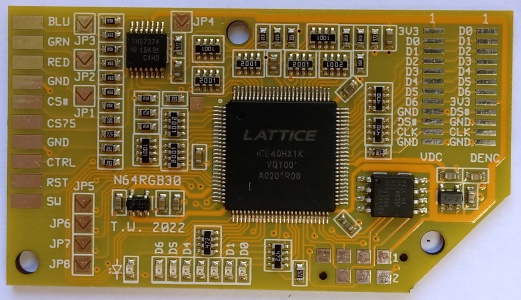


 Clean sync output is a good addition though.


