Soul Star, Galaxy Force, Scaling & Rotation, PCE,SNES &a
-
elvis

- Posts: 984
- Joined: Fri Nov 04, 2005 10:42 pm
- Location: Brisbane, Australia
Thanks for clarifying. I did not know that.AirRaidX wrote: elvis - as I said, there is a dedicated ASIC chip in MegaCD / SegaCD that handles scaling & rotation in hardware. that's in addition to the extra 12.5 MHz 68000 in the MegaCD/SegaCD.
http://www.consoledatabase.com/consolei ... index.html
Anybody got some hardware specs on this IC?
-
AirRaidX
- Posts: 75
- Joined: Sat Mar 18, 2006 8:53 pm
the 32X AfterBurner might even have been emulation. wether it was a port or an emulation, the 32X version runs at about roughly HALF the framerate of the Arcade, Saturn, Dreamcast and Xbox versions. the 32X version is just NOT as smooth and is also more pixelated-- Although it does seem to keep all of the graphics and audio of the arcade, it just does not run as smoothly--- although it is a huge improvement over the standard Genesis ABII, and even the SegaCD's "AfterBurner III" which is really a conversion of the arcade Strike Fighter.Specineff wrote:The 32X version of AB 2 was ported directly from the board's code. There's a trick that gets you into the test menu, in which you can adjust the tilt of the cabinet. So you don't really need to wait for the PS2 release.
Too bad they didn't do Galaxy Force on the 32X. It should have been able to handle it just fine.
The best versions of AfterBurner II to play at home (aside from MAME or FinalBurn emulation) are the ones in Dreamcast Shenmue II, Dreamcast Yu Suzuki Game Works Vol 1 (same as DC Shenmue II) and Xbox Shenmue II. the Saturn verison is also exellent. all provide smooth framerates, like the arcade, and unlike the 32X version.
the funny thing is, Saturn Galaxy Force II is only about as smooth as the 32X AfterBurner, but Saturn Galaxy Force II has more framerate problems with dips below 30fps..
both 32X and Saturn hardware totally outclass the arcade boards that powered AfterBurner II (X Board Hardware with twin 68000s) and Galaxy Force II (Y Board Hardware with triple 68000s), but the ports/emulations did not provide arcade speed/smoothness.
if carefully programmed, I would like to think that the 32X could've handled ANY of Sega's multi 68000 "Super Scaler" arcade games of the 1980s at full speed. however, even Rutubo Games, who did an exellent job for the most part, did not get AfterBurner II running at full speed/smoothness on 32X (although they pretty much did on Saturn)
the Playstation2 release of AfterBurner II which came out in 2004 in Japan, is a 3D polygon remake. I've never played it, but would dearly love to try it. the Playstation2 Galaxy Force II which has yet to be released, is meant to be a straight port without 3D upgraded graphics, AFAIK.
I also want to commend Sharp/SPS for their little-seen but exellent effort on the X68000 translation of ThunderBlade. given that X68000 is not nearly as powerful as Sega's System X hardware with twin 68000s and Super Scaler technology that runs arcade TB/ABII/Super Monaco GP, and that X68000 lacks hardware scaling, Sharp/SPS did an outstanding job capturing the look and feel of arcade game, even though it's not as smooth as the arcade (maybe 50%) and most definitally not arcade quality much less "arcade perfect", it still it blows the Amiga, PC-Engine ThunderBlade and Genesis Super Thunder Blade out of the water.
From what I recall, the X68000 ThunderBlade is a better translation than X68000 AfterBurner II or Space Harrier. Thunder Blade on X68000 is like getting a straight translation of the arcade that is about 50% in graphics/smoothness, which is an awesome achivement given that the PC-Engine barely manages 10%, the Master System 5% and Genesis STB is a totally different game.
http://i15.ebayimg.com/03/i/02/7d/0e/89_1.JPG
http://spacemul.emu-france.com/images/S ... /19915.png
http://spacemul.emu-france.com/images/S ... /19915.png
http://spacemul.emu-france.com/images/S ... /19915.png
Last edited by AirRaidX on Tue Mar 28, 2006 9:51 pm, edited 3 times in total.
-
Specineff

- Posts: 5806
- Joined: Wed Jan 26, 2005 12:54 am
- Location: Ari-Freaking-Zona!
- Contact:
-
AirRaidX
- Posts: 75
- Joined: Sat Mar 18, 2006 8:53 pm
I learned early on to never, ever , ever trust GameFan when it came to what they said about home versions being "arcade perfect". Now to be fair, compared to the Genesis and every other home version of After Burner II, the 32X version *was* basicly just like the arcade. It was a massive, massive leap over any previous home version. including X68000 and FM Towns versions (which I had never seen but would later turn out to be not as good as the arcade). 32X AfterBurner *was* pretty much the arcade, with all the scaling & rotation and intense detailed graphics and speed (not to be confused with framerate) but when closely scrutinized, it can been shown to be not as smooth as the arcade, with only about 1/2 the framerate, and the graphics are noticably more pixelated.Specineff wrote:Thanks for the eye opener, AirRaid. I was under the impression, (and thanks to Gamefan's review) that it was a perfect port since it used the arcade code. What about 32X space harrier? I couldn't find any difference between that and Shenmue's SH.
The Saturn AfterBurner II that came out 2 years later in Japan, in 1996, (1997 in the U.S.) was the first version of the game that was on par with the arcade in every way, even if not 100% absolutely exact.
32X Space Harrier is very close to the arcade, pretty much arcade quality, (where X68000 version is not) but a little bit below the Saturn version, and the Dreamcast version in Shenmue, Shenmue II, Yu Suzuki Game Works and Xbox Shenmue II. There are probably people that can offer a more detailed review of 32X Space Harrier compared to the arcade and more recent home versions. I think 32X ver had borders on the top and bottem of the screen.
I might even be tempted to say 32X Space Harrier is closer to the arcade than 32X AfterBurner.
but neither are "arcade perfect"... Yet, they do give you home versions of the games that were not massively downgraded as earlier translations were.
-
Specineff
- Posts: 5806
- Joined: Wed Jan 26, 2005 12:54 am
- Location: Ari-Freaking-Zona!
- Contact:
Just tried NightStriker on SCD via emulation.
The scaling seems a bit faster and smoother than that of Soulstar, if the resolution is quite decreased. Even non-scaled objects look somewhat pixilated/grainy, due to the lower resolution of the Genny. Not quite as nice as the arcade, but still a decent conversion. I'm sure the Saturn version looks better. I remember playing the original via emulation on the Box, and yup, the SCD version is a bit inferior, but again, decent. As a point of comparison, Space Harrier 32X has smoother framerate and higher resolution.
You get the option of original or arranged soundtrack, disable the auto-center feature found in the original arcade, and even an option to use an analog controller. (WTF? Analog on the Genny?)
Worth just to show off what the Sega CD can do in terms of scaling.
The scaling seems a bit faster and smoother than that of Soulstar, if the resolution is quite decreased. Even non-scaled objects look somewhat pixilated/grainy, due to the lower resolution of the Genny. Not quite as nice as the arcade, but still a decent conversion. I'm sure the Saturn version looks better. I remember playing the original via emulation on the Box, and yup, the SCD version is a bit inferior, but again, decent. As a point of comparison, Space Harrier 32X has smoother framerate and higher resolution.
You get the option of original or arranged soundtrack, disable the auto-center feature found in the original arcade, and even an option to use an analog controller. (WTF? Analog on the Genny?)
Worth just to show off what the Sega CD can do in terms of scaling.
Don't hold grudges. GET EVEN.
-
welcometoyourdoom

- Posts: 45
- Joined: Tue May 31, 2005 12:45 pm
Yes. If I remember correctly there was an analog controller of some sort released in Japan for the MD version of Afterburner II. It was called the XE1-AP "batwing" or something like that. Apparently only a few games supported it...maybe AB II and NS are the only ones.Specineff wrote:WTF? Analog on the Genny?
As for scaling on the Neo Geo, it most definitely did scaling in hardware, though no rotation. What made the scaling in Neo games (usually) look so much better than SNES or Sega CD was that the large cartridge sizes allowed Neo programmers to start with a detailed, large image and then scale that down. Then when it was scaled back to full size, it looked detailed and sharp. Usually, but not always, on Sega CD and especially on SNES, a lower-resolution sprite/bitmap/background/whatever was used, so that when scaled up, it looked really pixellated. I'm pretty sure this is a memory issue, since doubling the resolution of an image basically quadruples its size, memory-wise.
I have played the PSX Night Striker, and from what I can remember it was near-perfect, except for some loading and the road scrolling strangely in the tunnel sections between levels.
-
ccovell

- Posts: 203
- Joined: Mon Feb 14, 2005 3:03 am
- Location: Japan
- Contact:
It's nice to get into a discussion about scaling and other effects. So let me add my perception of the SNES' and Neo-Geo's scaling. True, some games used a very small map for the SNES mode 7 effect, but the Mode 7 map was in fact quite large. If used fully, the Mode 7 map could stretch over several screens (like Stage 2 in Space Megaforce).
As for the Neo-Geo, the scaling was sometimes smooth, but I always felt it looked like a different type of scaling than the SNES. The NG's scaling seemed a bit jerky or it seemed as if scaling was done inside the graphic tiles first. I can't explain it well, but the NG's scaling seemed less smooth than the SNES. Can anybody who knows technically how the NG's scaling is done put in their opinions?
As for the Neo-Geo, the scaling was sometimes smooth, but I always felt it looked like a different type of scaling than the SNES. The NG's scaling seemed a bit jerky or it seemed as if scaling was done inside the graphic tiles first. I can't explain it well, but the NG's scaling seemed less smooth than the SNES. Can anybody who knows technically how the NG's scaling is done put in their opinions?
http://www.chrismcovell.com
Chris' Journey
Chris' Journey
-
D

- Posts: 3853
- Joined: Tue Feb 01, 2005 3:49 pm
- Location: Almere, Netherlands
- Contact:
What? the mega CD has hardware scaling? WTF?
Why did those #@$^%#$%^magazines in the 90's always talked bad about Sega? EGM?
Then few years later they badmouthed the Saturn. they never mentioned the huge framerate in Sega Rally as opposed to the PS Ridge Racer.
And yes I am still bitter about that. I paid about 1.400 guilders (635 EURO) back then for a jap PS! I want my money back
I definetly should've gotten a Saturn, but got sucked in by the mags, brainwashed if you will.
Why did those #@$^%#$%^magazines in the 90's always talked bad about Sega? EGM?
Then few years later they badmouthed the Saturn. they never mentioned the huge framerate in Sega Rally as opposed to the PS Ridge Racer.
And yes I am still bitter about that. I paid about 1.400 guilders (635 EURO) back then for a jap PS! I want my money back
I definetly should've gotten a Saturn, but got sucked in by the mags, brainwashed if you will.
-
AirRaidX
- Posts: 75
- Joined: Sat Mar 18, 2006 8:53 pm
It's been known since late 1991 that the MegaCD has had built-in hardware scaling an 'bi-axial' rotation. EGM and other American magazines reported this quite a few times.D wrote:What? the mega CD has hardware scaling? WTF?
Why did those #@$^%#$%^magazines in the 90's always talked bad about Sega? EGM?
Then few years later they badmouthed the Saturn. they never mentioned the huge framerate in Sega Rally as opposed to the PS Ridge Racer.
And yes I am still bitter about that. I paid about 1.400 guilders (635 EURO) back then for a jap PS! I want my money back
I definetly should've gotten a Saturn, but got sucked in by the mags, brainwashed if you will.
as for the Saturn, a completely seperate generation and seperate issue
Sega Rally, it gave Saturn a game that was only about as smooth (30fps) as PlayStation the older Ridge Racer (30fps) and the then-current Ridge Racer Revolution (30fps)... before Sega Rally, Sega had the extremely bad translation of Daytona USA that ran at 15 ~ 20 fps.
-
AirRaidX
- Posts: 75
- Joined: Sat Mar 18, 2006 8:53 pm
ccovell wrote:It's nice to get into a discussion about scaling and other effects. So let me add my perception of the SNES' and Neo-Geo's scaling. True, some games used a very small map for the SNES mode 7 effect, but the Mode 7 map was in fact quite large. If used fully, the Mode 7 map could stretch over several screens (like Stage 2 in Space Megaforce).
As for the Neo-Geo, the scaling was sometimes smooth, but I always felt it looked like a different type of scaling than the SNES. The NG's scaling seemed a bit jerky or it seemed as if scaling was done inside the graphic tiles first. I can't explain it well, but the NG's scaling seemed less smooth than the SNES. Can anybody who knows technically how the NG's scaling is done put in their opinions?
I think I know what you mean. I cannot explain it very well but it *might* be because the Neo=Geo scaling was done in software and with alot of frames of animation - I am not certain if Neo-Geo had true hardware scaling or not (I don't want to say either way because i could be wrong)
From what I understand, the SNES can only do hardware scaling of the backgrounds, not individual sprites. whereas the MegaCD-SegaCD can do scaling of sprites.
I can say this though - all of the scaling & rotation of the SNES, Neo-Geo and MegaCD-SegaCD of the early 1990s *pales* in comparison to the massively powerful 'Super Scaler' technology of Sega's arcade hardware of the mid to late 1980s.
Even the 32X, which is actually more powerful than Sega's most powerful arcade hardware of the 80s, struggles to do it at full speed
(probably because of slower emulation, not hardware fault)
although the 32X should be technically capable of it, you need a Saturn, which is massively more powerful than Sega arcade hardware of the 80s (not the 90s) to play the Super Scaler games with full speed, and even then, only with certain games (ABII, OR, SH) while others were poorly programmed (PowerDrift, GFII)
It would've been nice to see every single 1980s Sega 'Super Scaler' arcade game done 100% exact on both 32X and Saturn.
btw, I just played Space Harrier and After Burner Complete (ABII) on 32X again. Space Harrier is definitally smoother and there seems to be less difference from the arcade when compared to After Burner on 32X.
if you have 32X After Burner and either: Arcade, Arcade emulation, Saturn, Dreamcast Shenmue II, Dreamcast Yu Suzuki Game Works, or Xbox Shenmue II, compare them to the 32X version and tell me what you think.
-
nZero

- Posts: 2608
- Joined: Wed Jan 26, 2005 1:20 am
- Location: DC Area
- Contact:
The Neo*Geo sprite drawing hardware can scale objects down but not up (can't zoom past the full size of a sprite). Calculations for zooming are based on a 64KB lookup table.AirRaidX wrote:I think I know what you mean. I cannot explain it very well but it *might* be because the Neo=Geo scaling was done in software and with alot of frames of animation - I am not certain if Neo-Geo had true hardware scaling or not (I don't want to say either way because i could be wrong)
True, the SNES PPU's famed mode 7 is a 256x256 tiled background layer with rotation and zooming, and is the only RoZ capability the base hardware has. However, the add-on chips such as the DSP-1 and SuperFX that certain games used can increase the capability by far.AirRaidX wrote:From what I understand, the SNES can only do hardware scaling of the backgrounds, not individual sprites. whereas the MegaCD-SegaCD can do scaling of sprites.
Emulation?AirRaidX wrote:Even the 32X, which is actually more powerful than Sega's most powerful arcade hardware of the 80s, struggles to do it at full speed
(probably because of slower emulation, not hardware fault)

-
welcometoyourdoom
- Posts: 45
- Joined: Tue May 31, 2005 12:45 pm
I know exactly what you mean. I'm glad you made the distinction between true scaling and rotation done in software, as opposed to several slightly different sprites drawn one after the other to represent one sprite at different sizes/angles. Many X68000 games have some pretty nice scaling and rotation done with software routines. A super powerful machine is not necessarily a requirement for scaling in software though, just look at the Road Rash games for the Genesis.elvis wrote: Sorry, I should clarify:
By "software" I don't mean pre-drawn sprites. I mean that the developers wrote a software routine that then used the comparatively speedy hardware to rotate the sprites.
-
AirRaidX
- Posts: 75
- Joined: Sat Mar 18, 2006 8:53 pm
nZero wrote:[quote="AirRaidX]Emulation?AirRaidX wrote:Even the 32X, which is actually more powerful than Sega's most powerful arcade hardware of the 80s, struggles to do it at full speed
(probably because of slower emulation, not hardware fault)
well, I said emulation because AfterBurner 32X seems to be an emulation of the arcade AfterBurner II, because they have the arcade test/menu operators screens in there. but in another post, I said emulation *or* port. I said whether it was an emulation or port, the 32X version runs at roughly half the framerate / smoothness of the arcade and other more recent home versions.
-
AirRaidX
- Posts: 75
- Joined: Sat Mar 18, 2006 8:53 pm
welcometoyourdoom wrote:I know exactly what you mean. I'm glad you made the distinction between true scaling and rotation done in software, as opposed to several slightly different sprites drawn one after the other to represent one sprite at different sizes/angles. Many X68000 games have some pretty nice scaling and rotation done with software routines. A super powerful machine is not necessarily a requirement for scaling in software though, just look at the Road Rash games for the Genesis.elvis wrote: Sorry, I should clarify:
By "software" I don't mean pre-drawn sprites. I mean that the developers wrote a software routine that then used the comparatively speedy hardware to rotate the sprites.
true. if you look at the scaling in X68000 ThunderBlade, although it is not true hardware scaling that is extremely smooth as in the arcade which uses Sega's 'Super Scaler' technology (their term for hardware scaling) the X68000 scaling still very smooth compared to other home versions of the game.
-
Specineff
- Posts: 5806
- Joined: Wed Jan 26, 2005 12:54 am
- Location: Ari-Freaking-Zona!
- Contact:
Alpha Mission 2 features a part where your ship zooms out from above, looking all pixilated and then reaching its size. This could have been simply be done in software, of course. I don't remember the Neo zooming in something to the point that it looks close like the SNES does.nZero wrote:
The Neo*Geo sprite drawing hardware can scale objects down but not up (can't zoom past the full size of a sprite). Calculations for zooming are based on a 64KB lookup table.
Now, something that really pissed me off about them SNERDS back in the 90's, was how much they gloated about rotation and scaling on their system, when pretty much only a handful of games used it on a meaningful way. Other than F-Zero and D-Force (yuck) it was used to zoom game titles in and out. Some notable exceptions include Adventures of Batman and Robin when you fight Man-Bat, or Super Nova/Darius Force when it zooms into the zone you selected. But that's about it.
Don't hold grudges. GET EVEN.
-
gameoverDude

- Posts: 2269
- Joined: Wed Jan 26, 2005 12:28 am
- Contact:
I was sure After Burner III on SCD supported the XE1-AP controller as well. There was also an XE1-AJ, mentioned in the manual for FM Towns After Burner III (it may also have been out for MD). The Batwing was expensive when it first came out- probably around $120+.welcometoyourdoom wrote:Yes. If I remember correctly there was an analog controller of some sort released in Japan for the MD version of Afterburner II. It was called the XE1-AP "batwing" or something like that. Apparently only a few games supported it...maybe AB II and NS are the only ones.Specineff wrote:WTF? Analog on the Genny?
That Saturn translation of Daytona USA didn't impress me. They got the graphics right though not arcade perfect, but it's all hurt by framerate.
Kinect? KIN NOT.
-
Thunder Force

- Posts: 1773
- Joined: Wed Jan 26, 2005 11:21 am
- Location: research and development facility for Vasteel Technology.
You forgot the great Konami SNES titles which integrated the rotation effects into the game, like Castlevania IV, Contra III: The Alien Wars, and Axelay. Konami did some of their best work on the SNES.Specineff wrote:Now, something that really pissed me off about them SNERDS back in the 90's, was how much they gloated about rotation and scaling on their system, when pretty much only a handful of games used it on a meaningful way. Other than F-Zero and D-Force (yuck) it was used to zoom game titles in and out. Some notable exceptions include Adventures of Batman and Robin when you fight Man-Bat, or Super Nova/Darius Force when it zooms into the zone you selected. But that's about it.
"Thunder Force VI does not suck, shut your fucking mouth." ~ Shane Bettenhausen
-
elvis
- Posts: 984
- Joined: Fri Nov 04, 2005 10:42 pm
- Location: Brisbane, Australia
Amen to that. Konami used every spare bit of processing power on the SNES, both for video and audio. They rate as one of my alltime favourite SNES developers for all genres (not just shmups).Thunder Force wrote:You forgot the great Konami SNES titles which integrated the rotation effects into the game, like Castlevania IV, Contra III: The Alien Wars, and Axelay. Konami did some of their best work on the SNES.
-
Alpolio

- Posts: 192
- Joined: Tue Jan 10, 2006 9:39 pm
- Location: Ft Smith, AR USA
- Contact:
Yep, I think that the Sega CD and the Saturn would have really taken off in the states if it weren't for EGM & Gamepro.D wrote:What? the mega CD has hardware scaling? WTF?
Why did those #@$^%#$%^magazines in the 90's always talked bad about Sega? EGM?
Then few years later they badmouthed the Saturn. they never mentioned the huge framerate in Sega Rally as opposed to the PS Ridge Racer.
And yes I am still bitter about that. I paid about 1.400 guilders (635 EURO) back then for a jap PS! I want my money back
I definetly should've gotten a Saturn, but got sucked in by the mags, brainwashed if you will.
I also think that Sega Rally had the same frame rate as Ridge Racer (30fps). It's just that Sega Rally looked and played a whole lot better. VF2, however, ran at 60fps in high res (720x576). And if you really want to see the Saturn strut it's stuff, check out this video... Shenmue - Saturn version.
-
Specineff
- Posts: 5806
- Joined: Wed Jan 26, 2005 12:54 am
- Location: Ari-Freaking-Zona!
- Contact:
D'oh. You're right. How could I forget the overhead stages and the bomber plane setting the first stage on fire?Thunder Force wrote: You forgot the great Konami SNES titles which integrated the rotation effects into the game, like Castlevania IV, Contra III: The Alien Wars, and Axelay. Konami did some of their best work on the SNES.
Don't hold grudges. GET EVEN.
-
elvis
- Posts: 984
- Joined: Fri Nov 04, 2005 10:42 pm
- Location: Brisbane, Australia


-
Alpolio
- Posts: 192
- Joined: Tue Jan 10, 2006 9:39 pm
- Location: Ft Smith, AR USA
- Contact:
In 1991 & 1992, Sega was the mainstream front-runner too. Example: EGM 1991 console ratings and EGM 1992 console ratings. Notice any hype in those Sega Genesis reviews?AirRaidX wrote:the magazines that I read in 1991-1992 often mentioned the fact that MEGACD~SEGACD had built-in hardware scaling and 'biaxial rotation'.

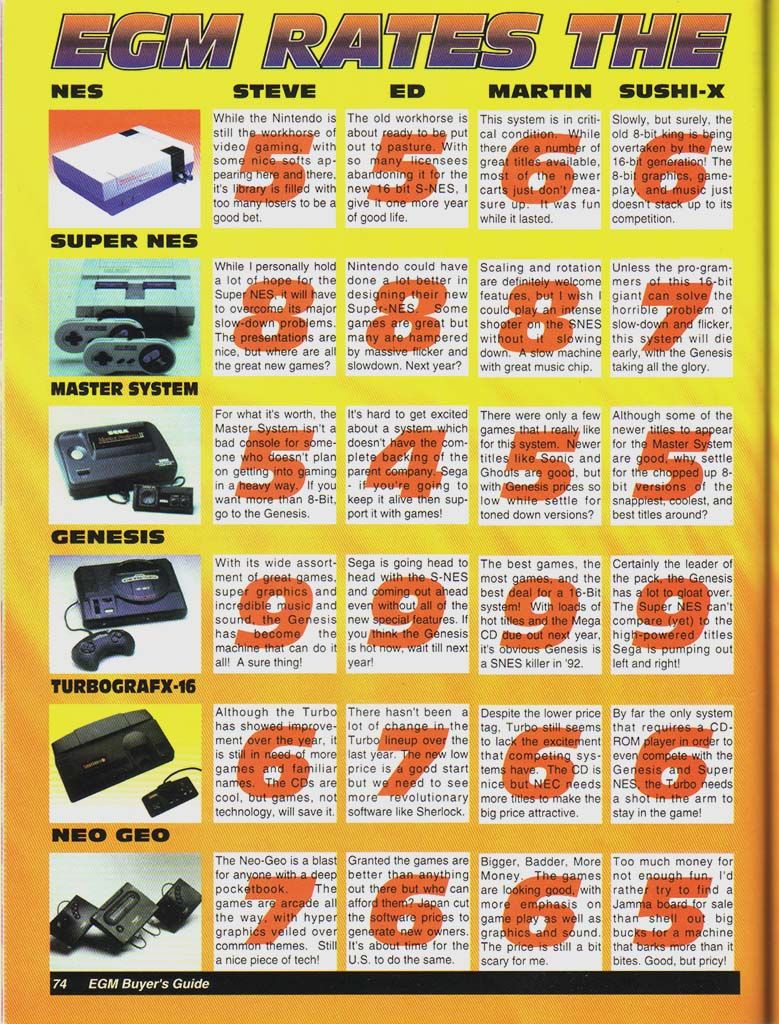
And I should point out that I absolutely loved EGM back in the Genesis' early years. But because of their reviews back then, I had no idea about the coolness of the PC-Engine/TG-16.
-
elvis
- Posts: 984
- Joined: Fri Nov 04, 2005 10:42 pm
- Location: Brisbane, Australia
Interesting how the GameBoy scores pretty low, despite being the most successful console EVER in terms of volume of sales.Alpolio wrote:EGM 1991 console ratings
-
The Coop

- Posts: 2948
- Joined: Wed Mar 01, 2006 2:57 am
- Location: Outskirts of B.F.E.
-
ccovell
- Posts: 203
- Joined: Mon Feb 14, 2005 3:03 am
- Location: Japan
- Contact:
There is a 2nd page to each of those console ratings, isn't there? I have the 1991 buyer's guide (released Fall 1990) and it reviews all the major systems over 2 pages.
Anyway, getting back to the topic, I asked the question about whether anybody knew technically how the Neo-Geo (and other systems) did scaling so we could avoid conjecture like "maybe it's done in software". Any system with a CPU can do scaling, but it's interesting to know if a given system has specialized *hardware* for it.
Anyway, getting back to the topic, I asked the question about whether anybody knew technically how the Neo-Geo (and other systems) did scaling so we could avoid conjecture like "maybe it's done in software". Any system with a CPU can do scaling, but it's interesting to know if a given system has specialized *hardware* for it.
http://www.chrismcovell.com
Chris' Journey
Chris' Journey
-
nZero
- Posts: 2608
- Joined: Wed Jan 26, 2005 1:20 am
- Location: DC Area
- Contact:
From /src/vidhrdw/neogeo.c:ccovell wrote:Anyway, getting back to the topic, I asked the question about whether anybody knew technically how the Neo-Geo (and other systems) did scaling so we could avoid conjecture like "maybe it's done in software". Any system with a CPU can do scaling, but it's interesting to know if a given system has specialized *hardware* for it.
The Y zoom table is part of the BIOS, and actually differs between the MVS and the standalone PCB versionsMAME wrote:0x10000: Control for sprites banks, arranged in words
Bit 0 to 3 - Y zoom LSB
Bit 4 to 7 - Y zoom MSB (ie, 1 byte for Y zoom).
Bit 8 to 11 - X zoom, 0xf is full size (no scale).
Bit 12 to 15 - Unknown, probably unused

-
AirRaidX
- Posts: 75
- Joined: Sat Mar 18, 2006 8:53 pm
I don't understand - that's a little bit above my head. can someone explain how Neo-Geo MVS and Home console AES does scaling, if it's software or in hardware as it is in SNES and SegaCD.
I've always wanted to know.
btw, Sega's 'X Board Hardware', sometimes known as the
'AfterBurner Hardware' that powers After Burner II, Thunder Blade, Super Monaco GP and others, it pushes 256 sprites
(less than Neo-Geo's 380 sprites) and has a color pallete of 32,768 (half of Neo-Geo's) but seems to have full hardware scaling & rotation and can do this at the same time as seen in ABII. I don't know if there is a specific chip in the X Board Hardware for the scaling & rotation or if the 2nd 68000 CPU handles it.
the specs listed on System16.com for X Board Hardware are not extensive enough - all it says is hardware sprite zooming.
I've always wanted to know.
btw, Sega's 'X Board Hardware', sometimes known as the
'AfterBurner Hardware' that powers After Burner II, Thunder Blade, Super Monaco GP and others, it pushes 256 sprites
(less than Neo-Geo's 380 sprites) and has a color pallete of 32,768 (half of Neo-Geo's) but seems to have full hardware scaling & rotation and can do this at the same time as seen in ABII. I don't know if there is a specific chip in the X Board Hardware for the scaling & rotation or if the 2nd 68000 CPU handles it.
the specs listed on System16.com for X Board Hardware are not extensive enough - all it says is hardware sprite zooming.
-
nZero
- Posts: 2608
- Joined: Wed Jan 26, 2005 1:20 am
- Location: DC Area
- Contact:
Yes, that's a function of the sprite drawing hardware. It works differently than on the SNES and Sega CD, though. It's based on a set of lookup tables that say which pixels NOT to sample when drawing the sprite. So, only scaling from the full size of the sprite down is handled by the video hardware. AES and MVS are identical, the later standalone PCB Neo*Geo games like KoF2003 and SvC Chaos are slightly different.AirRaidX wrote:I don't understand - that's a little bit above my head. can someone explain how Neo-Geo MVS and Home console AES does scaling, if it's software or in hardware as it is in SNES and SegaCD.
The Neo*Geo needed more sprites because it has only the front text layer and sprites, no tilemapped backgrounds.AirRaidX wrote:btw, Sega's 'X Board Hardware', sometimes known as the
'AfterBurner Hardware' that powers After Burner II, Thunder Blade, Super Monaco GP and others, it pushes 256 sprites
(less than Neo-Geo's 380 sprites) and has a color pallete of 32,768 (half of Neo-Geo's) but seems to have full hardware scaling & rotation and can do this at the same time as seen in ABII. I don't know if there is a specific chip in the X Board Hardware for the scaling & rotation or if the 2nd 68000 CPU handles it.
X-Board's sprite generator can arbitrarily scale sprites independently in X and Y directions, and can use shadow/highlight capability to broaden the sprite color palette. There is no built in sprite rotation, as far as I know. One of the tilemap generators (backgrounds, usually) is ridiculously flexible in terms of scaling and rotation, being an evolution of what was originally designed to power the road drawing in Outrun.