240p vs 480i Signalling

The place for all discussion on gaming hardware
Post Reply
mybook4
Posts: 25
Joined: Sun Jan 18, 2015 11:35 pm

240p vs 480i Signalling

Post by mybook4 »

I'm curious about the difference between 240p and 480i signalling. Using my N64 over RGB SCART, I captured the sync signal for two games (one running in 240p and another running in 480i). I noticed that both signals draw roughly 60fps ("fields" per second). The only difference I noticed was around the vsync pulse.

240p signal
Image

480i signal
Image

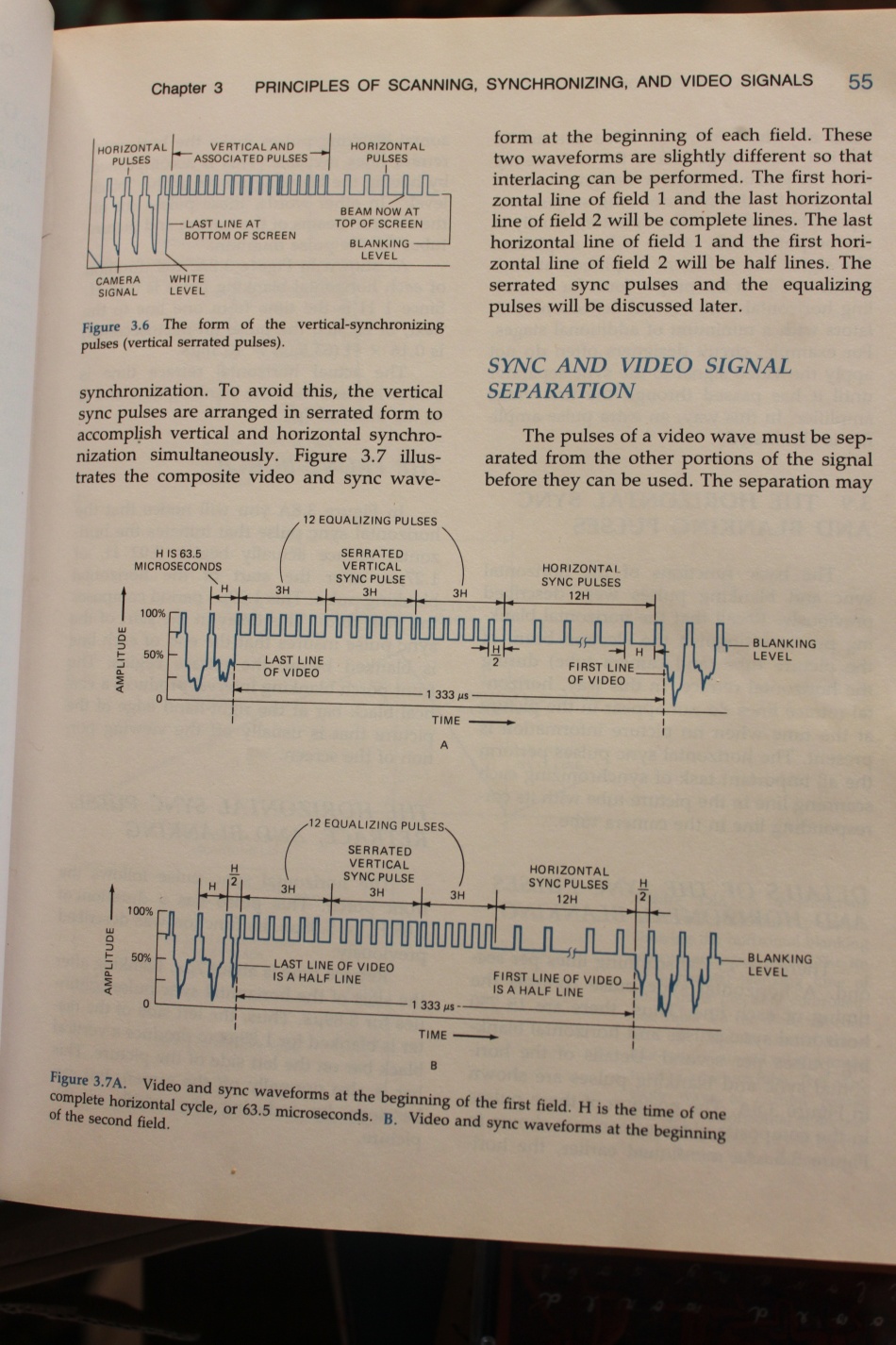
For 480i signal, the period of the hsync pulses appears to reduce to half the normal period (~63.5us) just before, during, and just after the vsync pulse. This doesn't occur during the 240p signal. Why is this? Is this the only difference between 240p and 480i?

What are the signalling differences between 240p and 480i? I've seen Fudoh's scanlines page (http://scanlines.hazard-city.de/), but am still unsure about what the difference is. They both seem to display 60fps ("fields), have a ~63.5us line period (other than around the vsync pulse), and have the same vsync pulse period.

My connection setup is as follows:
-RGB SCART N64 to LM1881 sync stripper to GBS 8220 (capture taken on jamma connector pins for the input)
User avatar
Fudoh
Posts: 13044
Joined: Mon Mar 06, 2006 3:29 am
Location: Germany
Contact:

Re: 240p vs 480i Signalling

Post by Fudoh »

I'm pretty sure you won't find a standard for 240p signals, so one system will be different to the next. The signals are fully compatible. Every analogue CRT will display both just fine.

The main difference between the two is where the actual line starts. While a 480i signal starts (ends?) with half a line of video, 240p signals starts (ends?) with a full line.
User avatar
Unseen
Posts: 738
Joined: Sun May 25, 2014 8:12 pm
Contact:

Re: 240p vs 480i Signalling

Post by Unseen »

mybook4 wrote:For 480i signal, the period of the hsync pulses appears to reduce to half the normal period (~63.5us) just before, during, and just after the vsync pulse. This doesn't occur during the 240p signal. Why is this? Is this the only difference between 240p and 480i?
These pulses you see are called equalisation pulses, IIRC they were originally needed to ensure that the television does not lose sync during the vertical sync pulse but they can also be used to determine if the next field is even or odd.

You view on the 480i signal is incomplete though, your images show only one of the two field transitions in the signal. If you ignore the equalisation pulses, the VSync in your 480i capture is aligned with a video line. In the other one, you would see that the VSync starts in the middle of the line, which is another way of detecting if the following field is even or odd.
mybook4
Posts: 25
Joined: Sun Jan 18, 2015 11:35 pm

Re: 240p vs 480i Signalling

Post by mybook4 »

Thanks for the quick responses!
Unseen wrote: You view on the 480i signal is incomplete though, your images show only one of the two field transitions in the signal. If you ignore the equalisation pulses, the VSync in your 480i capture is aligned with a video line. In the other one, you would see that the VSync starts in the middle of the line, which is another way of detecting if the following field is even or odd.
I added the following new picture. This captures the middle of the line start, correct?

Image

Unseen wrote: These pulses you see are called equalisation pulses, IIRC they were originally needed to ensure that the television does not lose sync during the vertical sync pulse but they can also be used to determine if the next field is even or odd.
I see that in this picture, the first 63.5us hsync period starts half a period sooner. Is this picture showing the first field as odd? Does the initial 480i screenshot in the opening post show the first field as even? EDIT: I currently believe the picture in this post is showing an odd field ending and an even field beginning. I currently believe the picture in the opening post is showing an even field ending and an odd field beginning.

Just as a sanity check to make sure I'm understanding things correctly. Please don't hesitate to correct me if I'm incorrect!
-I observe approximately 262 63.5us periods between vsync pulses. There are 60 vsync pulses in a second.
-After vsync, the field pattern is either odd, odd, odd... or even, even, even... depending on whether or not the last field endedwith a half or whole 63.5us period.
-If the last field ended with a half 63.5us period, the field after the vsync pulse is even. If the last field ended with a whole 63.5us period, the field after the vsync pulse is odd. (based on info from the lm1881 data sheet)

Correct?
Last edited by mybook4 on Thu May 14, 2015 11:11 pm, edited 2 times in total.
User avatar
Unseen
Posts: 738
Joined: Sun May 25, 2014 8:12 pm
Contact:

Re: 240p vs 480i Signalling

Post by Unseen »

mybook4 wrote:This captures the middle of the line start, correct?
Yes
Is this picture showing the first field as odd? Does the initial 480i screenshot in the opening post show the first field as even?
Ugh, I can never remember which one is the even one and which one the odd one - if you really want to know, you could see if you can locate a copy of Video Demystified, it should have diagrams for that which even include details like the expected color carrier phase at the start of the even/odd field for composite PAL/NTSC video.
-I observe approximately 262 63.5us periods between vsync pulses. There are 60 vsync pulses in a second.
I think that is correct. For color NTSC the field rate (=number of vsync pulses) should be 59.94 Hz (1000/1001 * 60 Hz), but that small difference is easy to miss and the tolerances that a display must accept are quite a bit larger than 0.1%.
-After vsync, the field pattern is either odd, odd, odd... or even, even, even... depending on whether or not the last field endedwith a half or whole 63.5us period.
I'm not sure what you mean there. A 480i signal consists of alternating odd and even frames, it would not make any sense to have multiple odd or even frames after each other in an interlaced signal.
-If the last field ended with a half 63.5us period, the field after the vsync pulse is even. If the last field ended with a whole 63.5us period, the field after the vsync pulse is odd. (based on info from the lm1881 data sheet)
Plausible =)

Another source you could look at are leaked copies of CEA-861. It specifies picture formats for digital video transmission and assumes seperate H/V sync (and thus no equalisation pulses), but the number of lines per field/frame and the location of the HSync and VSync pulses should be the same as for analog signals.
mybook4
Posts: 25
Joined: Sun Jan 18, 2015 11:35 pm

Re: 240p vs 480i Signalling

Post by mybook4 »

Unseen wrote:
-After vsync, the field pattern is either odd, odd, odd... or even, even, even... depending on whether or not the last field endedwith a half or whole 63.5us period.
I'm not sure what you mean there. A 480i signal consists of alternating odd and even frames, it would not make any sense to have multiple odd or even frames after each other in an interlaced signal.
Sorry, I butchered that one. What I meant to say was that after vsync, the lines are odd, odd, odd (e.g. 1, 3, 5, ...525) or even, even, even (e.g. 2, 4, 6, ...524).

e.g. for 480i,
odd field (263 lines) - last line of previous field was a full line (full 63.5us period).
even field (262 lines) - last line of previous field was a half line (half 63.5us period)
odd field (263 lines) - last line of previous field was full a line (full the 63.5us period)

From the lm1881 datasheet (not the NTSC spec, but relatively easy to digest):
"The “even field” or “field 2” has a complete horizontal scan line at the end of the field". (i.e. The left portion of the 480i screenshot in the opening post. This would mean the right portion of the 480i screenshot in the opening post is the start of an odd field)

By elimination, the odd field, or field 1 has a half complete horizontal scan line at the end of the field. I.e. the left portion of the 480i screenshot two posts above this. This would mean that the right portion of the 480i screenshot two posts above this is the start of an even field.

I checked out Video Demystified (5th edition).
Chapter 8, page 264, figure 8.5, shows 4 fields of NTSC (480i). The odd and even field characteristics are as described in this post (i.e. odd fields end with a half line, even fields end with a full line).

240p is described briefly on pate 265:
"Noninterlaced NTSC is a 262-line, 60
frames-per-second version of NTSC, as shown
in Figure 8.7. This format is identical to stan-
dard (M) NTSC, except that there are 262 lines
per frame."

Figure 8.7 (on page 266) is very similar to what is shown in the 240p screenshot in the opening post (as expected). The field (frame in this case?) starts and ends with a whole line period.
Last edited by mybook4 on Thu May 14, 2015 11:47 pm, edited 1 time in total.
User avatar
Unseen
Posts: 738
Joined: Sun May 25, 2014 8:12 pm
Contact:

Re: 240p vs 480i Signalling

Post by Unseen »

mybook4 wrote:Sorry, I butchered that one. What I meant to say was that after vsync, the lines are odd, odd, odd (e.g. 1, 3, 5, ...525) or even, even, even (e.g. 2, 4, 6, ...524).
Yes, that is how interlaced video works - each field only "updates" half of the lines.
viletim
Posts: 565
Joined: Mon Aug 07, 2006 6:44 am
Location: Sydney, Australia
Contact:

Re: 240p vs 480i Signalling

Post by viletim »

mybook4,

Here's good diagram that explains how interlace is achieved.
http://etim.net.au/temp/forum/sync_fields.jpg

Also, when comparing two signals (as in your first post) it's much more helpful if they are presented at the same scale.
mybook4
Posts: 25
Joined: Sun Jan 18, 2015 11:35 pm

Re: 240p vs 480i Signalling

Post by mybook4 »

viletim wrote:mybook4,

Here's good diagram that explains how interlace is achieved.
http://etim.net.au/temp/forum/sync_fields.jpg
Thanks for the pic! Very helpful. What book is that from?
viletim wrote: Also, when comparing two signals (as in your first post) it's much more helpful if they are presented at the same scale.
Not sure exactly what you mean. Do you mean time scale? I tried to line up the signals and set a consistent time scale. The 240p signal doesn't have equalization pulses. The vsync is about the same length for both signals.
mybook4
Posts: 25
Joined: Sun Jan 18, 2015 11:35 pm

Re: 240p vs 480i Signalling

Post by mybook4 »

Also, here's another source of info.
http://www.kolumbus.fi/pami1/video/pal_ntsc.html
Post Reply