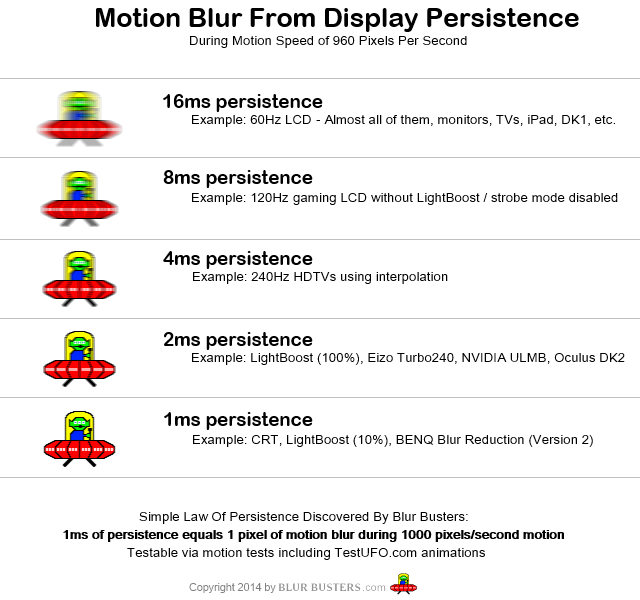
Black frame insertion should have exactly the same brightness loss as strobing the display with a 50% duty cycle.Fudoh wrote:BFI is offered since strobing takes away much light and isn't for everyone. On the W models since 2013 Sony tried strobing without BFI and ended up with terrible ghosting. Don't ask me why they're doing it, I can just report what they're doing.If the set is doing BFI to get to 120Hz - and I cannot understand the logic of that at all - and then strobing the backlight on top of that to get to "240Hz", why not refresh at 60Hz with a single strobe that has a duration of 4ms instead?
In both situations you have an image displayed for 8ms and a black frame displayed for 8ms, halving your brightness.
The difference is that BFI is typically used for displays which cannot support backlight scanning.
E.g. CCFL backlit LCDs which cannot handle being switched on/off like that, and do not switch on/off as instantaneously as an LED.
Strobing the backlight should always result in much better apparent response times.
If you're using BFI, the transition to black and out of black is visible because the panel is still illuminated, and transitioning to/from black itself is introducing smearing of the image.
Since the backlight is entirely separate from the image with an LCD, switching the backlight off for 8ms means that whatever transition state the LCD goes through is invisible until the backlight is switched on again another 8ms later.
If you lower the duty cycle of the strobe, which will lower the brightness and flicker more, but do a better job of reducing motion blur, you also get the advantage of better response times.
If your duty cycle is 25%, the panel now has 12ms to complete its transition before the backlight is switched back on.
So you not only have the better motion clarity of a 4ms strobe (4 pixels of blur on an object moving at 1000px/s, rather than 8) but the panel has an additional 4ms to complete any transitions.
If you reduce the strobe duration to 1ms - equal to or better than some CRTs - the panel has 15ms to complete a transition.
If the panel is able to complete all transitions under 15ms you have eliminated any smearing on the panel - not because it isn't happening, but because you can't see it when the backlight is off.
What was possibly happening with the 2013 panels - and I can only speculate - is that the increased clarity from strobing the backlight made existing reponse time issues more visible.
Or perhaps people complaining of this were trying to use the Impulse Mode - assuming it did one strobe per refresh - with modern 30 FPS games, which repeats each frame twice, thus producing a double-image and judder on the screen.
Yes, I am aware of that. But if you have a screen which supports an input that is a multiple of 24Hz and supports it natively (i.e. displays it at the input rate, doesn't otherwise touch the signal) you can use software to apply black frame insertion and get a proper low-persistence "24Hz" output.Unseen wrote:Fun fact: Film projectors for cinemas show every frame of the film twice to increase the flicker rate to 48Hz.Exidna wrote:One strobe per refresh has a vastly different appearance to multiple strobes. It's the only time 24p ever looks judder-free without using interpolation for example.
Of course the flicker is unacceptable at that rate. The only solution is moving to higher framerates. (or interpolation...)


 .
.